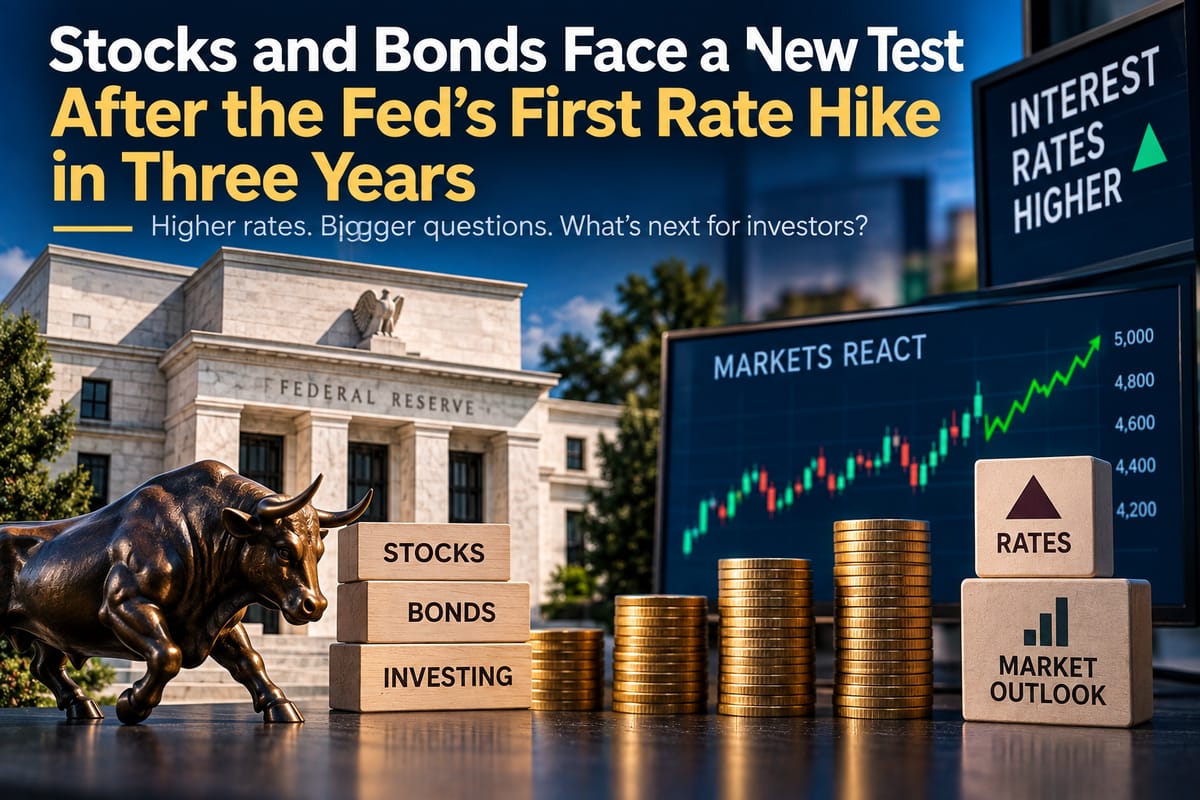
Stocks and Bonds Face a New Test After the Fed’s First Rate Hike in Three Years
Financial markets are entering a new phase after the Federal Reserve delivered its first interest-rate increase in more than three years, putting renewed attention on borrowing costs, Treasury yields, corporate earnings and the path of future monetary policy.
The Federal Open Market Committee voted unanimously on September 16 to raise the federal funds target range by 25 basis points to 3.75% to 4%. The increase took effect September 17 and marked the Fed’s first rate hike since July 2023.
The decision comes at a particularly important moment for investors. Inflation remains elevated, while economic activity and consumer spending have remained relatively resilient. At the same time, financial markets have already been adjusting to higher Treasury yields, rising energy prices and uncertainty over how much additional tightening may be required.
For both stock and bond investors, the question is no longer simply whether rates are going higher. The bigger issue is how markets respond if higher rates remain in place for an extended period.
Why This Rate Hike Matters
The Federal Reserve had spent much of the previous three years moving through an extended period of rate cuts and pauses. The September increase changes that backdrop.
The Fed said economic activity was expanding at a solid pace, domestic spending remained resilient and productivity growth was strong. However, it also said inflation remained elevated and that the latest policy action was intended to support a return toward its 2% inflation objective.
That combination creates a complicated environment for investors.
A stronger economy can support corporate revenue and earnings, which can help stocks. But persistent inflation can keep interest rates higher, increasing financing costs and putting pressure on valuations.
Investors therefore have to consider both sides of the equation rather than treating the rate increase as automatically positive or negative for markets.
A broader explanation of these relationships can be found in the Complete Guide to Financial Markets and How They Work.
Treasury Yields Are Back in the Spotlight
Bond markets are likely to remain one of the clearest places to watch the impact of the Fed’s decision.
The benchmark 10-year Treasury yield was around 5% in mid-September, according to Federal Reserve market data, while yields across shorter maturities had also moved higher. On September 16, the 10-year Treasury yield was 5.01%, compared with 4.74% for the two-year note and 5.35% for the 30-year bond.
Higher yields can make newly issued bonds more attractive because investors receive more income from new securities. At the same time, existing bonds with lower coupon rates generally become less valuable in the secondary market.
This is one reason interest-rate changes can produce immediate price movements in bond portfolios.
Investors looking to understand that relationship in greater depth can explore the Complete Guide to Bond Markets.
Stocks Face a Different Set of Pressures
Equities respond to interest-rate changes through several channels.
Higher rates can increase borrowing costs for businesses. Companies that rely heavily on debt may face larger interest expenses, potentially reducing profits if financing costs remain elevated.
Higher rates can also affect how investors value future corporate earnings. When safer assets offer higher yields, investors may demand a greater potential return from stocks, which can place pressure on equity valuations.
Growth-oriented companies can be particularly sensitive because a larger portion of their perceived value may depend on profits expected years into the future.
Yet higher rates do not automatically mean falling stock prices.
The economic backdrop matters. If the economy continues to expand and corporate earnings remain strong, companies may be able to absorb higher financing costs. Reuters reported that U.S. stocks rebounded after the Fed’s latest decision, with technology shares leading the move as Treasury yields eased and oil prices declined.
That response illustrates why markets cannot be understood through the interest-rate decision alone.
The Market’s Reaction May Depend on What Comes Next
The September increase itself was widely anticipated by markets. What matters now is whether investors begin pricing additional rate increases.
Reuters reported that 16 of the 18 Fed policymakers projected at least one additional increase by the end of 2026. The central bank’s projections therefore leave open the possibility that September’s move is part of a broader tightening cycle rather than an isolated adjustment.
That possibility creates another layer of uncertainty.
If inflation falls steadily, investors could eventually begin anticipating a return to stable or lower rates. If inflation remains stubborn, markets may have to adjust to the possibility of additional tightening.
The distinction is important because financial markets respond not only to today’s interest rate but also to expectations about future rates.
This transmission mechanism is explored in greater detail in How Monetary Policy Affects Financial Markets.
Oil Prices Add Another Complication
Energy markets are also influencing the interest-rate outlook.
Oil prices have been volatile amid geopolitical tensions and concerns about disruptions to supply. Higher energy costs can feed into headline inflation and make the Federal Reserve’s task more difficult.
At the same time, falling oil prices can ease some inflationary pressure and give financial markets more room to focus on economic growth and corporate earnings.
Recent market activity has demonstrated this connection. Reuters reported that easing oil prices and lower Treasury yields helped support stocks following the Fed’s rate decision.
For investors, this means that the direction of interest rates cannot be viewed independently of developments in energy markets.
Volatility Could Become a Bigger Part of the Story
Rate changes often create uncertainty because investors must reassess assumptions about economic growth, company profits, bond yields and asset valuations.
That can lead to sharper movements in individual sectors even when major indexes appear relatively stable.
Technology stocks, for example, can be particularly sensitive to changes in discount rates because investors often place substantial value on future earnings. Financial companies can experience different effects because higher rates may influence lending margins and demand for credit.
Smaller companies can also face greater pressure if they depend more heavily on external financing.
The mechanics behind these market swings are explained in How Stock Market Volatility Works and What Causes Market Volatility.
What Investors Will Be Watching Now
Several indicators could become especially important as markets digest the new rate environment.
Inflation
The Fed has made clear that elevated inflation remains a central concern. A sustained decline in inflation could reduce pressure for further rate increases, while renewed price increases could have the opposite effect.
Employment
The labor market remains another important part of the Fed’s dual mandate. Policymakers are balancing price stability against the need to maintain healthy employment conditions.
Treasury Yields
Bond yields provide a real-time indication of how investors are interpreting economic and monetary-policy developments. A sustained rise in long-term yields could affect everything from mortgage rates to corporate financing costs and equity valuations.
Corporate Earnings
Strong earnings growth can help companies offset some of the effects of higher interest rates. Weakening profits, however, could make expensive financing more consequential for businesses.
Future Fed Communications
Investors will closely examine speeches and economic data for clues about how policymakers view inflation, economic growth and the appropriate level of interest rates.
A New Environment for Stocks and Bonds
The Fed’s first rate hike in three years marks a significant change in the interest-rate landscape, but its ultimate effect on markets will depend on what happens next.
Stocks are now confronting a world in which higher borrowing costs can coexist with solid economic growth. Bonds, meanwhile, are adjusting to a higher-yield environment in which new securities can offer more income but existing lower-yield bonds remain vulnerable to price declines.
The key variable is the trajectory of inflation and monetary policy.
If price pressures ease while economic growth remains resilient, markets could eventually find a more stable balance between interest rates and economic expansion. If inflation persists and additional tightening follows, investors may face another period of repricing across stocks, bonds and other financial assets.
For now, the September rate increase has reopened a debate that had largely disappeared from markets over the past several years: how much higher do interest rates need to go, and how long will they have to stay there?
The answer will depend less on the single 25-basis-point move than on the economic data that follows it.