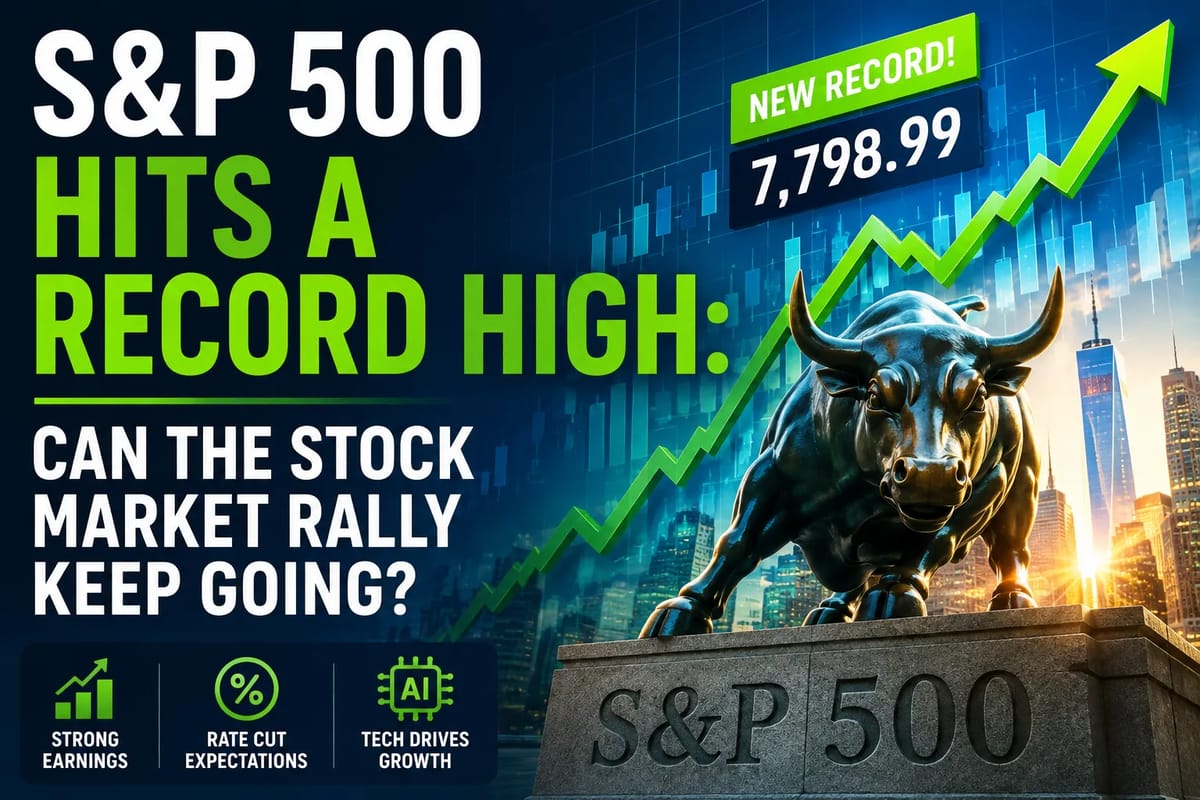
S & P 500 Hits a Record High: Can the Stock Market Rally Keep Going?
The U.S. stock market has reached another milestone, with the S&P 500 closing at a record 7,798.99 on August 13, 2026. The index gained 0.65% that day as investors responded positively to softer inflation data, falling Treasury yields and renewed enthusiasm for technology and artificial-intelligence stocks.
The rally has continued despite a complicated backdrop. Inflation is still above the Federal Reserve’s long-term target, interest rates remain relatively high, geopolitical risks persist and some areas of the market appear increasingly expensive.
Yet investors continue to buy stocks.
That raises the question many market participants are now asking:
Can the S&P 500 keep climbing, or is the market approaching a point where expectations have become too optimistic?
The answer will likely depend on three things: corporate earnings, interest rates and economic growth.
The S&P 500 Has Reached Another Record
The S&P 500 is one of the most widely followed measures of the U.S. stock market because it represents roughly 500 large publicly traded companies across numerous industries.
On August 13, the index closed at 7,798.99, its latest record high. The Nasdaq also reached a record, while the Dow Jones Industrial Average moved close to its own peak.
The advance has been particularly notable because the market has had plenty of reasons to hesitate.
Investors have been dealing with:
- Elevated inflation
- Uncertainty surrounding Federal Reserve policy
- Geopolitical tensions
- Oil-price volatility
- Concerns about technology valuations
- Questions about consumer spending
- Heavy expectations surrounding artificial intelligence
Despite those concerns, stocks have continued to move higher.
What Is Driving the Rally?
Several forces are working together.
1. Inflation Data Has Improved
One of the biggest catalysts has been the changing inflation outlook.
July producer-price data came in softer than investors feared, supporting expectations that the Federal Reserve may not need to raise interest rates at its September meeting.
That matters because interest rates have a direct influence on how investors value stocks.
When investors expect interest rates to remain stable—or eventually fall—the future earnings of companies can become more attractive relative to bonds and cash.
2. The Federal Reserve Is No Longer Expected to Keep Tightening Indefinitely
The Federal Reserve has maintained its target federal-funds rate at 3.50% to 3.75%. At its July 29 meeting, the central bank kept rates unchanged, while noting that economic activity was expanding at a solid pace and that inflation remained elevated relative to its 2% objective.
That creates an unusual situation for investors.
The economy is still expanding, but monetary policy isn’t becoming dramatically tighter.
If inflation continues to moderate, investors could increasingly price in lower rates later on.
That would potentially provide another tailwind for stocks.
However, the Fed hasn’t declared victory over inflation.
Its July statement explicitly said inflation remained elevated relative to the 2% target, partly because of supply shocks, including energy-related pressures.
So the market’s assumption of easier monetary policy remains dependent on future economic data.
3. Corporate Earnings Are Doing Much of the Heavy Lifting
A stock market rally cannot run indefinitely on optimism alone.
Eventually, companies have to produce the profits investors are paying for.
So far, earnings have provided an important source of support.
Investors saw a combination of strong corporate profits, a reset in some high-flying AI shares and relatively reasonable valuations as factors that could help extend the rally.
For a broader explanation of how company profits translate into changes in stock prices and valuations, see how corporate earnings affect stock prices and market valuations.
Recent earnings have also shown that the AI investment boom isn’t limited to a handful of software companies.
Demand for:
- Data-center infrastructure
- Semiconductors
- Networking equipment
- Cloud computing
- AI software
- Power infrastructure
has become a major theme across corporate America.
4. Artificial Intelligence Remains a Major Market Theme
AI continues to be one of the biggest forces behind investor enthusiasm.
Companies connected to the AI infrastructure buildout have attracted substantial attention, particularly semiconductor and data-center businesses.
Strong results from AI infrastructure companies have helped lift the S&P 500 and Nasdaq, while mild inflation has reinforced expectations that the Fed will hold rates steady in September.
The AI story is therefore increasingly becoming an earnings story.
Investors aren’t simply betting that AI will be important someday.
They’re looking for evidence that companies are already turning AI spending into:
- Higher revenue
- Better margins
- Greater productivity
- Stronger cash flow
- New products and services
That distinction will become increasingly important.
5. Falling Treasury Yields Are Helping Stocks
Bond yields influence the relative attractiveness of stocks.
When Treasury yields decline, investors may become more willing to accept the risks of equities because the return available from relatively safe government debt has fallen.
For more context on how movements in Treasury yields can affect stock valuations, see why rising Treasury yields can put pressure on stock valuations.
This helped create a favorable environment for growth stocks, particularly companies whose valuations depend heavily on expectations for future earnings.
But the relationship works in both directions.
If inflation accelerates again and Treasury yields rise sharply, stock valuations could come under pressure.
Investors should also understand the broader relationship between stocks, bonds and other markets through this complete guide to financial markets and how they work.
The Market Has Already Had a Powerful Run
The recent rally isn’t happening from depressed levels.
According to Associated Press data, the S&P 500 was up approximately 13.9% year to date through August 13, while the Nasdaq had gained about 15.3%.
That means investors entering the market now aren’t buying after a major collapse.
They’re buying after a substantial advance.
This creates an important distinction:
A strong market can continue rising, but the margin for disappointment becomes smaller when expectations are already high.
Why Record Highs Don’t Automatically Mean a Crash Is Coming
Investors often become nervous when markets reach record levels.
But a record high by itself isn’t a reliable sell signal.
Markets regularly establish new records during long-term bull markets.
A company can reach a record stock price because:
- Its earnings are growing
- Its future prospects have improved
- The economy is expanding
- Interest rates are becoming more favorable
- Investors are willing to pay more for future earnings
The important question isn’t simply:
“Is the S&P 500 at a record?”
It’s:
“Are corporate earnings and economic fundamentals strong enough to justify current prices?”
The Biggest Risk: Expectations Become Too High
One of the clearest risks to the rally is not necessarily a recession.
It could simply be disappointment.
Suppose investors expect:
- Very strong AI growth
- Rapid earnings expansion
- Lower interest rates
- Falling inflation
- Stable economic growth
If companies deliver merely good results instead of exceptional results, stocks could still fall.
Markets price expectations, not just reality.
That’s particularly important for highly valued technology companies.
AI Stocks Face an Especially High Bar
The AI investment boom has generated enormous optimism.
Companies involved in the AI ecosystem have benefited from huge spending on:
- Data centers
- GPUs
- Networking
- Memory
- Cloud infrastructure
- AI models
- Enterprise software
But investors eventually need evidence that this spending produces sufficient economic returns.
If corporate customers begin questioning whether AI investments are generating enough revenue or productivity gains, the growth expectations supporting some valuations could weaken.
What Happens If AI Spending Slows?
This is one of the most important questions for the market.
A slowdown wouldn’t necessarily mean AI is failing.
Companies could simply reach a stage where they become more selective about spending.
That could affect businesses supplying:
- Chips
- Servers
- Data-center equipment
- Networking hardware
- Cloud capacity
- Power systems
Because AI-related companies have become important contributors to market performance, a major slowdown could have effects well beyond the technology sector.
Market Breadth Matters
Another factor investors should watch is market breadth.
A healthy rally generally becomes more convincing when gains spread across many companies and sectors rather than being driven by only a handful of mega-cap stocks.
Technology has been a major contributor to the current rally.
But industrials, financial companies, consumer businesses, healthcare firms and other sectors also matter.
A broader rally can suggest that investors are becoming more confident about the overall economy rather than simply chasing one theme.
Investors should also pay attention to how stock market volatility works and what causes market volatility, particularly when a record-setting market begins experiencing sharper daily moves.
Small-Cap Stocks Tell Another Story
The S&P 500 represents large companies.
Smaller companies can behave differently.
The Russell 2000, which tracks smaller U.S. companies, has also performed strongly in 2026. AP reported that the index was up about 23% year to date through August 13, ahead of the S&P 500.
That’s an interesting development because smaller companies are often more sensitive to:
- Domestic economic growth
- Borrowing costs
- Credit conditions
- Consumer demand
Strength in small caps can therefore provide another signal about investor confidence.
The Consumer Could Become More Important
The latest economic data also contains a warning.
On August 14, the S&P 500 fell 0.2% from its record as investors responded to unexpectedly weak retail-sales data and geopolitical concerns.
This is a reminder that the stock market and economy aren’t moving in a perfectly straight line.
A strong stock market can coexist with signs of pressure among consumers.
Investors will therefore be watching whether weaker spending is temporary or becomes part of a broader slowdown.
Oil Prices Are Another Wild Card
Energy prices can affect both inflation and consumer spending.
Higher oil prices can:
- Raise transportation costs
- Increase business expenses
- Push inflation higher
- Reduce household purchasing power
Oil prices have also been influenced by geopolitical developments surrounding the Middle East and the Strait of Hormuz.
Crude prices declined sharply on August 13 as investors assessed demand expectations and geopolitical developments, but oil remained an important source of uncertainty.
If energy prices rise substantially again, the market could quickly reconsider its assumptions about inflation.
What Could Keep the Rally Going?
There are several plausible catalysts for continued gains.
Continued Earnings Growth
If companies keep beating expectations and raising forecasts, investors may have justification for higher stock prices.
Lower Inflation
Continued moderation in inflation could give the Federal Reserve more flexibility.
Stable Interest Rates
A predictable rate environment can reduce uncertainty for businesses and investors.
Strong Productivity
AI and other technologies could increase productivity and support corporate profit margins.
Broader Market Participation
If gains spread beyond mega-cap technology stocks, the rally could become more resilient.
Strong Economic Growth
A soft landing—where inflation cools without a major recession—would be a particularly favorable environment for equities.
What Could Stop the Rally?
The opposite scenario is also possible.
Inflation Returns
A renewed inflation surge could push interest rates higher.
Treasury Yields Rise
Higher bond yields can pressure equity valuations.
Earnings Disappoint
If profits fail to justify current expectations, investors could reassess stock prices.
AI Spending Slows
A slowdown in AI infrastructure spending could affect a large group of technology companies.
Consumer Spending Weakens
A significant slowdown could reduce corporate revenue and economic growth.
Geopolitical Risk Escalates
War, energy disruptions or other geopolitical shocks could increase volatility.
Valuations Become Too Stretched
Even good companies can become poor investments if investors pay too much.
Is the Stock Market Overvalued?
The answer depends on which part of the market you’re examining.
Some companies may have valuations that require very strong future growth.
Others may trade at more moderate multiples.
This is why saying “the S&P 500 is expensive” can be misleading.
The index contains businesses with very different:
- Growth rates
- Profit margins
- Balance sheets
- Competitive advantages
- Valuations
- Economic sensitivities
Investors should therefore look beyond the index headline.
Why Valuation Still Matters
A company’s share price represents expectations about future cash flows.
If investors pay a very high price for those expected earnings, the company needs to deliver strong growth.
That creates a vulnerability.
For example:
High expectations + exceptional results = potentially higher prices
But:
High expectations + merely average results = potentially significant downside
This is one of the biggest risks facing parts of the market today.
Should Investors Try to Time the Market?
This is where things become particularly difficult.
An investor who sells because the S&P 500 appears expensive faces another problem:
When should they buy back in?
The market can remain expensive-looking for much longer than expected.
Missing just a handful of strong market days can have a significant impact on long-term returns.
For long-term investors, this is one reason a disciplined strategy is generally more practical than attempting to predict every short-term market peak and bottom.
Diversification Still Matters
A record-setting S&P 500 doesn’t eliminate investment risk.
A diversified portfolio may include different combinations of:
- U.S. stocks
- International stocks
- Bonds
- Cash
- Real assets
- Other investments appropriate to an individual’s circumstances
Diversification doesn’t guarantee profits or prevent losses.
Its purpose is to reduce dependence on a single asset, sector or market outcome.
What Long-Term Investors Should Watch
Rather than obsessing over whether the S&P 500 rises another 5% next month, investors can monitor several fundamental indicators.
Inflation
Is price growth continuing to moderate?
Interest Rates
Is the Federal Reserve becoming more or less restrictive?
Earnings
Are corporate profits growing?
Profit Margins
Are companies maintaining profitability despite higher costs?
Employment
Is the labor market stable?
Consumer Spending
Are households continuing to support economic growth?
Capital Investment
Are businesses investing for future growth?
Market Breadth
Are more companies participating in the rally?
These indicators can provide a more useful picture than the index level alone.
What the Fed Could Mean for Stocks
Monetary policy will remain one of the market’s biggest drivers.
The Federal Reserve currently has to balance two competing risks:
Inflation that remains above target
versus
a labor market or economy that could weaken.
Its July statement said economic activity was expanding at a solid pace, while inflation remained elevated relative to the 2% target.
That means investors should be careful about assuming rate cuts are guaranteed.
The Fed will continue to respond to incoming data.
Why the September Fed Meeting Matters
The September policy decision has become an important focus for markets.
After recent inflation data, traders reduced expectations of another rate increase, helping support equities.
That doesn’t mean the Fed has committed to a particular policy path.
It means markets are adjusting expectations based on incoming evidence.
The Difference Between a Healthy Pullback and a Market Breakdown
Investors sometimes treat every market decline as a warning sign.
But pullbacks are normal.
A market can fall several percent without changing its long-term trajectory.
The more important question is why stocks are falling.
A pullback caused by profit-taking after a strong rally is different from a decline caused by:
- Rapidly rising inflation
- A severe earnings downturn
- Credit-market stress
- A recession
- Financial instability
- Major geopolitical escalation
Understanding the cause matters more than the size of the daily decline.
What a Strong Bull Market Usually Needs
For the current rally to continue for an extended period, investors will probably need to see several conditions remain favorable.
Profits Need to Catch Up With Prices
Rising valuations are easier to sustain when earnings rise as well.
Inflation Needs to Stay Under Control
A renewed inflation shock could change the interest-rate outlook.
The Economy Needs to Keep Growing
Corporate profits ultimately depend on economic activity and demand.
AI Needs to Deliver Real Returns
Investment in AI infrastructure needs to translate into sustainable business benefits.
Investor Confidence Needs to Remain Rational
Excessive optimism can eventually become a source of instability.
What Investors Shouldn’t Do
A record market can trigger emotional decisions.
Avoid making major changes simply because:
- Headlines say stocks are at an all-time high
- Friends are talking about investing
- A particular technology stock is surging
- You fear missing out
- You are convinced a crash is imminent
Investment decisions should be tied to goals, risk tolerance, time horizon and portfolio strategy.
A Practical Approach to a Record-High Market
For investors already holding diversified portfolios, a record S&P 500 doesn’t automatically mean it’s time to sell everything.
Instead, consider:
- Review your asset allocation.
- Check whether your portfolio has become too concentrated.
- Rebalance if appropriate.
- Review your investment horizon.
- Keep adequate liquidity for near-term needs.
- Avoid taking additional risk simply because markets are rising.
- Continue evaluating investments based on fundamentals.
Tax considerations also matter when selling investments, so major portfolio changes may warrant professional advice.
The Bigger Picture for Investors
The S&P 500’s latest record is significant, but the number itself doesn’t tell investors whether stocks are cheap or expensive.
What matters is the relationship between price and future earnings.
At the moment, the market has several powerful forces working in its favor:
- Strong corporate earnings
- AI-driven investment
- Improving inflation expectations
- Stable Federal Reserve policy
- Falling Treasury yields
- Continued economic growth
But there are meaningful risks on the other side:
- Inflation remains above the Fed’s target
- Geopolitical tensions remain elevated
- Consumer spending has shown signs of weakness
- Expectations for AI growth are high
- Some valuations leave little room for disappointment
Recent trading illustrates the tension. The S&P 500 reached a record close of 7,798.99 on August 13, then slipped 0.2% on August 14 as investors digested weaker retail-sales data and renewed geopolitical concerns.
That’s not necessarily evidence that the bull market is ending.
It is evidence that markets can change direction quickly even when the broader trend remains positive.
Can the Rally Keep Going?
Yes—but continued gains are likely to require continued fundamental support.
If corporate profits keep growing, inflation remains manageable and the Federal Reserve doesn’t need to tighten policy aggressively, the S&P 500 could continue setting new records.
If earnings disappoint, inflation accelerates or economic growth weakens sharply, the market could experience a meaningful correction.
The most important takeaway for investors is therefore not whether 7,798 is the top.
Nobody knows that in advance.
The more useful question is whether the businesses represented by the index can continue growing their earnings fast enough to justify today’s prices.
As the S&P 500 enters another record-setting phase, the next chapter of the rally will likely be determined less by momentum and more by whether corporate America can keep delivering the profits investors are already expecting.