PPI Report Tomorrow: What Producer Prices Could Mean for Inflation and Savings Rates
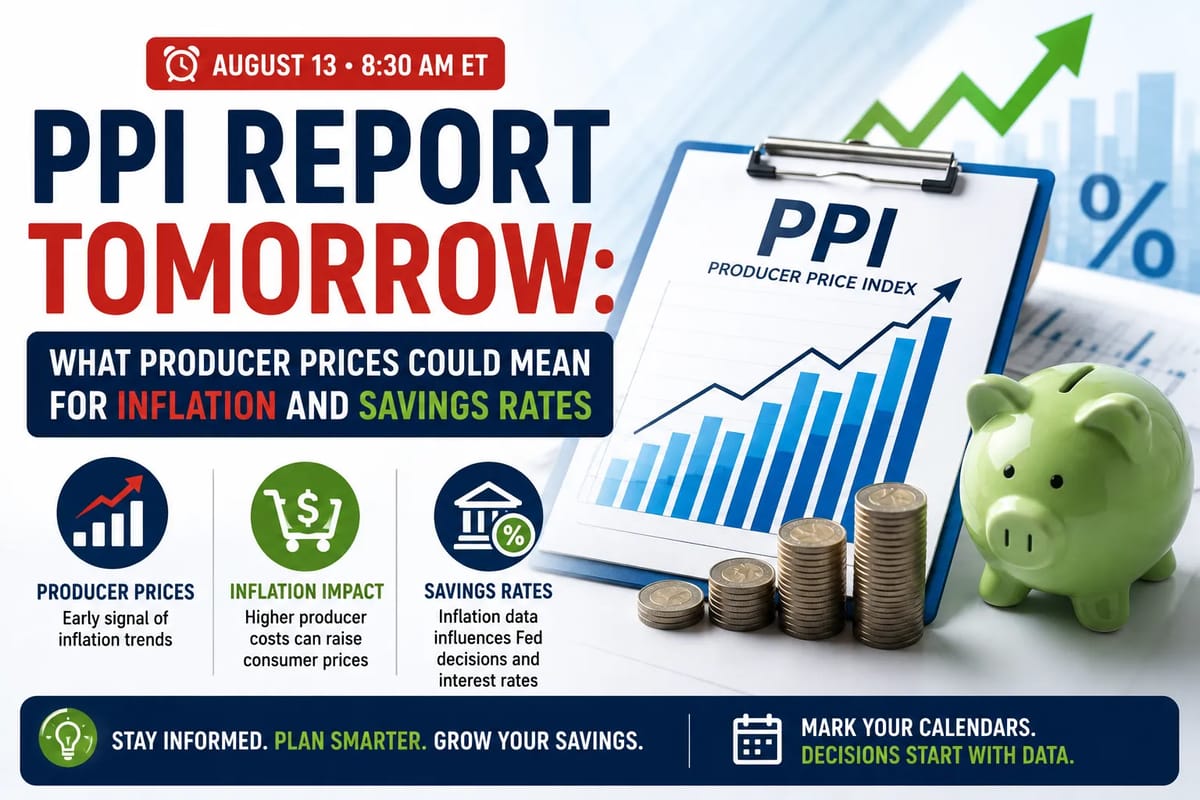
The next major inflation signal arrives Thursday, August 13, when the U.S. Bureau of Labor Statistics releases its July Producer Price Index (PPI) report.
The report will give investors, policymakers and consumers another look at whether price pressures are building at the producer level. That matters because persistent increases in the prices businesses receive for goods and services can eventually feed into consumer prices, although the relationship is not automatic or immediate.
For savers, the bigger question is what the report could mean for interest rates.
A hotter-than-expected PPI reading could reinforce expectations that the Federal Reserve will keep monetary policy restrictive for longer. A softer reading could strengthen the case for eventual rate cuts or at least reduce pressure for additional tightening.
That distinction matters for people holding savings accounts, money-market products and certificates of deposit (CDs), as well as borrowers trying to decide whether to lock in rates.
When Is the PPI Report Released?
The July 2026 PPI report is scheduled for Thursday, August 13, at 8:30 a.m. Eastern Time, according to the Bureau of Labor Statistics.
The release comes one day after the July Consumer Price Index report, making this week’s inflation data particularly important for markets.
The Federal Reserve held its benchmark federal funds target range at 3.50% to 3.75% at its July 29 meeting. Three policymakers dissented in favor of a quarter-point increase, while the committee said inflation remained elevated relative to its 2% objective.
That means the latest inflation data could influence how investors assess the Fed’s next move.
What Is the Producer Price Index?
The Producer Price Index measures changes over time in the prices received by domestic producers for their goods and services.
Unlike the Consumer Price Index, which measures prices from the purchaser’s perspective, PPI looks at prices from the seller’s perspective.
The PPI system covers a wide range of economic activity, including:
- Goods
- Services
- Construction
- Energy
- Food
- Transportation
- Wholesale and retail margins
- Business inputs
The headline final-demand index also covers products and services sold for personal consumption, capital investment, government purchases and exports.
That makes PPI a broad measure of price pressure in the production and distribution side of the economy.
For a broader overview of how PPI fits alongside inflation, employment, interest rates and other major economic measures, see the complete guide to economic indicators.
Why Does PPI Matter for Inflation?
Businesses face costs when producing and selling goods and services.
If those costs rise persistently, companies may eventually attempt to pass some of the increase on to customers.
That can contribute to higher consumer prices.
But there is an important qualification: a rise in PPI does not automatically translate into an equivalent rise in CPI.
Businesses can absorb higher costs by accepting smaller profit margins, improving productivity, changing suppliers or reducing other expenses.
Similarly, falling producer prices do not guarantee that consumer prices will immediately fall.
The timing and size of the pass-through can vary considerably across industries.
What Happened to PPI in June?
The June report provides an important starting point for Thursday’s release.
According to the BLS, final-demand producer prices fell 0.3% in June on a seasonally adjusted basis. Final-demand goods prices dropped 1.4%, while final-demand services increased 0.2%.
Despite the monthly decline, final-demand prices were still 5.5% higher than a year earlier in June.
That combination is important.
A single monthly decline does not necessarily mean underlying inflation pressures have disappeared, particularly when the annual rate remains elevated.
The June decline was also heavily influenced by goods and energy prices, making the composition of the July report especially important.
What Economists and Investors Will Watch
The headline PPI number will attract most of the attention, but investors will likely examine the underlying components as well.
Final Demand
This is the headline measure and captures prices received by producers for goods, services and construction sold to final demand.
Final-Demand Goods
This category includes products such as food, energy and other goods.
Final-Demand Services
Services are particularly important because they represent a substantial part of the U.S. economy.
Trade Services
The PPI also measures changes in retailer and wholesaler margins rather than simply looking at the sticker price of merchandise.
Core Measures
Measures excluding volatile components can sometimes provide a clearer indication of persistent price pressure.
The composition of the report can therefore matter as much as the headline figure.
Scenario 1: A Hotter-Than-Expected PPI
Suppose Thursday’s PPI report shows producer prices rising significantly more than economists expected.
That could reinforce concerns that inflation remains persistent.
Markets could respond by increasing expectations that the Federal Reserve will maintain higher interest rates for longer—or potentially raise rates if other economic data support that move.
The July Fed statement already said inflation remains elevated relative to its 2% goal.
A hotter PPI would therefore add another piece of evidence policymakers could consider.
What Could Happen to Interest Rates?
Market interest rates could move higher if investors revise their expectations for Fed policy.
That could affect:
- Treasury yields
- Mortgage rates
- Consumer loans
- Business borrowing
- Credit-card rates
- Savings products
The effects would not necessarily be immediate or identical across all financial products.
Scenario 2: A Cooler-Than-Expected PPI
A softer PPI report could have the opposite effect.
If producer prices show limited pressure, investors may become more confident that inflation is gradually cooling.
That could strengthen expectations for easier monetary policy over time.
Bond yields could fall as markets price a greater possibility of future rate cuts.
That could eventually place downward pressure on some savings rates.
For savers, that creates an important trade-off: lower future rates can be beneficial for borrowers but less attractive for people relying on interest income.
Scenario 3: A Mixed PPI Report
The most interesting outcome may be one that falls somewhere between clearly hot and clearly cool.
For example, headline PPI could be modest while services prices remain elevated.
Or goods prices could decline while certain business costs continue rising.
In that situation, markets may focus more heavily on the details than on the headline number.
This is why simply reading the first percentage in the PPI release may not provide the complete picture.
What Could PPI Mean for Savings Rates?
Savings rates are influenced by broader interest-rate conditions, competition between banks and financial institutions, funding needs and expectations about future monetary policy.
The Federal Reserve’s policy rate is particularly important because it influences the general level of short-term interest rates in the economy.
If markets expect rates to remain high, banks may continue offering relatively attractive yields on some deposit products to attract or retain customers.
If markets increasingly expect rates to decline, financial institutions may begin lowering rates on certain deposit products.
That means a single PPI report is unlikely to cause every savings account to immediately change its rate.
Instead, it can influence the interest-rate outlook that financial institutions and markets use when making decisions.
High-Yield Savings Accounts Could Feel the Impact
High-yield savings accounts typically have variable interest rates.
That means their yields can change over time.
If the broader interest-rate environment moves lower, these accounts may eventually offer lower returns.
For savers, this makes it important to distinguish between:
The rate you are earning today
and
the rate you may earn several months from now.
A high advertised savings rate can be attractive, but the rate may not be guaranteed permanently.
What About Certificates of Deposit?
CDs work differently because many products allow customers to lock in a stated interest rate for a defined period.
If you believe interest rates could fall, locking in an attractive fixed rate can provide certainty.
But there is a trade-off.
A long-term CD can prevent you from taking advantage of higher rates later if inflation or monetary policy moves in the opposite direction.
The decision therefore depends on:
- Current rates
- Expected future rates
- Your cash needs
- CD maturity
- Early-withdrawal penalties
- Your tolerance for uncertainty
The PPI report is only one piece of that decision.
Money-Market Accounts and Other Cash Products
Money-market deposit accounts and similar cash products can also respond to changes in the interest-rate environment.
Because many of these products have variable yields, falling market rates can eventually reduce the interest paid to depositors.
Savers who depend heavily on interest income should therefore monitor their accounts rather than assuming today’s yield will remain unchanged.
Why Inflation Matters Even When Savings Rates Are High
A savings account can pay interest while your purchasing power still declines.
The important concept is the real return.
In simple terms:
Real return ≈ savings interest rate − inflation rate
For example, if a savings product earns 5% while inflation is running at 3%, the nominal return is 5%, but the purchasing-power gain is much smaller.
This is why inflation data matters to savers even when they are earning a seemingly attractive interest rate.
A higher savings rate is useful, but what matters ultimately is what that interest can buy.
The PPI Report Won’t Determine Savings Rates by Itself
It is important not to overstate the importance of Thursday’s report.
The Federal Reserve does not set policy based on PPI alone.
Officials consider a broad range of information, including:
- Consumer inflation
- Labor-market conditions
- Economic growth
- Wage trends
- Inflation expectations
- Financial conditions
- International developments
- Other price measures
The Fed has emphasized that inflation remains above its 2% goal and that economic uncertainty remains elevated.
Therefore, PPI should be viewed as one piece of a larger economic puzzle.
Why the CPI and PPI Need to Be Read Together
CPI and PPI measure different parts of the pricing process.
CPI
Measures prices paid by consumers.
PPI
Measures prices received by producers.
Looking at both can provide a broader picture of inflation.
If both measures show persistent increases, concerns about inflation may intensify.
If both are cooling, markets may become more comfortable with the idea that inflation is moving toward the Fed’s target.
But if they move in different directions, policymakers may need more data before drawing firm conclusions.
Investors can also examine the recent July CPI report and its potential impact on stocks and interest-rate expectations for additional context.
What Savers Should Watch After the Release
Instead of focusing only on whether PPI beats or misses expectations, savers can watch several broader indicators.
1. Treasury Yields
Changes in government bond yields can reveal how markets are reassessing interest-rate expectations.
2. Fed Rate Expectations
Investors will continually adjust their expectations for future Fed decisions as new data arrives.
3. Bank Deposit Rates
Check whether your bank changes the rate on your savings account.
4. CD Offers
If rates appear likely to decline, fixed-rate products may become more interesting to some savers.
5. Inflation
A high savings rate is less valuable if inflation is rising rapidly.
What Borrowers Should Watch
The same economic developments that matter to savers can matter to borrowers in the opposite direction.
If inflation remains persistent and markets expect higher interest rates, borrowing costs could remain elevated.
That can affect:
- Credit cards
- Variable-rate loans
- Home-equity products
- Business loans
- Mortgages
- Auto financing
Borrowers with variable rates should understand how their rates are determined and how quickly they can change.
For broader context on the relationship between monetary policy, borrowing costs and financial markets, see how monetary policy affects financial markets.
Should You Change Your Savings Strategy Before PPI?
A single economic report generally should not be a reason to completely overhaul a personal savings strategy.
Instead, consider your financial needs first.
If you need money for an emergency, keeping an appropriate amount accessible may be more important than chasing the highest possible yield.
If you have money that you will not need for several months or years, you may have more options for considering fixed-income products.
The right strategy depends on your time horizon and financial circumstances.
A Simple Approach for Savers
Rather than trying to predict exactly what the Fed will do after Thursday’s report, savers can focus on fundamentals.
Keep Emergency Cash Accessible
Money needed for unexpected expenses should generally remain readily available.
Compare Savings Rates
Banks can offer significantly different yields.
Check Whether Your Rate Is Variable
Know whether the advertised yield can change.
Consider Rate-Locking Options
CDs and other fixed-rate products can provide certainty for a defined period.
Watch Fees
A high interest rate can be undermined by account fees.
Don’t Chase Every Market Move
Constantly moving money based on individual economic reports can create unnecessary complexity.
The Bigger Question: Is Inflation Cooling?
The real significance of Thursday’s PPI report will depend on the broader inflation trend.
June’s PPI decline was encouraging on a monthly basis, but the annual increase remained substantial at 5.5%.
Meanwhile, the Federal Reserve’s July policy statement said inflation remained elevated relative to its 2% objective.
That leaves policymakers balancing two competing concerns: keeping inflation under control while avoiding unnecessarily restrictive policy if economic conditions weaken.
The latest PPI number will not settle that debate.
But it can influence how markets assess the direction of the economy.
What Could Happen to Your Savings Rate Next?
There are three broad possibilities.
| PPI outcome | Likely market interpretation | Potential savings-rate direction |
|---|---|---|
| Hot | Inflation pressure remains strong | Rates could stay higher for longer |
| Moderate | Inflation is mixed | Savings rates may remain relatively stable |
| Cool | Inflation pressure may be easing | Rates could face downward pressure over time |
These are scenarios, not guarantees.
Banks do not necessarily change deposit rates immediately after economic reports, and different financial institutions respond differently to market conditions.
Why Savers Should Look Beyond the Headline
A PPI reading of a certain percentage does not tell the entire story.
Suppose overall producer prices rise, but the increase comes mainly from a volatile category.
That could mean something very different from a broad-based increase across goods and services.
Similarly, a headline decline could look reassuring while underlying service prices remain stubborn.
The details matter because central bankers are interested in whether inflation pressures are persistent.
The Report Could Matter Beyond the United States
Although the PPI report measures U.S. producer prices, its market implications can extend beyond American households.
U.S. interest rates influence global financial conditions.
Changes in Treasury yields, the dollar and expectations for Federal Reserve policy can affect international capital flows and borrowing conditions.
For savers outside the United States, the impact will depend on their local central bank, currency, banking system and domestic inflation.
The relationship is therefore indirect rather than one-to-one.
What to Watch at 8:30 a.m. ET Thursday
When the BLS releases the July PPI report, the most useful checklist is:
- Headline final demand PPI
- Monthly change
- Annual change
- Final-demand goods
- Final-demand services
- Energy prices
- Food prices
- Underlying price measures
- Revisions to previous figures
The market reaction can also provide clues about how investors interpret the report.
A number that looks high in isolation may produce little reaction if it was already expected.
Conversely, a relatively small surprise can trigger a larger market move when positioning is heavily concentrated around one outcome.
What the PPI Report Could Mean for Your Money
Thursday’s PPI report is unlikely to determine the future of inflation or savings rates on its own. But it arrives at an important moment for U.S. monetary policy.
The Federal Reserve is holding its benchmark rate at 3.50%–3.75%, while inflation remains above its 2% objective. June’s PPI showed a 0.3% monthly decline in final-demand prices but a 5.5% annual increase, leaving investors with plenty of reason to examine whether producer-price pressure is genuinely easing.
For savers, the key lesson is not to treat one economic report as a signal to make a rushed move.
Instead, watch the direction of inflation, understand whether your savings rate is variable or fixed, compare competing deposit products and keep your cash strategy aligned with when you actually need the money.
If July PPI comes in hot, markets may see a stronger case for keeping interest rates higher for longer. If it comes in soft, expectations for eventual easing could strengthen.
Either way, the most valuable number for a saver is not simply the interest rate printed on an account—it is the return that remains after inflation, fees and taxes are taken into account.