Global Bond Sell-Off Sends Borrowing Costs Higher: What Households Need to Know
A renewed sell-off in global government bonds is pushing borrowing costs higher across major economies, creating another challenge for households already dealing with elevated interest rates, expensive mortgages and tighter monthly budgets.
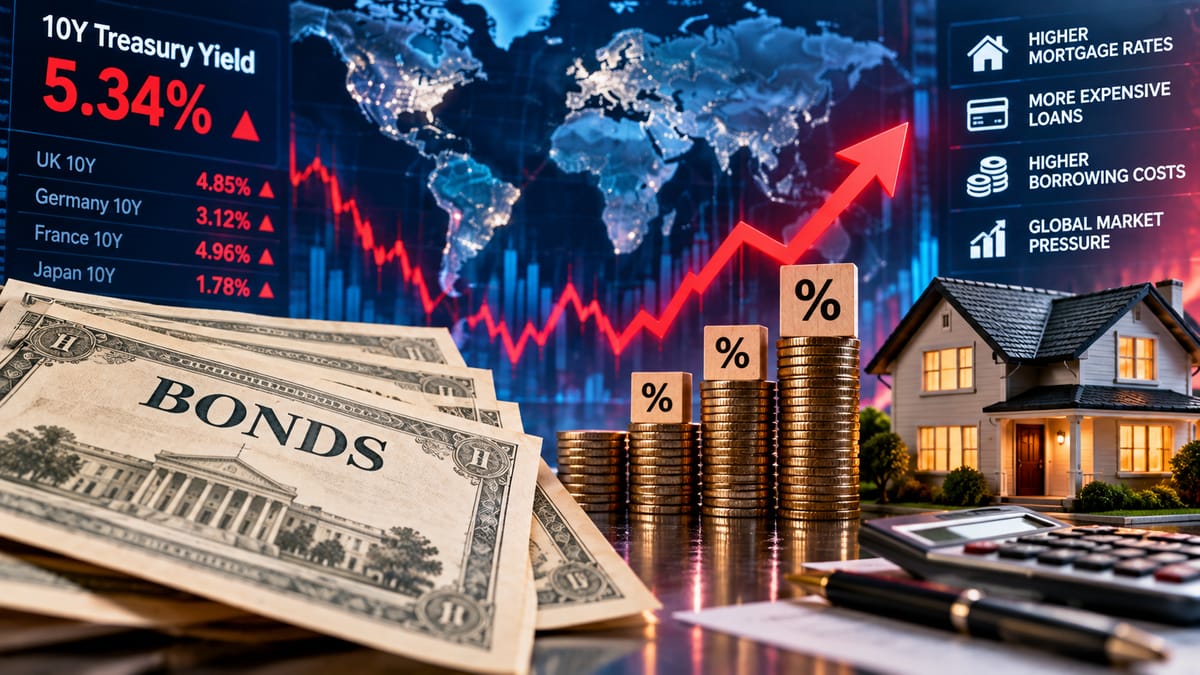
The latest wave of bond-market selling sent the benchmark U.S. 10-year Treasury yield to 5.34% on October 1, its highest level since 2002, before yields eased somewhat. Longer-term U.S. Treasury yields also reached multi-year highs, while borrowing costs in countries including Britain, France and Japan climbed to levels not seen in decades.
The move matters beyond financial markets.
Government bond yields influence the cost of financing for governments, companies and consumers. When longer-term yields rise sharply, lenders may demand higher returns on mortgages, business loans and other forms of long-term credit.
That can make borrowing more expensive even when a central bank has not just raised its short-term policy rate.
What Is Driving the Global Bond Sell-Off?
Several forces are contributing to the recent pressure on government bonds.
One is renewed concern about inflation. Higher energy prices have raised fears that inflation could remain elevated, making investors less confident that central banks will be able to lower interest rates quickly. Reuters reported that rising oil and diesel prices have become an important part of the latest inflation concerns.
Government debt is another factor.
Large borrowing requirements mean governments need to issue substantial amounts of debt to finance spending and refinance existing obligations. When investors become more concerned about fiscal positions, they can demand higher yields before purchasing new bonds.
Higher yields then increase the government’s own interest costs, potentially creating a feedback loop in which rising financing expenses add to concerns about future borrowing.
Investors are also reassessing the broader economic outlook. Stronger-than-expected growth can reduce expectations for rapid interest-rate cuts because central banks may have less reason to stimulate demand.
Bond Prices and Yields Move in Opposite Directions
To understand why the sell-off matters, it helps to understand the relationship between bond prices and yields.
Bond prices and yields generally move in opposite directions.
When investors sell existing bonds, their prices fall. Because the fixed payments on those bonds become more valuable relative to a lower purchase price, their effective yield rises.
That relationship is central to the Complete Guide to Bond Markets.
For households, the important point is that a rising bond yield is not simply a statistic appearing on a financial website. It can influence the price that banks and other lenders charge for money.
Why the U.S. Treasury Market Matters Around the World
U.S. Treasury securities occupy an unusually important position in global financial markets.
The 10-year Treasury yield is widely used as a reference point for pricing assets and borrowing costs. Reuters described it as a yardstick for global borrowing costs and asset prices.
When Treasury yields rise significantly, the effects can extend beyond the United States.
International investors compare government bonds across countries. A substantial increase in U.S. yields can therefore influence capital flows, exchange rates and the relative attractiveness of bonds issued by other governments.
This helps explain why the latest sell-off has not been confined to the United States.
Britain’s 30-year government borrowing cost moved above 6% for the first time since 1998, while Japanese long-term yields reached multi-decade highs. French 10-year yields also approached 5%.
How Higher Bond Yields Can Affect Mortgage Costs
Mortgage rates are among the most visible ways households can feel the effects of rising long-term bond yields.
Mortgage pricing depends on several factors, including expectations for future interest rates, lender funding costs, mortgage-backed securities and investor demand. Long-term government bond yields are an important reference point.
That means a household shopping for a mortgage can encounter higher rates even if the Federal Reserve has not changed its policy rate at the same time.
The latest bond-market move has already put pressure on mortgage financing. Reuters reported that U.S. 30-year mortgage rates had risen to about 7.28% amid the broader increase in long-term yields.
For a prospective homeowner, even a modest increase in the mortgage rate can translate into a substantially larger monthly payment over a long repayment period.
The Fed’s Policy Rate Is Still Important
The Federal Reserve remains a major influence on U.S. financial conditions.
At its September 2026 meeting, the Federal Open Market Committee raised the federal funds target range by 25 basis points to 3.75% to 4.00%. The Fed said economic activity was expanding at a solid pace, while inflation remained elevated relative to its 2% objective.
But the federal funds rate is a short-term policy rate.
Long-term Treasury yields reflect broader market expectations about inflation, economic growth, future monetary policy and the supply and demand for government debt.
This distinction explains why mortgage rates and other long-term borrowing costs do not necessarily move in lockstep with the Fed’s next decision.
Households looking to understand the relationship between monetary policy and everyday borrowing can review Understanding Interest Rates and Their Effects.
Higher Rates Can Reach Credit Cards and Personal Loans
Mortgage borrowers are not the only consumers affected by tighter financial conditions.
Credit cards, personal loans, auto financing and other forms of consumer credit can also become more expensive when interest rates remain elevated.
The effect varies depending on the type of loan.
Variable-rate borrowing can respond relatively quickly to changes in benchmark rates. Fixed-rate loans may not change after they are originated, but new borrowers can face higher rates when lenders adjust pricing.
For households carrying balances from month to month, higher interest charges can consume a larger share of disposable income.
That can make it harder to build emergency savings, pay down debt or absorb increases in food, energy and transportation costs.
Auto Loans Could Become More Expensive
Vehicle financing can also be affected by higher borrowing costs.
A borrower may focus on the monthly payment rather than the total interest cost when shopping for a vehicle. But even a relatively small increase in the interest rate can add hundreds or thousands of dollars to the total cost of financing over a multi-year loan.
Higher rates can also encourage consumers to choose cheaper vehicles, increase down payments or delay purchases.
For households already operating with tight budgets, these decisions can become increasingly important as financing costs rise.
Higher Bond Yields Can Affect Business Costs Too
The impact of the bond sell-off does not stop with consumers.
Companies often use bond markets and other forms of credit to finance investment, acquisitions, expansion and day-to-day operations.
When benchmark yields rise, corporate borrowing can become more expensive.
Companies with higher financing costs may respond by reducing investment, delaying expansion or passing some costs to customers.
The effects can therefore reach households indirectly through employment, wages, product prices and availability of goods and services.
Why Global Interest Rates Matter to Households
The current episode also demonstrates how closely connected national financial systems have become.
Changes in one major economy can influence other countries through investment flows, exchange rates, commodity prices and financial-market expectations.
The relationship is especially important for countries that rely heavily on foreign capital or have substantial external debt.
How Global Interest Rates Affect Countries provides broader context on how changes in borrowing costs can move through national economies.
For households, those international effects can eventually appear through changes in local loan rates, currency values, imported goods and inflation.
Energy Prices Are Adding to Inflation Concerns
The latest bond-market turbulence has also been connected to higher energy prices.
When oil and refined fuel prices rise, investors can become concerned that inflation will remain elevated for longer.
That creates a difficult environment for central banks.
If inflation remains high, policymakers may be reluctant to cut interest rates aggressively. But keeping rates high for longer can put pressure on economic activity and borrowers.
Reuters reported that Brent crude had moved above $100 a barrel during the recent period of market volatility, adding to concerns about persistent inflation.
For consumers, higher energy prices can create a double squeeze: household fuel and utility expenses rise at the same time that borrowing costs remain elevated.
Government Debt Is Becoming a Bigger Market Concern
The global bond sell-off is also highlighting concerns about government debt.
When governments borrow heavily, investors may demand higher yields to hold additional debt, particularly if they believe fiscal deficits could remain large.
Higher yields then increase the cost of servicing that debt.
Reuters reported that the recent global bond rout has been driven partly by concerns about government debt burdens and fiscal risks, with France receiving particular market attention as its borrowing costs rose relative to Germany.
For households, government borrowing costs may seem distant from personal finances.
But governments ultimately finance interest payments through public revenues and borrowing. Persistent increases in debt-service costs can therefore influence future fiscal decisions, spending priorities and taxation.
Monetary Policy Can Amplify Market Movements
Central banks do not directly control every long-term interest rate.
Their decisions influence expectations, liquidity and financial conditions, but bond investors also continuously reassess economic data and future policy.
That is why a change in market expectations can produce large moves in bond yields without an immediate central-bank announcement.
The interaction between central banks and markets is explained further in How Monetary Policy Affects Financial Markets.
The current environment illustrates that relationship clearly. Investors are weighing inflation, economic growth, government borrowing and expected central-bank policy simultaneously.
What the Bond Sell-Off Means for Savers
Higher interest rates are not necessarily negative for every household.
People with savings can benefit when banks and other financial institutions increase the rates offered on deposits, certificates of deposit and other interest-bearing accounts.
The key issue is whether deposit rates rise enough to offset inflation.
A household earning a higher nominal return on savings may still lose purchasing power if consumer prices are rising faster than the account’s interest rate.
That makes the relationship between inflation and interest income particularly important when deciding where to keep emergency funds and other short-term savings.
Households Should Pay Attention to Total Borrowing Costs
When rates rise, consumers may be tempted to focus on the monthly payment.
But a lower monthly payment can sometimes come from extending the loan term rather than obtaining a meaningfully cheaper loan.
A household comparing financing options should consider:
- The interest rate
- The total interest paid
- Loan fees
- Repayment period
- Fixed versus variable rates
- Early repayment conditions
- Potential changes in household income
- The effect of the payment on emergency savings
This approach can provide a clearer picture of the true cost of borrowing.
Building More Flexibility Into a Household Budget
A period of elevated borrowing costs can make financial flexibility more valuable.
Households can review recurring expenses, prioritize high-interest debt and maintain an emergency reserve where possible.
People with variable-rate debt may also want to understand how a change in interest rates could affect their monthly payments.
For households considering a major purchase, it can be useful to stress-test the budget under different interest-rate assumptions rather than relying on today’s financing conditions remaining unchanged.
That does not mean delaying every purchase. It means understanding how a higher financing cost would affect the rest of the household budget.
What to Watch in the Coming Weeks
Several developments could determine whether the recent bond-market pressure continues.
U.S. employment data
The September jobs report is particularly important because investors are assessing whether the labor market remains strong enough to support continued economic activity and potentially higher interest rates.
Inflation reports
Persistent inflation could reinforce expectations that central banks will keep rates elevated.
Energy prices
Oil and diesel prices have become an important source of inflation uncertainty. A sustained increase could place additional pressure on bond markets.
Government borrowing
Investors will continue watching the size of fiscal deficits and the volume of new debt being issued.
Central-bank decisions
The Federal Reserve and other major central banks will remain important sources of information for bond investors.
Treasury yields
Perhaps most directly, households should watch longer-term yields because they can influence mortgage and other long-term borrowing costs.
A Higher-Rate Environment Can Change Household Priorities
The latest bond sell-off is a reminder that household borrowing costs are shaped by much more than a single central-bank announcement.
Global bond markets respond to inflation expectations, government debt, economic growth, energy prices, investor demand and expectations for future monetary policy.
The sharp increase in U.S. Treasury yields on October 1 showed how quickly those forces can come together. The 10-year Treasury yield reached 5.34%, while yields in several other major economies also climbed to historically high levels.
For households, the practical lesson is that borrowing conditions can remain challenging even when financial markets occasionally reverse course.
Mortgage rates, auto loans, credit cards and personal loans can all affect monthly cash flow, while higher savings rates may provide some benefit to households holding cash.
The bond market is ultimately far removed from an individual household budget, but its movements can travel through the financial system and eventually reach the decisions consumers make every day. Understanding that connection can make it easier to evaluate borrowing costs, protect savings and plan for a period in which interest rates may remain higher for longer.