Higher Energy Costs and Interest Rates Put Household Budgets Under Fresh Pressure
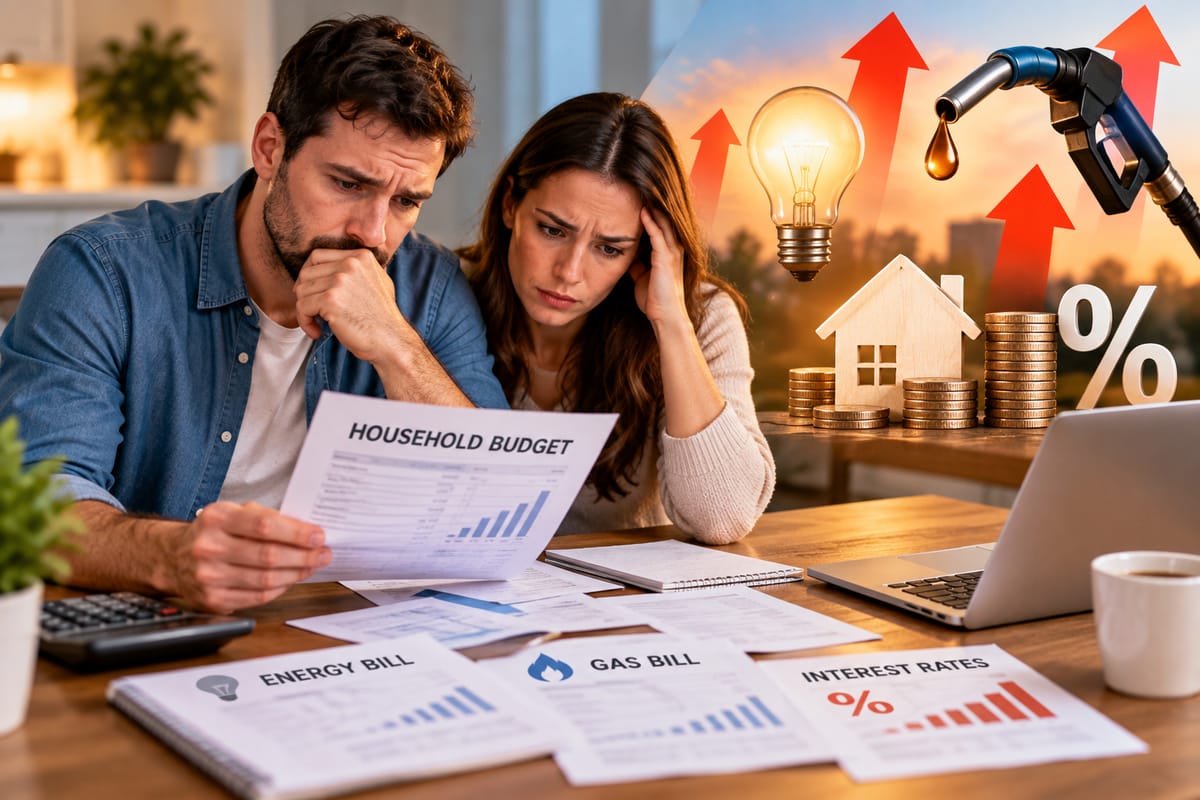
Household budgets are facing pressure from two directions as elevated energy costs collide with a still-high interest-rate environment.
For American families, the squeeze can appear in several places at once. Gasoline can raise the cost of commuting and transportation, electricity and natural gas can increase monthly utility bills, while higher borrowing costs can make credit cards, auto loans and other forms of debt more expensive.
The latest U.S. inflation data show how significant energy costs have become. The Consumer Price Index rose 3.4% over the 12 months through August 2026, while the energy index increased 16.3% over the same period. Gasoline prices were up 27.4% year over year, while natural gas prices increased 4.4% and electricity prices rose 3.8%.
At the same time, the Federal Reserve raised its federal funds target range by a quarter percentage point in September to 3.75% to 4.00%, citing elevated inflation and the need to support a return toward its 2% goal.
The combination creates a complicated environment for households trying to balance everyday spending, debt payments, emergency savings and longer-term financial goals.
Energy Costs Are Taking a Larger Share of Household Budgets
Energy is different from many other household expenses because it affects both direct and indirect spending.
A family pays directly for gasoline, electricity and natural gas. But energy is also an input into transportation, manufacturing, food distribution and many other services.
When energy costs rise significantly, businesses can face higher operating expenses. Some of those costs can eventually be reflected in the prices consumers pay.
The August CPI data illustrate the direct pressure. Gasoline increased 3.9% during August alone, while the overall energy index rose 2.1%. Natural gas declined 1.1% during the month and electricity fell 0.2%, showing that different energy categories do not necessarily move in the same direction at the same time.
For households, however, even temporary movements can matter when budgets are already tight.
Gasoline Has an Immediate Effect on Monthly Spending
Gasoline prices can be particularly visible because consumers often pay them repeatedly throughout the month.
Someone commuting long distances may have limited ability to reduce fuel consumption without changing jobs, transportation arrangements or where they live.
Higher gasoline prices can therefore function almost like a fixed expense for households that depend heavily on automobiles.
The August data showed gasoline prices were 27.4% higher than a year earlier.
That does not mean every driver experienced exactly the same increase. Local fuel prices vary based on taxes, transportation costs, refinery conditions and regional supply.
Nevertheless, a sustained increase can force households to reconsider how much money is available for discretionary spending.
The relationship between fuel prices and household finances is also explored in Rising Fuel Prices Could Force Households to Rethink Their Monthly Budgets.
Utility Bills Can Create a Different Kind of Pressure
Electricity and natural gas affect household budgets differently from gasoline.
Utility bills are often recurring monthly expenses, making changes easier to notice when a household compares one billing cycle with another.
The latest CPI data showed electricity prices up 3.8% over the year through August, while natural gas prices increased 4.4%.
Actual bills can vary considerably depending on location, weather, home size, energy efficiency and consumption patterns.
A household with an older, poorly insulated home may use substantially more energy than a similar household living in a newer, more efficient property.
This means inflation in energy prices does not translate into identical financial pressure for every family.
Inflation Affects More Than the Energy Bill
Energy costs are only one component of the broader inflation picture.
The August CPI showed food prices rising 2.7% over the year, while food away from home increased 3.4%. Core CPI, which excludes food and energy, rose 2.4% over the same period.
This matters because households rarely experience inflation as one isolated price increase.
A family may simultaneously face higher gasoline costs, increased insurance premiums, rising restaurant prices and higher borrowing costs.
The cumulative effect can be much more noticeable than any individual increase.
Understanding How Inflation Affects Everyday Finances can help explain why the same headline inflation rate can feel very different from one household to another.
Interest Rates Add a Second Financial Challenge
Higher energy prices are only part of the current household-budget equation.
Interest rates also influence the cost of borrowing.
The Federal Reserve’s September 2026 decision lifted the target federal funds rate to 3.75% to 4.00%. The central bank said inflation remained elevated and that the policy move was intended to support a timelier return to its 2% objective.
The federal funds rate does not directly determine the interest rate on every household loan.
Instead, it influences broader financial conditions. The effects can reach consumers through products such as variable-rate credit cards, some adjustable-rate loans and new borrowing.
For a household carrying substantial debt, even a relatively small increase in financing costs can reduce the amount of money available for other priorities.
Credit-Card Debt Can Become More Expensive
Credit cards are particularly important when discussing household budgets because many cards have variable interest rates.
When borrowing costs remain high, consumers carrying balances from month to month can face substantial interest charges.
That creates a challenge for households already dealing with higher prices.
A family might use a credit card to cover a higher-than-expected utility bill or fuel expense. If the balance is not repaid quickly, the original expense can generate additional interest costs.
Over time, this can create a feedback loop in which higher everyday expenses lead to more borrowing, while the resulting debt payments reduce future financial flexibility.
Auto Loans Can Connect Energy and Interest Costs
Transportation provides another example of how energy costs and interest rates can overlap.
A household purchasing a gasoline-powered vehicle is exposed to fuel costs after the purchase. If the vehicle is financed, the family is also exposed to borrowing costs.
Higher interest rates can increase the monthly payment on a new auto loan, while higher gasoline prices can increase the ongoing cost of operating the vehicle.
An electric vehicle changes the nature of that calculation but does not eliminate energy costs entirely. Electricity prices, charging infrastructure and local utility rates can influence the cost of charging.
Recent analysis has highlighted substantial geographic differences in the relative costs of gasoline and EV charging, with local electricity prices playing an increasingly important role in transportation economics.
Housing Costs Can Compound the Pressure
Housing is another major category that can interact with interest rates.
Homeowners with fixed-rate mortgages may be insulated from changes in their mortgage interest rate, although they can still face higher property taxes, insurance, maintenance and utility expenses.
Borrowers with variable-rate debt can have different exposure.
Meanwhile, people purchasing homes or refinancing loans in a high-rate environment may face substantially different monthly payments from borrowers who secured financing when rates were lower.
Renters can also be affected indirectly because landlords face their own financing, maintenance, insurance and operating costs.
The result is that interest-rate changes can influence housing costs through several different channels.
Household Expenses Do Not Rise at the Same Speed
One of the most important budgeting realities is that inflation is not uniform.
The CPI measures changes across a large basket of goods and services, but individual households have their own spending patterns.
A family that spends a large share of its income on gasoline may experience stronger pressure when fuel prices rise. A household with high medical expenses may be more affected by healthcare costs.
Someone who rarely drives may barely notice a major gasoline-price increase compared with a commuter who fills the tank every week.
This is why understanding Why Household Expenses Keep Increasing requires looking beyond the headline inflation rate and examining the individual categories that dominate a household’s spending.
Global Energy Markets Can Influence Local Budgets
Household energy prices are also connected to international markets.
Oil and natural gas are traded across global markets, while geopolitical developments, supply disruptions, transportation constraints and production decisions can influence prices.
Recent developments in global energy markets have demonstrated how quickly changes in oil and natural-gas prices can feed into inflation concerns.
In Europe, for example, wholesale natural-gas prices have risen sharply in 2026, with the European Central Bank warning that higher gas costs could pass through to consumer inflation more quickly than in previous years.
The implications extend beyond Europe because energy markets are interconnected.
For households, this means local utility and transportation costs can sometimes be influenced by developments occurring thousands of miles away.
Interest Rates Are Also Part of a Global Financial System
The same interconnectedness applies to interest rates.
Central banks around the world respond to inflation, economic growth, employment conditions, exchange rates and financial stability.
A change in one major economy can influence currency markets, bond yields, capital flows and borrowing conditions elsewhere.
This makes How Global Interest Rates Affect Countries relevant to understanding why household borrowing costs cannot always be viewed in isolation from the international economy.
For individual families, however, the most immediate question is usually much simpler: how much money remains after paying essential expenses and debt obligations?
Household Budgets May Need More Flexibility
A budget designed around a previous price environment can become less useful when recurring expenses change.
For example, a household that previously allocated a fixed amount to transportation may discover that gasoline now consumes more of that category.
The same can happen with utilities, groceries, insurance or debt payments.
Rather than assuming every category will remain constant, households can periodically review spending and identify which expenses are genuinely fixed and which can change.
This can make it easier to distinguish between temporary price increases and persistent changes that require a longer-term adjustment.
Emergency Savings Become More Important During Cost Shocks
Higher expenses can also highlight the importance of emergency savings.
An emergency fund provides a financial buffer when an unexpected repair, medical expense, utility bill or temporary income disruption occurs.
Without savings, households may have to rely on credit cards or other borrowing during periods when interest rates are already elevated.
That can turn a temporary expense into a longer-lasting debt obligation.
The appropriate emergency-fund amount varies by household because income stability, expenses, dependents and access to other financial resources differ.
The broader principle is that savings can provide flexibility when expenses become less predictable.
Cutting Spending Is Not Always the Only Option
When budgets come under pressure, households often focus immediately on reducing expenses.
That can help, but it is not the only possible response.
A household may also examine opportunities to increase income, restructure expensive debt, improve energy efficiency or change how frequently certain purchases are made.
Energy efficiency can be particularly relevant when utility costs are persistent.
Simple measures such as improving insulation, sealing air leaks, maintaining heating and cooling equipment, using efficient lighting and adjusting thermostat settings can sometimes reduce consumption.
Larger improvements can involve more significant upfront costs, so homeowners need to consider the initial investment alongside potential long-term savings.
Debt Payments Can Crowd Out Saving
One of the less visible effects of higher interest rates is the opportunity cost of debt repayment.
When more household income goes toward interest, less money may be available for savings or investments.
This can create difficult choices.
A household might want to build an emergency fund while simultaneously paying down a high-interest credit-card balance. It may also be saving for retirement, a home purchase, education or other long-term goals.
There is no universal solution because the appropriate balance depends on the type and cost of debt, available savings and the household’s broader financial circumstances.
But making the trade-offs visible is an important part of effective budgeting.
Fixed and Variable Expenses Deserve Different Treatment
Separating fixed expenses from variable expenses can make a budget easier to manage during periods of economic uncertainty.
Fixed expenses might include certain housing payments, insurance premiums or contractual obligations.
Variable expenses can include groceries, fuel, dining out, entertainment and some utility costs.
Not every expense fits neatly into one category, but the distinction can help households identify where changes are possible.
If gasoline prices rise, transportation spending may need to be adjusted. If interest charges increase, debt repayment may require a larger allocation. If utility costs rise seasonally, households can plan for those periods rather than treating the increase as unexpected.
What Households Can Watch in the Coming Months
Several economic indicators will be particularly relevant to household budgets.
Future inflation reports will show whether price pressures are accelerating or moderating. Energy prices will remain important because gasoline, natural gas and electricity can have substantial effects on household expenses.
The Federal Reserve’s interest-rate decisions will also matter for borrowing costs.
The central bank’s September projections showed policymakers had differing views about the appropriate path for the federal funds rate, illustrating that future policy will depend on incoming economic conditions rather than following a predetermined schedule.
Employment and wage data will also be important.
If household incomes rise sufficiently to offset higher expenses, families may have more room to absorb cost increases. If expenses rise faster than incomes, household budgets can become progressively tighter.
The Budgeting Challenge Is About the Combined Effect
The most important issue for households may not be any single price or interest-rate figure.
It is the combined effect.
A family could face higher gasoline costs, increased utility bills and more expensive credit-card debt at the same time. Each individual increase might appear manageable, but together they can significantly reduce monthly financial flexibility.
That is why household budgeting becomes particularly important when economic conditions are changing quickly.
Tracking actual spending can reveal whether inflation is affecting a household more severely than national averages suggest.
A More Flexible Approach to Household Finances
Higher energy prices and elevated interest rates create a financial environment in which flexibility can become increasingly valuable.
Households cannot control global oil prices or Federal Reserve decisions. They can, however, monitor their own expenses, understand their debt costs, maintain appropriate savings and periodically adjust their budgets as circumstances change.
The latest U.S. data show why the issue deserves attention. Energy prices were up 16.3% over the year through August, with gasoline rising 27.4%, while the federal funds target range now stands at 3.75% to 4.00%.
Those figures do not determine what any individual household will experience. But they illustrate the broader financial environment in which families are making everyday decisions.
For consumers, the challenge is increasingly about managing the interaction between essential expenses, borrowing costs, income and savings rather than responding to any one economic headline in isolation.