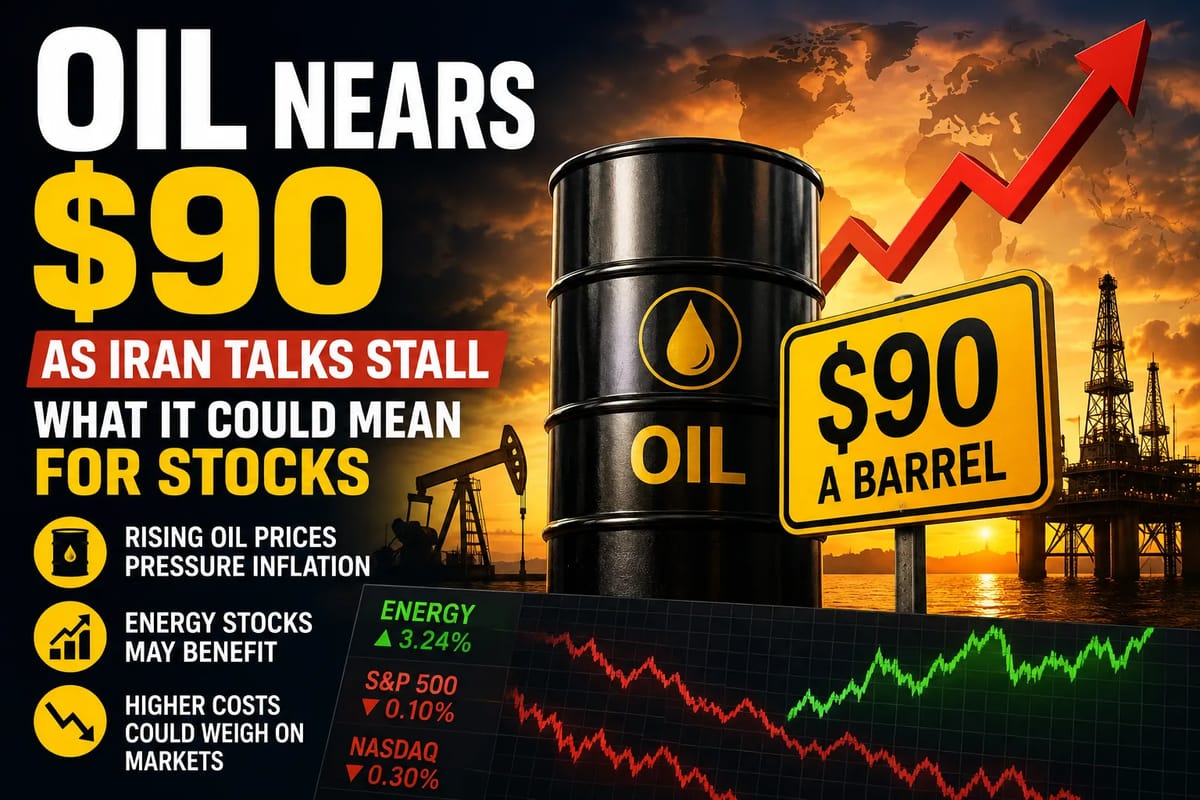
Oil Nears $90 as Iran Talks Stall: What It Could Mean for Stocks
Oil prices are pushing back toward $90 a barrel as hopes for a breakthrough in U.S.-Iran negotiations fade, putting investors on alert for another bout of inflation and market volatility.
Brent crude reached about $89.80 a barrel on Tuesday, August 11, while U.S. West Texas Intermediate crude climbed to around $84.28. Brent has risen sharply over the past two sessions as uncertainty over the reopening of the Strait of Hormuz has returned to the market.
The move matters well beyond the energy sector.
Oil is a fundamental input for transportation, manufacturing, chemicals and many other parts of the economy. If crude remains elevated, companies can face higher operating costs, consumers can face higher fuel prices, and investors may have to reassess expectations for inflation and interest rates.
For stocks, that creates a complicated picture: energy companies may benefit from higher crude prices, while businesses and consumers that depend heavily on fuel could come under pressure.
For investors looking to understand how developments like these can ripple through stocks, bonds and other assets, this is part of the broader landscape covered in the complete guide to financial markets and how they work.
Why Oil Is Rising Again
The immediate catalyst is renewed uncertainty surrounding the U.S.-Iran standoff and efforts to restore normal commercial traffic through the Strait of Hormuz.
Negotiations have stalled, particularly over conditions surrounding the reopening of the strategically important waterway. New demands from the U.S. and Iran have reduced market confidence that a quick resolution is close. Reuters reported that Brent was around $88 a barrel on Tuesday, roughly 25% above early-July levels.
The market is especially sensitive to the situation because the Strait of Hormuz is one of the world’s most important energy chokepoints.
According to the U.S. Energy Information Administration, approximately 20 million barrels of oil per day moved through the strait in 2024, equivalent to about one-fifth of global petroleum liquids consumption. About one-quarter of global seaborne oil trade also passed through the waterway.
That makes any threat to normal shipping activity important for global energy markets.
The Strait of Hormuz Is the Bigger Story
Oil prices are not rising simply because negotiations have become more difficult.
Investors are trying to price the possibility that supply disruptions could last longer than previously expected.
The Strait of Hormuz connects the Persian Gulf with the Gulf of Oman and the Arabian Sea. Major producers and exporters in the region rely heavily on the waterway to move crude and petroleum products to international markets.
There are alternative pipelines and routes, but they cannot fully replace the volumes that normally move through the strait. The EIA estimates that Saudi Arabia, the United Arab Emirates and Iran have alternative pipeline capacity, but the available alternatives represent only a portion of normal Hormuz flows.
That limited ability to reroute supplies is what gives the strait such influence over prices.
Why $90 Oil Matters for Investors
A move toward $90 does not automatically mean stocks will fall.
The bigger issue is how long oil stays there and why it is there.
A short-lived geopolitical spike can be absorbed by markets relatively easily if traders believe supplies will normalize.
A prolonged oil shock is different.
If crude stays elevated for weeks or months, the effects can spread through the economy:
Higher fuel costs → higher transportation costs → higher business expenses → higher consumer prices → pressure on profit margins and inflation.
That chain is what investors need to watch.
Energy Stocks Could Be the Immediate Winners
The most obvious beneficiaries of higher oil prices are companies that produce crude.
When oil rises, producers can potentially sell their output at higher prices, improving revenue and cash flow if production costs remain relatively stable.
That can benefit:
- Oil producers
- Exploration companies
- Oilfield-service companies
- Some energy-focused funds
- Certain pipeline and infrastructure businesses
The market has already shown this relationship.
On August 10, the S&P 500 energy sector had its strongest performance in four weeks as crude prices climbed. The Energy Select Sector SPDR ETF rose about 3%, with all of its components gaining that day.
That does not guarantee that energy stocks will continue rising.
Investors also need to consider whether crude prices are rising because of a temporary supply disruption or because the global economy itself is strengthening.
Airlines Could Feel the Pressure
Airlines are among the businesses most directly exposed to fuel costs.
Jet fuel is a major operating expense, meaning sustained increases in crude and refined-product prices can put pressure on airline profitability.
If carriers cannot pass higher costs to passengers through ticket prices, margins can shrink.
If they do raise fares, consumers may travel less.
That creates a difficult environment for an industry that is already sensitive to consumer demand, labor costs and economic conditions.
Transportation Companies Face Similar Risks
Higher oil prices can also affect:
- Trucking companies
- Delivery businesses
- Logistics providers
- Shipping companies
- Taxi and ride-hailing operators
- Public transportation systems
The effect varies considerably by business.
Companies with fuel hedges may have some short-term protection, while businesses with pricing power may be able to pass higher costs to customers.
Others may have little ability to absorb the increase.
Investors therefore need to look beyond the headline oil price and examine individual companies’ cost structures.
Consumer Spending Could Come Under Pressure
Higher gasoline prices can affect household budgets directly.
When consumers spend more at the pump, they have less disposable income available for other purchases.
That can put pressure on discretionary categories such as:
- Restaurants
- Travel
- Entertainment
- Retail
- Leisure
- Consumer services
The impact depends on how large and persistent the fuel-price increase becomes.
A temporary spike may have a limited effect.
A sustained increase can become much more significant, particularly for lower-income households that spend a larger share of their budgets on transportation and essential goods.
Oil Can Feed Inflation
This may be the most important issue for the broader stock market.
Energy is a component of consumer inflation, and higher fuel prices can also indirectly increase the cost of transporting goods and providing services.
That means a prolonged oil rally could make it more difficult for inflation to fall.
The timing is particularly important because investors are already watching U.S. inflation data ahead of the Federal Reserve’s next policy decisions.
Markets are preparing for the July consumer-price report due Wednesday, August 12. Reuters reported that investors see the inflation release as an important signal for the Fed’s September decision, with expectations for a rate cut roughly balanced against the possibility of no cut.
That creates a potentially important combination:
Higher oil + stronger inflation = potentially higher interest rates for longer.
Why Higher Rates Can Hurt Stocks
When investors expect interest rates to remain elevated, the valuation of stocks can come under pressure.
Higher interest rates can:
- Increase borrowing costs
- Reduce consumer demand
- Raise corporate financing expenses
- Make bonds more attractive relative to stocks
- Reduce the present value investors place on future earnings
Growth-oriented companies can be particularly sensitive because a larger portion of their valuation may depend on earnings expected several years in the future.
That does not mean technology stocks automatically fall whenever oil rises.
It means investors may become more selective if an energy shock begins changing expectations for monetary policy.
Investors should also understand how stock market volatility works and what causes market volatility, particularly when geopolitical developments cause expectations to change quickly.
Treasury Yields Are Already Sending a Signal
The bond market is also reacting.
On Monday, the 10-year U.S. Treasury yield rose to about 4.697%, while the S&P 500 slipped 0.1% and the Nasdaq declined 0.3%.
The combination is worth watching.
If oil continues climbing while Treasury yields rise, investors may increasingly worry that an energy shock is becoming an inflation problem rather than simply a geopolitical headline.
That would create a more challenging environment for stocks broadly.
The relationship between yields and stock valuations is particularly important, which is why investors should also understand how rising Treasury yields can put pressure on stock valuations.
The Stock Market Does Not Treat Every Oil Rally the Same
One of the biggest mistakes investors can make is assuming that rising oil prices always mean falling stocks.
The relationship is more complicated.
There are several possible scenarios.
Scenario 1: Talks Resume and Oil Falls
If negotiations make meaningful progress and the Strait of Hormuz becomes more accessible to commercial shipping, oil could fall quickly.
That could remove some inflation pressure and support sectors that have been hurt by higher energy costs.
Airlines, transportation companies and consumer-focused businesses could benefit from lower fuel costs.
At the same time, energy stocks could give back some of their recent gains.
Scenario 2: Oil Stabilizes Around $85–$95
This could be a more manageable scenario for markets.
Reuters cited analysts who see oil potentially stabilizing in roughly the $75-to-$95 range during the current standoff.
If crude settles into that range without accelerating further, investors may gradually adapt.
Energy companies could continue benefiting from higher prices, while the broader economy absorbs the additional costs.
The Federal Reserve would still need to monitor inflation, but the shock might not be large enough to fundamentally change the economic outlook.
Scenario 3: Oil Moves Significantly Above $90
A sustained move well beyond $90 would present a greater challenge.
At that point, investors would likely become increasingly focused on:
- Inflation expectations
- Gasoline prices
- Corporate margins
- Consumer spending
- Federal Reserve policy
- Economic growth
The further and faster oil rises, the greater the risk that the energy shock becomes a broader macroeconomic problem.
What It Could Mean for Technology Stocks
Technology stocks are not directly dependent on crude prices in the same way energy producers are.
However, they can still be affected indirectly.
If oil pushes inflation higher and bond yields rise, valuations for high-growth companies may face pressure.
Technology businesses also have large data centers and infrastructure requirements, meaning energy costs can matter at the operational level.
For major technology companies with strong balance sheets and pricing power, the impact may be relatively manageable.
Smaller, less profitable companies could be more vulnerable if financing conditions tighten.
What It Could Mean for Consumer Stocks
Consumer companies face two opposing forces.
Higher energy costs can increase operating expenses, including transportation, manufacturing and distribution.
At the same time, consumers may reduce discretionary spending if gasoline and other essential costs rise.
Companies selling necessities may therefore be better positioned than businesses dependent on discretionary purchases if the oil shock persists.
But even defensive consumer companies are not immune.
If costs rise faster than prices can be increased, profit margins can suffer.
What It Could Mean for Industrial Stocks
Industrial companies can be sensitive to fuel, transportation and raw-material costs.
The impact depends heavily on the business model.
Companies with strong backlogs and pricing power may be able to pass higher costs to customers.
Companies competing primarily on price may have less flexibility.
Investors should therefore examine earnings guidance and management commentary for evidence that higher energy costs are beginning to affect margins.
Emerging Markets May Face a Different Problem
Oil-importing economies can be particularly vulnerable to a sustained energy shock.
Higher crude prices can increase import bills and put pressure on:
- Inflation
- Currency markets
- Trade balances
- Household purchasing power
- Central-bank policy
Asia is particularly important because the EIA estimates that the overwhelming majority of crude and condensate moving through the Strait of Hormuz is ultimately destined for Asian markets. China, India, Japan and South Korea are among the largest destinations.
For investors with international portfolios, the geographic exposure of an economy to imported energy can therefore matter as much as the headline oil price.
U.S. Investors Have Some Protection From Domestic Production
The United States is less directly dependent on Hormuz crude than many Asian economies.
The EIA estimates that U.S. imports of crude and condensate from Persian Gulf countries through the Strait represented about 2% of total U.S. petroleum liquids consumption in 2024.
That does not make the U.S. immune.
Oil is traded in a global market.
If global supply is disrupted, U.S. prices can rise even when domestic production remains strong.
The American consumer can therefore feel the impact through gasoline, diesel, transportation and other energy-linked costs.
Watch Corporate Earnings for the Next Clues
The next major signal for investors may come from company earnings rather than oil futures alone.
Management teams often provide information about how changing input costs are affecting their businesses.
Look for references to:
- Fuel expenses
- Freight costs
- Transportation
- Commodity costs
- Pricing power
- Consumer demand
- Margin pressure
- Capital spending
If companies across multiple industries begin warning about energy-related costs, that would suggest the oil shock is spreading beyond the energy market.
Watch the Yield Curve and Inflation Expectations
Oil itself is only one piece of the puzzle.
Investors should also watch:
- Treasury yields
- Inflation expectations
- Federal Reserve commentary
- Consumer inflation data
- Producer prices
- Gasoline prices
- Corporate earnings guidance
A rising oil price combined with falling inflation expectations would tell a very different story from rising oil accompanied by accelerating inflation expectations.
The market’s reaction depends on the broader combination.
Oil Prices Could Also Help Some Businesses
Higher oil prices are not universally negative for corporate America.
Energy producers are the obvious example.
But other businesses can benefit indirectly.
These can include:
- Oilfield-service providers
- Equipment manufacturers
- Pipeline operators
- Certain energy infrastructure companies
- Some commodity producers
Companies with long-term contracts and exposure to energy investment could also benefit if high prices encourage producers to increase drilling and infrastructure spending.
The important distinction is between higher oil prices caused by stronger demand and higher oil prices caused by supply disruption.
The first can accompany economic strength.
The second can hurt economic growth.
Why the Reason Behind the Oil Move Matters
This distinction is critical for investors.
Imagine oil rises from $75 to $90 because global economic growth is accelerating and factories, airlines and consumers are using more energy.
That could be a relatively positive signal for cyclical stocks.
Now imagine oil rises from $75 to $90 because a major shipping route is disrupted and investors fear physical shortages.
That is a very different signal.
The second scenario can increase inflation while simultaneously weakening economic activity.
That combination is sometimes described as a stagflationary risk.
Don’t Assume the Worst-Case Scenario Is Already Priced In
Financial markets constantly attempt to price future events.
If investors believe a diplomatic breakthrough is likely, oil and stocks may already reflect that expectation.
If the situation deteriorates unexpectedly, markets can move quickly.
The reverse is also true.
A credible agreement could produce a sharp decline in oil and a corresponding relief rally in stocks that have been pressured by inflation concerns.
That is why geopolitical markets can be extremely difficult to trade based solely on headlines.
What Long-Term Investors Should Watch
For long-term investors, the question is not necessarily whether oil reaches $90, $95 or $100 on a particular day.
The more important questions are:
Is the oil shock temporary or persistent?
Is inflation accelerating?
Are corporate profit margins deteriorating?
Are interest-rate expectations changing?
Is consumer demand weakening?
Are companies successfully passing higher costs to customers?
These factors can have a much larger influence on long-term stock returns than any single day’s crude-price movement.
A Practical Investor Checklist
As the Iran situation develops, investors can keep an eye on several indicators.
Oil
Watch both Brent and WTI, particularly whether prices remain elevated rather than simply spike temporarily.
The Strait of Hormuz
Look for evidence that commercial shipping is returning to normal.
Inflation
Pay attention to headline and core CPI as well as producer prices.
Treasury Yields
A continued rise in yields could signal increasing concern about inflation and interest rates.
Energy Stocks
Watch whether energy companies continue outperforming the broader market.
Consumer Stocks
Weakness in discretionary companies could signal that higher fuel and living costs are affecting household spending.
Corporate Guidance
Listen for management commentary about transportation, energy and commodity costs.
Federal Reserve Expectations
Changes in rate-cut expectations could have a broad effect on stock valuations.
What Investors Should Not Do
An oil spike can create a strong temptation to make dramatic portfolio changes.
That is where discipline becomes important.
Investors should be cautious about:
- Selling an entire portfolio because of one geopolitical event
- Buying energy stocks solely because oil is rising
- Assuming oil will continue climbing indefinitely
- Ignoring diversification
- Making decisions based on social-media predictions
- Treating a temporary price spike as a guaranteed long-term trend
Oil markets can reverse rapidly when diplomatic developments change.
The same event that sends crude higher one day can send it sharply lower the next.
The Bigger Market Question Is Inflation
Oil nearing $90 is important, but the number itself is not necessarily the biggest concern for investors.
The bigger question is whether higher energy prices become embedded in broader inflation.
If the answer is no, markets may eventually look through the spike.
If the answer is yes, the consequences could be much larger.
A persistent energy shock could complicate the Federal Reserve’s efforts to bring inflation toward its target while maintaining economic growth.
That is why Wednesday’s U.S. CPI report is particularly important. Investors are entering the inflation release with oil prices rising and rate expectations already sensitive to incoming economic data.
The Path From Here Depends on Three Variables
The next phase of the oil and stock-market story will probably depend on three things.
First, diplomacy. A credible agreement between the U.S. and Iran could quickly reduce the geopolitical premium in crude.
Second, shipping. Even if political tensions ease, the physical movement of oil through the Strait of Hormuz needs to normalize before the market can fully price a return to ordinary supply conditions.
Third, inflation. If higher energy costs show up in broader price data and keep interest-rate expectations elevated, the effect on stocks could extend well beyond the energy sector.
For now, investors are dealing with an unusual combination of geopolitical uncertainty, elevated oil prices and an important inflation report arriving at almost the same time.
Brent approaching $90 is therefore less a standalone market signal than a warning to watch the connections between energy, inflation, interest rates and corporate earnings.
Energy producers may continue to benefit if crude remains elevated, but the broader stock market will be watching for signs that expensive oil is beginning to squeeze consumers, margins and monetary-policy expectations.
For long-term investors, the most important development may not be whether Brent briefly crosses $90.
It will be whether it stays there—and what happens to inflation and economic growth if it does.