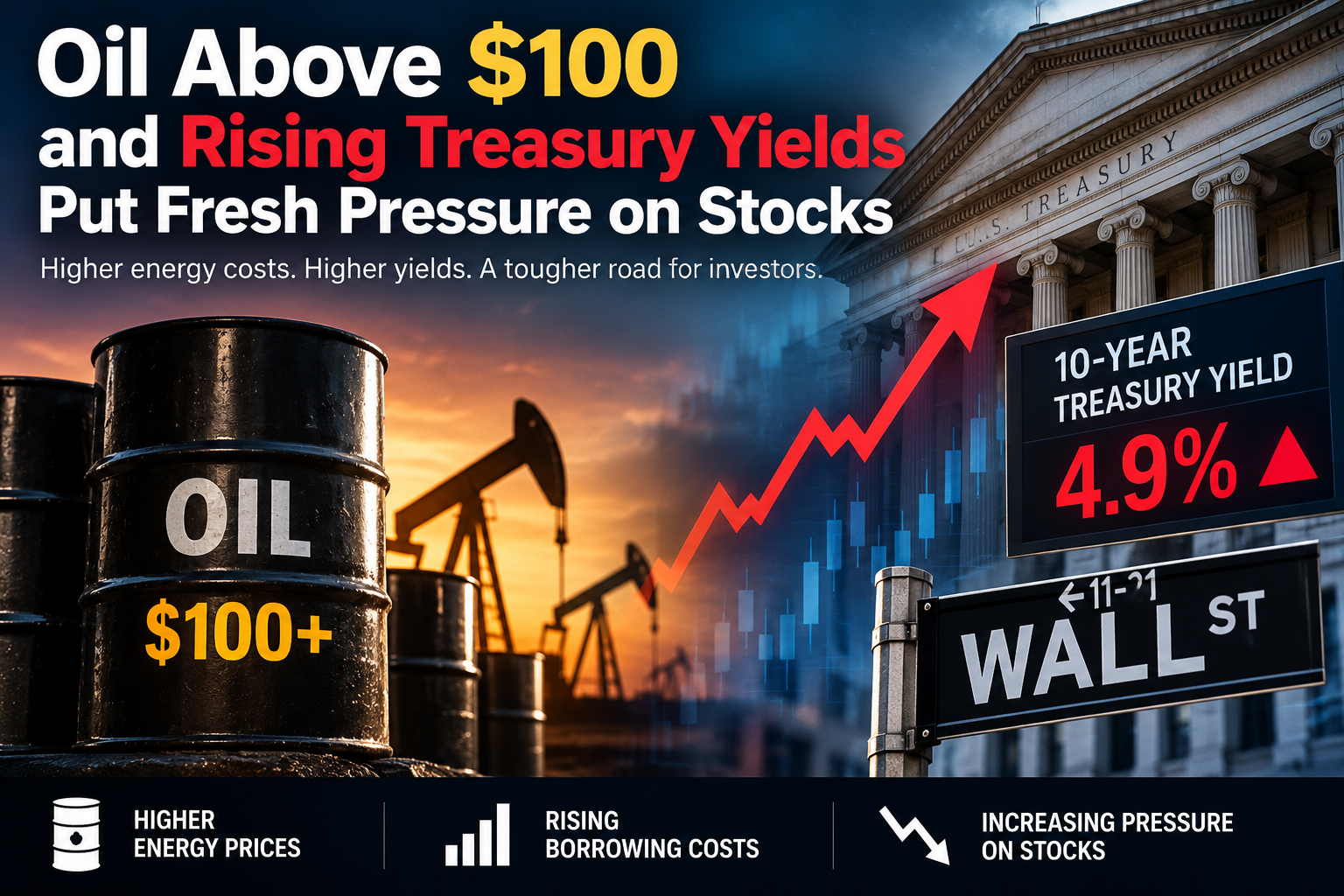
Oil Above $100 and Rising Treasury Yields Put Fresh Pressure on Stocks
Stocks are facing a more complicated market environment as oil prices push above $100 a barrel and U.S. Treasury yields climb toward levels that can materially change the investment landscape.
The combination is particularly uncomfortable for investors because higher energy prices can add to inflation while rising bond yields increase borrowing costs and make relatively safe fixed-income investments more competitive with stocks.
That does not automatically mean a major stock-market decline is coming. But it does create a tougher backdrop, particularly for expensive growth stocks, companies with heavy debt loads, and businesses whose valuations depend on expectations of lower interest rates.
For investors trying to understand the bigger picture, the Complete Guide to Financial Markets and How They Work provides useful context on how stocks, bonds, commodities, interest rates, and other markets interact.
Why Oil Above $100 Matters for Investors
Oil is one of the most important commodities in the global economy.
It affects transportation, manufacturing, electricity generation, agriculture, shipping, aviation, and countless other activities.
When crude prices rise sharply, the impact can spread throughout the economy.
Higher oil prices can increase:
- Gasoline and diesel costs
- Transportation expenses
- Manufacturing costs
- Shipping expenses
- Airline operating costs
- Agricultural production costs
- Chemical and plastics costs
- Household energy expenses
Companies may respond by absorbing these higher costs, raising prices, or reducing spending elsewhere.
None of those outcomes is particularly attractive for investors when inflation is already a concern.
The Inflation Problem Created by Higher Oil
One of the biggest concerns surrounding an oil-price surge is its potential effect on inflation.
Energy prices can directly affect consumer prices through gasoline, heating, electricity, and other energy-related expenses.
They can also have indirect effects.
A trucking company paying more for diesel, for example, may eventually face pressure to increase freight rates. Higher transportation costs can then affect the prices businesses and consumers pay for other goods.
This creates a potential second-round inflation effect.
The concern becomes even more significant when central banks are trying to bring inflation under control.
Why Rising Treasury Yields Matter
Treasury yields represent the interest rates investors demand to hold U.S. government debt for different periods.
The 10-year Treasury yield is particularly important because it influences borrowing costs throughout the economy.
Mortgage rates, corporate borrowing costs, asset valuations, and other financial conditions can all be affected by movements in longer-term Treasury yields.
The recent rise in yields has pushed the 10-year Treasury toward 5%, while the 30-year yield has moved above 5%, increasing pressure on equity valuations.
For a deeper explanation of this relationship, see Treasury Yields Are Surging: Why Rising Bond Yields Could Pressure Stocks Next.
Higher Yields Change the Competition for Investor Capital
Stocks compete with other assets for investors’ money.
When Treasury yields are very low, investors may be more willing to accept the additional risk of stocks because government bonds offer relatively limited returns.
When Treasury yields rise substantially, that calculation changes.
A government bond offering a considerably higher yield can become more attractive, particularly for investors focused on capital preservation or income.
Stocks then have to offer enough potential upside to justify their additional risk.
This does not mean investors automatically sell stocks whenever Treasury yields rise. It means the relative attractiveness of different asset classes changes.
Why Growth Stocks Can Be Especially Sensitive
Growth companies are often valued based on profits investors expect to receive far into the future.
Those future earnings become less valuable when interest rates rise.
Consider a company expected to generate substantial profits many years from now. If the rate used to discount those future cash flows increases, the present value of those profits generally falls.
That can put pressure on companies whose stock prices already reflect ambitious growth expectations.
Technology and other high-growth sectors can therefore be particularly sensitive to changes in long-term bond yields.
Higher Oil and Higher Yields Can Create a Difficult Combination
The biggest concern is not necessarily oil or Treasury yields by themselves.
It is the possibility that both rise at the same time.
Higher oil prices can push inflation higher.
Higher inflation can make central banks more cautious about cutting interest rates—or more willing to keep rates elevated.
Meanwhile, stronger inflation expectations can push longer-term bond yields higher.
That can create a feedback loop:
Higher oil → greater inflation pressure → higher rate expectations → higher bond yields → greater pressure on stock valuations
This is one reason investors are paying close attention to energy markets and the bond market simultaneously.
What It Could Mean for the Federal Reserve
The Federal Reserve faces a difficult balancing act when energy prices rise.
If higher oil prices are caused by a temporary supply disruption, policymakers may hesitate to respond aggressively because monetary policy cannot produce more crude oil.
But if higher energy costs begin spreading into broader inflation expectations and wages, the situation becomes more complicated.
The Fed must then consider whether inflation is likely to fade on its own or become more persistent.
That distinction can have major consequences for interest-rate expectations.
Investors are therefore watching inflation data, employment reports, consumer spending, and other economic indicators alongside oil prices.
Monetary Policy Remains Central to the Market Outlook
Interest rates influence financial markets through multiple channels.
They affect borrowing, saving, business investment, housing, consumer spending, currency markets, and asset valuations.
The relationship is explained in greater detail in How Monetary Policy Affects Financial Markets.
When monetary policy becomes tighter, financial conditions generally become less supportive of risk assets.
When policy becomes easier, lower borrowing costs and improved liquidity can provide more support for economic activity and asset prices.
The challenge for investors is that monetary policy responds to economic conditions that are constantly changing.
Corporate Borrowing Costs Could Rise
Higher Treasury yields can also increase financing costs for companies.
Businesses that regularly refinance debt may face higher interest expenses when existing borrowing matures.
Companies with large amounts of floating-rate debt can feel the impact even sooner.
Higher interest expenses can reduce profits if businesses cannot pass the additional costs on to customers.
This makes corporate balance sheets increasingly important when bond yields are rising.
Companies with strong cash flow, manageable debt, and substantial liquidity may be better positioned than highly leveraged businesses.
Consumers Could Also Feel the Pressure
The impact does not stop with financial markets.
Higher oil prices can increase household transportation and energy costs.
Higher interest rates can simultaneously increase borrowing costs for mortgages, credit cards, auto loans, and other forms of debt.
If households have less disposable income after paying for fuel, housing, and debt service, consumer spending could weaken.
That matters because consumer spending represents a significant portion of economic activity.
A prolonged combination of expensive energy and high borrowing costs could therefore affect corporate revenues as well as profit margins.
Energy Stocks May Tell a Different Story
Not every part of the stock market responds negatively to higher oil prices.
Energy producers can benefit when crude prices rise, assuming their production costs do not increase by the same amount.
Higher oil prices can increase revenue and potentially improve cash flow for companies involved in exploration, production, and related activities.
This can create an important difference between sectors.
An oil producer may benefit from $100-plus crude, while an airline, transportation company, or fuel-intensive manufacturer may face higher costs.
Sector selection can therefore become increasingly important during commodity-driven market moves.
Airlines and Transportation Companies Face a Different Equation
Fuel is a major operating expense for airlines and many transportation businesses.
When oil prices rise, fuel costs can increase rapidly.
Airlines may attempt to offset those costs through higher ticket prices, but their ability to do so depends on consumer demand and competition.
Transportation companies face similar challenges.
Higher diesel prices can squeeze margins unless businesses are able to pass increased costs to customers.
Investors therefore need to look beyond headline oil prices and consider how individual companies are positioned.
Small Companies May Feel Higher Rates More Sharply
Smaller businesses can be particularly vulnerable to rising financing costs.
Large corporations often have easier access to capital markets and may have locked in lower borrowing rates for extended periods.
Smaller companies may have less financial flexibility and greater dependence on bank lending.
If credit conditions tighten, smaller businesses can face higher costs when raising capital or refinancing debt.
This is one reason rising Treasury yields can affect different parts of the stock market in different ways.
Valuations Become More Important
When interest rates are low, investors may be willing to pay high prices for companies expected to grow rapidly.
When rates rise, valuation becomes more important.
Investors may begin asking:
- How much profit does this company actually generate?
- How much debt does it carry?
- How quickly can earnings grow?
- How sensitive is demand to higher prices?
- How much cash does the company have?
- Can it maintain margins if costs increase?
- How dependent is its valuation on future growth?
These questions can separate companies with strong fundamentals from those whose valuations rely heavily on optimistic assumptions.
The Dollar Can Add Another Layer
Oil is generally priced internationally in U.S. dollars.
Movements in the dollar can therefore influence commodity prices and the financial results of multinational companies.
A stronger dollar can also affect companies that generate significant revenue overseas because foreign earnings may translate into fewer U.S. dollars.
At the same time, currency movements can influence international capital flows.
This means investors are not watching only stocks, oil, and Treasury yields. The dollar can become another important piece of the market puzzle.
Market Volatility Could Remain Elevated
When several major asset classes move sharply at the same time, market volatility can increase.
Investors may react quickly to:
- Oil-price changes
- Inflation reports
- Federal Reserve signals
- Treasury auctions
- Geopolitical developments
- Economic data
- Corporate earnings
- Currency movements
That can produce large daily swings even when the longer-term economic outlook has not fundamentally changed.
Investors looking to understand these movements can explore How Stock Market Volatility Works and What Causes Market Volatility.
What Investors Should Watch Next
Several indicators could become particularly important in the weeks ahead.
Oil Prices
The biggest question is whether crude remains above $100 or begins to retreat.
A sustained decline could ease some inflation concerns, while another major increase could intensify pressure on central banks.
Treasury Yields
Investors should watch the 10-year and 30-year Treasury yields closely.
A continued rise would suggest that bond investors are demanding greater compensation for inflation, fiscal, economic, or other risks.
Inflation Data
Consumer and producer price reports can influence expectations about future monetary policy.
If inflation remains stubbornly high, investors may need to adjust expectations for interest rates.
Federal Reserve Communication
The Fed’s interest-rate decisions matter, but its language can be equally important.
Markets will look for clues about whether policymakers view inflation pressures as temporary or persistent.
Corporate Earnings
Ultimately, stock prices depend heavily on corporate earnings and future cash flows.
If companies continue delivering strong earnings despite higher energy and financing costs, equities may prove more resilient than the macroeconomic backdrop suggests.
Could Higher Oil and Yields Trigger a Larger Stock Correction?
It is possible, but it is far from inevitable.
Stock markets can absorb higher oil prices and bond yields when economic growth and corporate earnings remain strong.
The risk becomes greater if higher energy prices simultaneously weaken consumer spending, increase inflation, reduce profit margins, and force central banks to maintain restrictive monetary policy.
That would create pressure from multiple directions.
The market could also respond differently depending on how quickly conditions change.
A gradual increase in oil and Treasury yields may be easier for investors and businesses to absorb than a sudden shock.
What This Means for Long-Term Investors
Long-term investors should be careful about interpreting every market decline as a signal to make major portfolio changes.
Periods of higher inflation, elevated bond yields, geopolitical uncertainty, and commodity volatility are part of the broader market cycle.
The more important question is whether the underlying businesses in a portfolio remain financially healthy and capable of generating attractive long-term returns.
That means paying attention to earnings quality, debt levels, cash flow, competitive advantages, valuations, and exposure to changing economic conditions.
Diversification can also become particularly valuable when different sectors respond differently to the same macroeconomic shock.
The Market Is Being Tested by Several Forces at Once
Oil above $100 a barrel and Treasury yields approaching 5% represent more than two isolated market developments.
Together, they highlight a broader challenge facing investors: inflation remains capable of returning even as financial conditions are already relatively restrictive.
Higher energy prices can raise costs throughout the economy, while higher bond yields can increase financing costs and reduce the relative appeal of riskier assets.
That combination does not guarantee a prolonged stock-market selloff, but it does make the environment more sensitive to economic data, central-bank decisions, corporate earnings, and geopolitical developments.
For investors, the key may be less about predicting the next move in stocks and more about understanding how oil, inflation, interest rates, bonds, and corporate earnings interact. In a market where those forces are moving together, disciplined valuation analysis and diversification can matter more than simply following the latest headline.