How Recessions Happen and Affect Financial Markets
Recessions can change the economic environment surprisingly quickly. Businesses may slow hiring, consumers may reduce spending, corporate profits can weaken and investors may become more cautious about the future.
For households, a recession can affect employment, income, borrowing and investment decisions. For financial markets, it can produce sharp changes in stock prices, bond yields, currencies and other assets.
But recessions do not happen simply because the stock market falls. In fact, financial markets and the broader economy can move in different directions for periods of time.
Understanding how recessions develop—and how investors typically respond to them—can make economic headlines easier to interpret.
For a broader look at how recessions fit within economic cycles and other indicators, see the Complete Guide to Economic Indicators.
What Is a Recession?
A recession is generally a significant decline in economic activity spread across the economy and lasting for more than a brief period.
Economists look at a range of indicators when assessing whether an economy is in recession, including:
- Employment
- Household income
- Consumer spending
- Business investment
- Industrial production
- Overall economic output
- Retail activity
- Corporate conditions
In the United States, the National Bureau of Economic Research (NBER) is responsible for determining the official dates of U.S. business-cycle peaks and troughs.
This is important because the commonly repeated idea that two consecutive quarters of declining GDP automatically equal a recession is an oversimplification. GDP can be an important part of the analysis, but the NBER considers a broader set of economic evidence.
Recessions Usually Begin With a Slowdown
Economic expansions rarely end because of one isolated event.
A recession can develop after a combination of pressures causes economic activity to weaken.
For example, an economy might experience:
- Rising costs
- Higher interest rates
- Slower borrowing
- Reduced consumer spending
- Lower business investment
- Weaker hiring
- Declining demand
- Falling corporate profits
These effects can reinforce one another.
A business facing weaker demand may reduce production. It may then slow hiring or cut its workforce. Workers with less income may reduce their spending, creating even weaker demand for other businesses.
This process can turn an ordinary slowdown into a broader economic contraction.
What Causes Recessions?
There is no single cause that produces every recession.
Different downturns can result from different combinations of economic, financial and external forces.
Common triggers include:
- High inflation
- Rapid interest-rate increases
- Financial crises
- Housing-market collapses
- Excessive borrowing
- Sharp declines in consumer demand
- Business investment shocks
- Commodity-price spikes
- Major geopolitical disruptions
- Asset bubbles
- Banking-system stress
Sometimes the initial shock is obvious.
In other cases, vulnerabilities accumulate gradually until a relatively small event exposes larger weaknesses.
How High Interest Rates Can Contribute to a Recession
Central banks sometimes raise interest rates to slow inflation.
Higher interest rates make borrowing more expensive.
That can affect:
- Mortgages
- Auto loans
- Credit cards
- Business loans
- Corporate bonds
- Construction projects
- Investment decisions
When borrowing becomes more expensive, households may postpone purchases and businesses may delay expansion.
If enough economic activity slows, employment and corporate profits can eventually weaken.
This is one reason monetary policy can have an important role in the business cycle.
For a deeper explanation of how interest rates influence borrowing, spending, investment and financial markets, see How Monetary Policy Affects Financial Markets.
Why Central Banks May Raise Rates During Strong Economic Periods
Higher interest rates are not necessarily intended to cause a recession.
Central banks may increase rates when demand is running ahead of the economy’s ability to supply goods and services or when inflation remains too high.
The objective is often to bring economic activity into better balance with available resources.
The challenge is determining how much tightening is enough.
If policymakers raise rates too little, inflation may remain persistent.
If they tighten too aggressively, economic growth can weaken more than intended.
This balancing act is sometimes described as achieving a soft landing.
How Consumer Spending Affects Recessions
Consumers play a major role in economic activity.
Households spend money on:
- Housing
- Food
- Transportation
- Clothing
- Entertainment
- Travel
- Healthcare
- Household goods
- Services
When consumers feel financially secure, spending can remain strong.
When they become worried about job security, debt or future income, they may become more cautious.
They might delay major purchases, reduce discretionary spending or increase savings.
If enough households do this at the same time, businesses can experience weaker sales.
Why Employment Matters So Much
Employment is closely connected to household spending.
People who lose jobs typically have less income available for discretionary purchases.
Even workers who remain employed may reduce spending if they become concerned about layoffs or falling hours.
This creates an important feedback loop:
Weaker demand → lower business revenue → reduced hiring → weaker household income → weaker demand.
A recession can deepen when this cycle becomes widespread.
Employment data can therefore provide important clues about where the economy may be heading. The relationship between labor-market conditions and financial markets is explored further in How Employment Data Influences Financial Markets.
Business Investment Can Fall During a Downturn
Businesses invest when they expect future demand and returns to justify the cost.
During uncertain economic conditions, companies may postpone:
- New factories
- Office expansions
- Equipment purchases
- Technology upgrades
- Hiring
- Research projects
- Acquisitions
This can reduce economic activity in industries that depend on corporate investment.
It can also make a slowdown worse if businesses become excessively cautious.
Corporate Profits Often Come Under Pressure
Recessions can create difficult conditions for companies.
Businesses may face declining sales while still carrying fixed costs such as:
- Rent
- Salaries
- Debt payments
- Equipment costs
- Utilities
When revenue falls faster than expenses, profit margins can shrink.
Some companies may respond by cutting costs, while others may reduce prices to stimulate demand.
Companies with strong balance sheets may be better positioned to withstand a downturn than heavily indebted businesses.
How Recessions Affect the Stock Market
Stocks represent ownership interests in companies.
When investors expect corporate profits to weaken, they may become less willing to pay high prices for shares.
As a result, stock markets can decline before an official recession is declared.
This is an important feature of financial markets:
Markets are forward-looking.
Investors are constantly attempting to price what they believe will happen next rather than simply reacting to today’s economic conditions.
The Stock Market Can Fall Before a Recession
Suppose investors begin to believe that economic growth will slow significantly.
They may sell stocks months before economic data confirms that a recession has begun.
By the time official recession statistics are available, the stock market may already have experienced a substantial decline.
This is one reason economic headlines can sometimes seem contradictory.
A news report may say the economy has entered a recession while stocks are already recovering.
Investors may be looking beyond current conditions toward an expected economic improvement.
Stock Markets Do Not Always Fall During Recessions
Although recessions can be difficult for stocks, a recession does not guarantee that every stock market will decline throughout the entire period.
Markets respond to expectations.
If investors believe the worst of the downturn has already passed, stock prices can rise even while economic data remains weak.
Individual companies can also perform differently.
Businesses selling essential products may experience more stable demand than companies dependent on discretionary spending.
Defensive Stocks May Behave Differently
Some industries tend to have more stable demand during economic downturns.
These can include certain areas of:
- Consumer staples
- Utilities
- Healthcare
- Basic services
Consumers may continue purchasing food, household necessities and healthcare products even when they cut spending elsewhere.
This does not mean defensive stocks are guaranteed to rise during recessions.
They can still decline because of valuation, interest rates, company-specific problems and broader market conditions.
Cyclical Companies Can Be More Sensitive
Companies whose revenues depend heavily on economic activity can be more vulnerable during recessions.
These may include businesses involved in:
- Travel
- Luxury goods
- Automobiles
- Construction
- Manufacturing
- Certain financial services
- Commercial real estate
When consumers and businesses cut spending, demand for cyclical products can fall sharply.
What Happens to Bonds During a Recession?
Bond markets can behave differently from stock markets.
When investors become concerned about economic growth, they may seek assets perceived as relatively safer.
Government bonds can benefit from this shift in demand, although their prices and yields are influenced by many factors.
If investors expect central banks to lower interest rates during a downturn, existing bonds with higher coupon rates can become more attractive.
That can push their prices higher and their yields lower.
Why Bond Prices and Yields Move in Opposite Directions
Bond prices and yields generally move in opposite directions.
When demand pushes the price of an existing bond higher, its effective yield falls.
When bond prices decline, yields rise.
This relationship is fundamental to understanding fixed-income markets.
For example, if investors expect interest rates to fall, they may buy existing bonds offering relatively attractive fixed payments.
That increased demand can push bond prices upward.
Central Banks Often Respond to Recessions
When economic activity weakens significantly, central banks may attempt to support the economy.
Depending on the circumstances, policymakers can use tools such as:
- Lower interest rates
- Asset purchases
- Liquidity facilities
- Emergency lending programs
- Forward guidance
The exact response depends on the nature of the downturn and the inflation environment.
A central bank facing recession and very low inflation has more room to stimulate the economy than one facing a recession while inflation remains unusually high.
Why Inflation Complicates Recession Responses
A recession combined with high inflation creates a particularly difficult policy environment.
If inflation remains elevated, cutting interest rates aggressively could potentially make price pressures worse.
If policymakers keep rates high to control inflation, however, economic activity may remain under pressure.
This tension can limit the options available to central banks.
How Recessions Affect Interest Rates
Interest rates can move in different directions during a recession depending on monetary policy and market expectations.
If inflation is falling and policymakers are concerned about weak economic growth, rates may eventually decline.
Lower rates can reduce borrowing costs and potentially encourage:
- Home purchases
- Business investment
- Consumer spending
- Refinancing
- Credit growth
These effects can support economic recovery.
How Recessions Affect Housing
Housing can be particularly sensitive to interest rates and employment.
When borrowing costs rise, potential buyers may find mortgages less affordable.
During a recession, weaker employment can create additional pressure.
Home sales may decline, construction can slow and demand for housing-related services may weaken.
However, housing markets do not behave identically everywhere.
Local employment conditions, housing supply, population growth and affordability can produce very different outcomes from one region to another.
Commercial Real Estate Can Face Additional Pressure
Commercial real estate can be affected by both economic activity and financing conditions.
During a downturn, businesses may reduce office space, retail expansion or other commercial commitments.
At the same time, higher borrowing costs can make it more expensive for property owners to refinance debt.
Properties with high vacancy rates or substantial debt obligations can therefore face particular challenges.
How Recessions Affect Banks
Banks can be exposed to recessions through their lending activities.
When borrowers lose income or businesses experience declining revenue, some may struggle to repay loans.
This can increase loan losses.
Banks can also face pressure from declining asset values or funding problems.
A severe banking problem can in turn make a recession worse by reducing the availability of credit.
This is one reason financial stability is closely monitored during economic downturns.
Credit Markets Can Become More Difficult
During uncertain periods, lenders may become more cautious.
Businesses with weaker credit profiles can face higher borrowing costs or difficulty accessing financing.
This can create a divide between financially strong companies and highly leveraged businesses.
Companies with substantial cash reserves may be able to continue investing while weaker competitors are forced to cut spending.
Credit Spreads Can Signal Rising Risk
Investors often watch the difference between yields on corporate bonds and comparable government securities.
This difference is known as a credit spread.
When investors become more concerned about corporate defaults, they may demand higher yields to hold riskier debt.
Credit spreads can therefore widen during periods of financial stress.
A widening spread can provide a useful signal that investors perceive increasing credit risk.
How Recessions Affect Currencies
Currency markets can also respond to changes in economic expectations.
Exchange rates are influenced by factors including:
- Interest-rate differentials
- Economic growth
- Inflation
- Capital flows
- Political developments
- Investor risk appetite
During periods of global uncertainty, investors may move money toward currencies they perceive as relatively safe or liquid.
But currency movements can be complicated because multiple economies may be weakening at the same time.
Commodities Can React to Economic Slowdowns
Recessions often reduce demand for industrial commodities.
If factories produce fewer goods and construction activity slows, demand for materials such as metals and energy can decline.
That can put downward pressure on commodity prices.
However, supply disruptions can override this pattern.
Oil prices, for example, can rise even during weak economic conditions if supply is severely constrained.
Gold Can Behave Differently
Gold is often viewed as a defensive or alternative asset, but its performance during recessions is not guaranteed.
Its price can be influenced by:
- Real interest rates
- Inflation expectations
- Currency movements
- Investor demand
- Central-bank activity
- Geopolitical risk
Investors should therefore avoid assuming that gold automatically rises whenever the economy enters a recession.
Recessions Can Affect Different People Unequally
Economic downturns rarely affect everyone in the same way.
Workers in industries experiencing large demand declines may face greater employment risk.
Households with high debt may be more sensitive to borrowing costs.
People with stable employment and substantial savings may have more financial flexibility.
Likewise, some companies can continue growing during a recession while others experience severe declines.
This uneven impact is one reason aggregate economic statistics do not always reflect an individual’s financial experience.
Why Recessions Can Be Difficult to Predict
Economies are extremely complex.
Millions of consumers and businesses make decisions simultaneously, while governments, central banks and financial markets react to changing conditions.
Economic data is also released with delays and can later be revised.
As a result, economists may disagree about whether an economy is approaching a recession even when they are examining the same information.
Forecasting recessions with precision is therefore extremely difficult.
Leading Economic Indicators Can Provide Clues
Economists and investors monitor indicators that may change before the broader economy.
These can include:
- New orders
- Business surveys
- Consumer expectations
- Housing activity
- Employment claims
- Yield-curve conditions
- Credit conditions
- Manufacturing activity
No individual indicator is a perfect recession predictor.
The goal is to identify whether several independent signals are pointing in the same direction.
Why the Yield Curve Gets So Much Attention
The yield curve shows interest rates on bonds with different maturities.
Under normal conditions, longer-term bonds often offer higher yields than short-term bonds because investors expect compensation for taking on greater duration and uncertainty.
Sometimes short-term yields rise above long-term yields.
This condition is known as an inverted yield curve.
Historically, certain forms of yield-curve inversion have preceded U.S. recessions, which is why economists and investors watch it closely.
However, an inversion does not guarantee that a recession will occur at a specific time.
Recession Versus Market Correction
These terms describe different things.
A recession is a contraction in economic activity.
A market correction generally refers to a decline in the price of a financial asset or market after a previous rise.
A stock market can experience a correction while the economy continues expanding.
Conversely, an economy can enter recession after financial markets have already experienced a significant decline.
Understanding this distinction prevents many common misunderstandings about economic news.
Recessions Can Create Investment Opportunities
Market declines can create opportunities for investors with long time horizons.
When asset prices fall, investors may be able to purchase quality investments at lower valuations.
But this does not mean every declining asset is automatically a bargain.
A company’s earnings may deteriorate permanently, debt may become unsustainable or its business model may be disrupted.
Investors need to distinguish between temporary economic weakness and permanent deterioration.
Why Diversification Matters During Recessions
A diversified portfolio spreads exposure across different assets and investments.
Depending on an investor’s objectives and risk tolerance, diversification may include combinations of:
- Stocks
- Bonds
- Cash
- Real estate
- International investments
- Other asset classes
The purpose is not to eliminate losses.
Instead, diversification can reduce dependence on the performance of any single investment or market.
Avoiding Emotional Decisions
Recessions can produce frightening headlines.
Stock prices may fall sharply. Unemployment may increase. Analysts may revise forecasts repeatedly.
These conditions can encourage investors to make decisions based on fear.
Selling after a major decline may lock in losses and make it difficult to participate in a subsequent recovery.
At the same time, ignoring genuine changes in personal finances simply to stay invested can also be dangerous.
Investment decisions should therefore be connected to a person’s goals, time horizon, financial needs and ability to tolerate losses.
Emergency Savings Matter During Economic Downturns
For households, financial preparation can be just as important as investment strategy.
An emergency fund can provide a buffer against:
- Job loss
- Reduced working hours
- Unexpected repairs
- Medical expenses
- Temporary income disruptions
The appropriate amount depends on a person’s circumstances, but having accessible savings can reduce the need to sell investments during a market downturn.
Managing Debt Becomes More Important
High-interest debt can become particularly difficult during periods of economic uncertainty.
Households may benefit from understanding:
- Which debts have variable interest rates
- Which balances carry the highest costs
- When promotional rates expire
- How much cash is available for emergencies
Reducing expensive debt can improve financial resilience before or during a downturn.
Recessions Eventually End
Economic downturns are painful, but they are not permanent.
Eventually, conditions can begin to improve.
Consumers may regain confidence. Businesses can increase investment. Credit conditions can stabilize. Employment can recover.
Central-bank policy can also become more supportive when inflation allows it.
The recovery may be slow, uneven or interrupted by additional shocks, but economic activity generally moves through cycles of expansion and contraction.
What Investors Should Watch During a Recession
Rather than focusing exclusively on stock-market headlines, investors can monitor a broader group of indicators.
Important areas include:
- Employment trends
- Inflation
- Consumer spending
- Corporate earnings
- Interest rates
- Credit conditions
- Business investment
- Housing activity
- Central-bank policy
The combination of these signals can provide a clearer picture than any single market move.
Why the Recovery Can Start Before the Economy Looks Healthy
Financial markets often begin anticipating recovery before economic data becomes clearly positive.
Investors may buy stocks when they believe:
- Inflation is falling
- Interest rates may decline
- Corporate earnings will stabilize
- Economic growth is approaching a bottom
This can cause markets to rise while unemployment remains elevated and economic data still looks weak.
It may seem contradictory, but it reflects the forward-looking nature of financial markets.
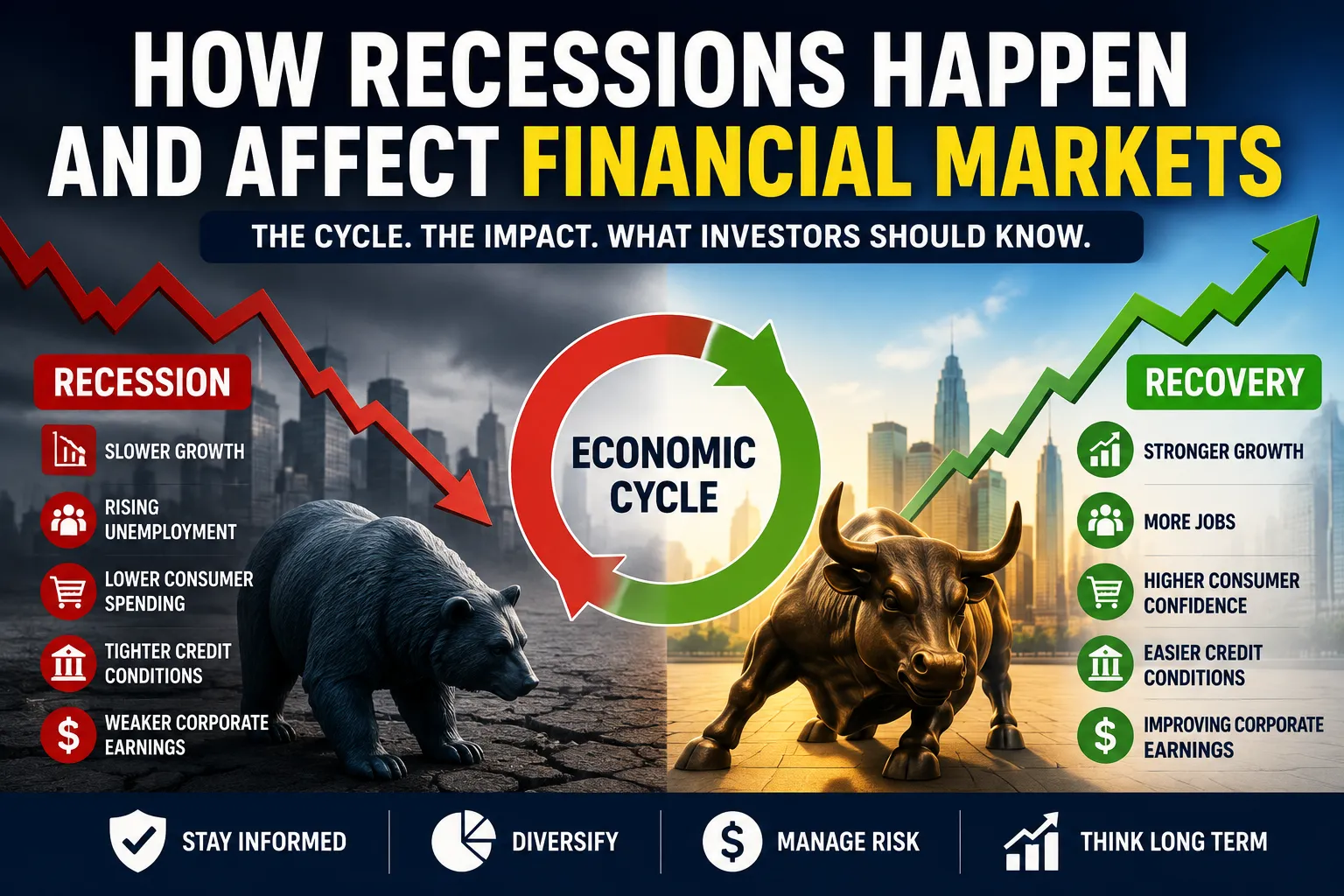
The Economic Cycle Is a Process, Not a Single Event
Recessions generally develop through a series of interconnected changes rather than one simple trigger.
Higher interest rates can slow borrowing. Reduced borrowing can weaken spending and investment. Lower demand can pressure corporate revenues. Weaker profits can affect employment. Falling employment can further reduce household spending.
Financial markets respond to these developments, but they also respond to expectations about what comes next.
That is why stocks can fall before a recession is officially recognized and recover before economic statistics show a strong rebound.
Understanding the Cycle Can Make Economic News Easier to Read
Recessions are complicated because they involve millions of decisions made by households, businesses, investors and policymakers.
For individuals, the most useful approach is rarely trying to predict the exact month a recession will begin or end. A stronger strategy is to build financial resilience before conditions deteriorate.
That can mean maintaining an appropriate emergency fund, managing high-cost debt, diversifying investments and avoiding decisions driven entirely by short-term market fear.
Recessions are a normal part of economic cycles, but their effects are never identical. Understanding how employment, spending, interest rates, corporate profits and financial markets interact can help investors and households make sense of downturns—and recognize why the financial markets may begin looking toward recovery long before the broader economy appears fully healed.