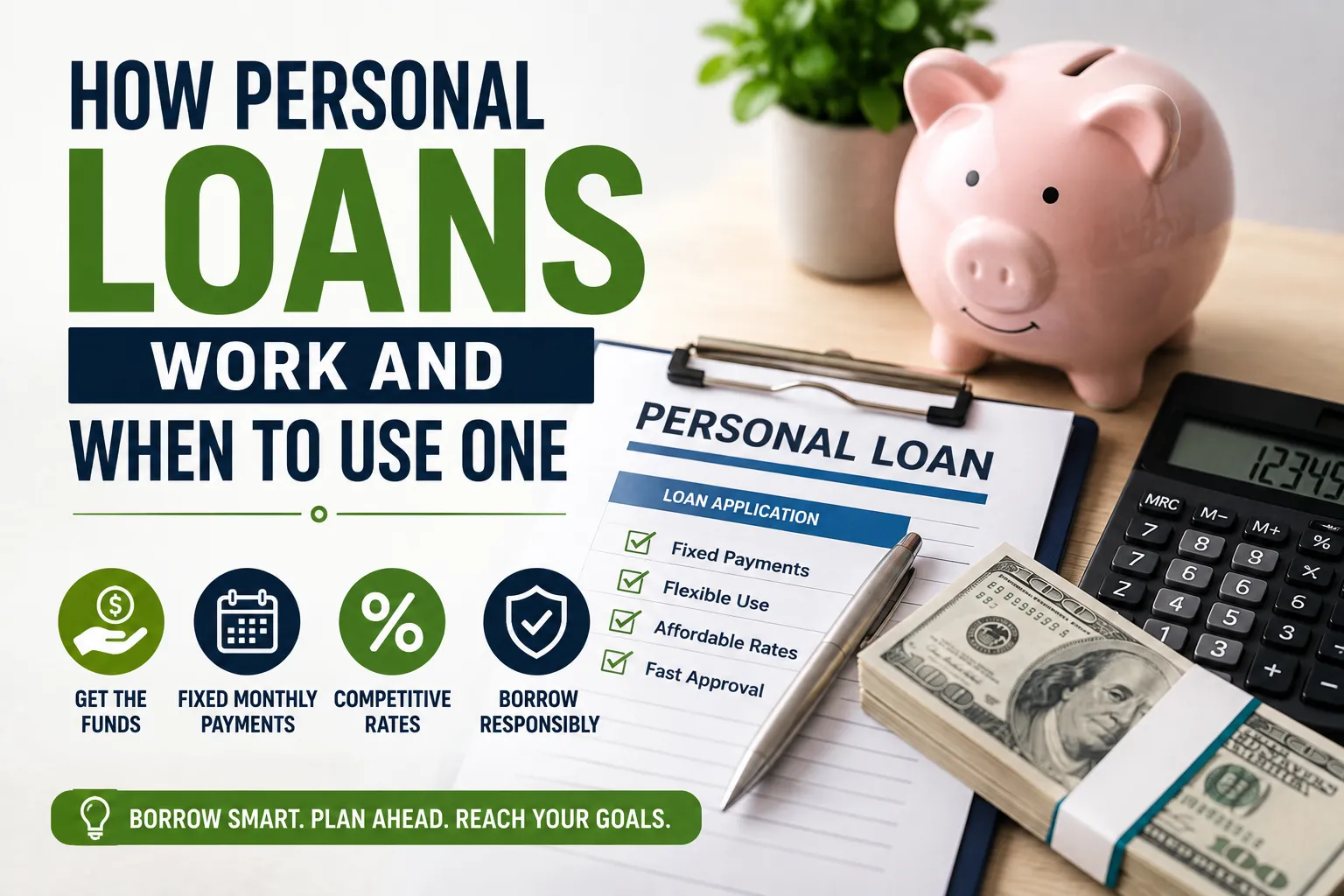
How Personal Loans Work and When to Use One
Personal loans can provide access to money when a household needs to cover a major expense, consolidate debt or manage an unexpected financial need.
Unlike a mortgage or auto loan, which are typically tied to a specific purchase, a personal loan can often be used for a wide range of purposes. That flexibility makes personal loans useful in some situations, but it can also make them tempting to use for expenses that may not justify taking on additional debt.
Understanding how personal loans work, what they cost and when borrowing makes financial sense can help consumers make more informed decisions.
For a broader overview of borrowing, debt and credit-related financial tools, see the Complete Guide to Credit Tools.
What Is a Personal Loan?
A personal loan is a form of installment credit in which a lender provides a borrower with a specific amount of money upfront.
The borrower then repays the loan over an agreed period through regular payments that generally include both principal and interest.
For example, someone might borrow money for:
- Home improvements
- Debt consolidation
- A major household expense
- Education-related costs
- A large purchase
- An unexpected expense
- Certain medical or family expenses
The exact uses allowed depend on the lender and the loan agreement.
Personal loans are generally different from revolving credit such as credit cards because the borrower receives a fixed amount and follows a predetermined repayment schedule.
How Does a Personal Loan Work?
The process typically begins with an application.
The lender may evaluate factors such as:
- Income
- Employment
- Existing debts
- Credit history
- Credit score or equivalent credit information
- Loan amount requested
- Repayment period
Based on this information, the lender determines whether to approve the application and, if so, the terms offered.
Those terms can include the interest rate, loan amount, repayment period and applicable fees.
Once approved, the borrower receives the funds and begins making scheduled payments.
Secured vs. Unsecured Personal Loans
Personal loans can generally be divided into two broad categories: secured and unsecured.
Unsecured Personal Loans
An unsecured loan does not require a specific asset to serve as collateral.
Approval is therefore generally based more heavily on the borrower’s creditworthiness, income and overall financial profile.
Because the lender does not have a specific asset securing the debt, the interest rate may be higher for borrowers considered more risky.
Secured Personal Loans
A secured loan is backed by an asset or other form of collateral.
If the borrower fails to meet the agreement, the lender may have rights to the collateral, subject to the applicable laws and loan terms.
Secured borrowing can sometimes offer more favorable rates because the lender has additional protection, but it also introduces the risk of losing the pledged asset.
How Interest Works on a Personal Loan
Interest is the cost of borrowing money.
Suppose a borrower takes out a loan of $10,000 with an annual interest rate of 10%. The borrower will repay more than the original $10,000 because interest is charged for providing access to the money.
The actual cost depends on factors including:
- Interest rate
- Loan balance
- Repayment period
- Payment schedule
- Fees
A loan with a lower interest rate is not automatically cheaper if it comes with significant fees or a much longer repayment period.
That is why borrowers should look at the total cost of borrowing, rather than focusing only on the advertised interest rate.
Fixed-Rate Loans Can Make Payments Predictable
Many personal loans use fixed interest rates.
With a fixed-rate loan, the interest rate generally remains unchanged throughout the repayment period.
This can make monthly payments easier to plan for because the borrower has a clearer idea of how much will be owed each month.
Predictability can be particularly useful for household budgeting.
However, borrowers should still check the loan agreement carefully because fees, payment structures and other terms can vary between lenders.
Variable Rates Can Change Borrowing Costs
Some loans may have interest rates that can change over time.
If the rate rises, the cost of borrowing may increase.
If the rate falls, the borrower could potentially pay less interest, depending on the loan’s terms.
Variable-rate borrowing therefore introduces more uncertainty into future payments.
Consumers considering such a loan should understand exactly what causes the rate to change and whether there are limits on how much it can increase.
The Loan Term Affects the Total Cost
The loan term is the length of time the borrower has to repay the loan.
A longer repayment period can reduce the required payment amount because the balance is spread over more months.
However, a longer term can also result in paying more interest over the life of the loan.
For example, a borrower might find a five-year loan easier to manage each month than a three-year loan, but the longer repayment period could increase the total amount paid.
The right term therefore involves balancing monthly affordability against total borrowing costs.
Monthly Payment Is Not the Same as Loan Cost
A common mistake is choosing a loan based primarily on whether the monthly payment looks affordable.
Consider two loans for the same amount.
One might require a higher monthly payment but be repaid much faster.
Another might have a lower monthly payment but remain outstanding for several additional years.
The second option can look cheaper while actually costing more in interest.
Before accepting a loan, consider both:
“Can I comfortably afford the monthly payment?”
and
“How much will I pay altogether?”
Both questions matter.
What Is a Personal Loan Fee?
Interest is not necessarily the only cost associated with borrowing.
Depending on the lender and market, personal loans may include fees such as:
- Origination or processing fees
- Application fees
- Late-payment fees
- Early-repayment charges
- Administrative fees
- Other service charges
Some fees may be deducted from the amount you receive.
For example, if you are approved for a $10,000 loan but the lender charges a processing fee before disbursing the money, the amount that actually reaches your account could be less than $10,000.
Always check how fees affect the amount received and the total repayment cost.
When a Personal Loan Can Make Sense
A personal loan can be useful when the borrowing serves a clear financial purpose and the repayment fits comfortably within the household budget.
Consolidating Expensive Debt
Debt consolidation is one common reason people consider personal loans.
A borrower with several high-interest debts may use a lower-cost personal loan to combine some of those balances into one payment.
The strategy can simplify repayment and potentially reduce interest costs.
However, consolidation only works financially if the new loan is genuinely less expensive and the borrower avoids rebuilding the old debt. Before making this decision, it can also help to understand how to manage household debt and pay off multiple debts.
Funding Necessary Home Improvements
A personal loan can sometimes help finance necessary home repairs or improvements.
Examples might include repairing a damaged roof, replacing essential systems or addressing a major maintenance problem.
Borrowing for a necessary repair can be more reasonable than allowing a problem to become substantially more expensive.
That does not mean every renovation should be financed with debt.
Cosmetic projects and luxury upgrades should be evaluated more carefully.
Managing a Large Unexpected Expense
Life can produce expenses that are difficult to cover from a normal monthly budget.
A personal loan may provide a source of funds when an important expense cannot reasonably be postponed.
However, borrowing should generally be considered alongside other options, such as emergency savings, payment plans or negotiating the expense.
Financing an Expense With a Long Useful Life
Borrowing can be easier to justify when the expense provides value over many years.
For example, an improvement that solves a major household problem may offer more lasting value than borrowing for a short-lived discretionary purchase.
The key question is not simply whether the purchase is useful.
It is whether taking on debt to pay for it is financially sustainable.
When a Personal Loan May Not Be a Good Idea
Personal loans can also create unnecessary financial pressure.
Borrowing deserves particular caution when it is being used to finance expenses that are:
- Impulsive
- Recurring
- Unnecessary
- Easily postponed
- Primarily for entertainment
- Beyond the household’s ability to repay
Taking out a loan to pay ordinary monthly bills can be a warning sign.
If income consistently fails to cover essential expenses, adding another monthly payment may make the underlying problem worse.
Be Careful About Borrowing for Everyday Spending
A personal loan can provide temporary relief when cash flow is tight.
But if the money is being used repeatedly for groceries, utilities or other routine expenses, the household may be dealing with a structural budget problem rather than a one-time need.
Loans are generally better suited to identifiable expenses with a defined cost and repayment plan.
Using new debt to cover an ongoing shortfall can lead to a cycle in which one loan is followed by another.
Personal Loans and Credit Scores
Applying for credit can affect a borrower’s credit profile, although the exact impact depends on the credit-reporting system and lender practices.
Once a loan is approved, making payments on time can help demonstrate responsible credit management where repayment behavior is reported to credit bureaus.
Missed or late payments, on the other hand, can damage a borrower’s credit standing and may lead to additional charges.
This makes payment reliability particularly important.
Before taking a personal loan, borrowers should make sure the required payment can be comfortably incorporated into their monthly budget.
Compare Lenders Before Borrowing
Personal loan terms can differ considerably between lenders.
Instead of accepting the first offer, compare factors such as:
- Interest rate
- Total repayment amount
- Loan term
- Fees
- Monthly payment
- Early repayment terms
- Late-payment consequences
- Eligibility requirements
A loan with a slightly lower interest rate may not necessarily be the best option if it has substantially higher fees.
Looking at the complete cost provides a better basis for comparison.
Don’t Borrow More Than You Need
A lender may approve a larger amount than you originally planned to borrow.
That does not mean you should take the full amount.
Borrowing more creates a larger balance and potentially more interest.
If the actual expense is $5,000, borrowing $10,000 simply because the lender offers it increases the amount that must eventually be repaid.
A useful principle is to borrow only what is necessary for the specific purpose.
Calculate the Payment Before Applying
Before submitting an application, estimate whether the expected payment fits your budget.
Start with monthly take-home income and subtract:
- Housing
- Food
- Transportation
- Utilities
- Insurance
- Existing debt payments
- Savings contributions
- Other regular expenses
Then consider the proposed loan payment.
Do not judge affordability solely by whether there is technically enough money left over.
A household also needs room for unexpected expenses and changes in income.
For more detailed repayment planning, a Complete Guide to Loan Calculators can help explain how payment amounts, loan terms and total borrowing costs can be compared.
Consider Your Debt-to-Income Position
Your existing debt obligations can influence both loan approval and financial stress.
Someone already making several large monthly debt payments may have less flexibility for another loan.
Before borrowing, calculate how much of your income is already committed to debt.
If adding another payment would leave very little room for emergencies or normal household expenses, the loan may not be affordable even if a lender approves it.
What Happens If You Miss Payments?
Failing to make loan payments can have several consequences.
Depending on the loan agreement and applicable laws, the borrower could face:
- Late fees
- Additional interest or charges
- Negative credit reporting
- Collection activity
- Legal action
- Loss of collateral on secured loans
The consequences can become more serious as missed payments accumulate.
If you realize you may not be able to make a payment, contacting the lender early is generally better than simply ignoring the problem.
Personal Loans Are Not Free Money
The simplicity of receiving a lump sum can make borrowing feel easier than it actually is.
The money in your account may be available immediately, but it represents a future obligation.
Every dollar borrowed must ultimately be repaid according to the agreement, usually with interest and potentially additional fees.
Thinking about the loan as future income already spent can help put the decision into perspective.
Questions to Ask Before Taking a Personal Loan
Before borrowing, ask yourself:
- Why do I need this money?
- Is the expense necessary?
- Could I pay for it by saving instead?
- Do I have an emergency fund?
- What is the total cost of the loan?
- What interest rate am I being offered?
- Are there additional fees?
- How long will I be making payments?
- Can I comfortably afford the payment if my expenses increase?
- What happens if my income falls?
If the answers reveal significant financial strain, postponing the loan may be wiser.
Alternatives to a Personal Loan
Borrowing is only one option.
Depending on the situation, alternatives may include:
Using Emergency Savings
If the expense is genuinely unexpected and you have sufficient savings, using part of your emergency fund may cost less than taking on interest-bearing debt.
However, avoid draining savings completely if doing so would leave you unable to handle another emergency.
Saving Before Making the Purchase
If the expense is not urgent, saving first eliminates borrowing costs.
This may require waiting, but it also removes the monthly repayment obligation.
Negotiating a Payment Plan
Some providers may offer installment arrangements for large expenses.
Compare the total cost and terms with those of a personal loan before choosing.
Reducing the Size of the Purchase
Sometimes the simplest alternative is to spend less.
A smaller project, used item or lower-cost option may eliminate the need to borrow.
How to Use a Personal Loan Responsibly
If borrowing makes sense, responsible use starts with having a specific purpose and repayment strategy.
Know exactly how much you need, understand the loan’s full cost and make sure the payment fits comfortably into your budget.
It can also help to avoid taking on additional unnecessary debt while repaying the loan.
Most importantly, keep the reason for borrowing in view.
A personal loan should solve a defined financial need rather than become a way to permanently spend beyond your income.
The Right Loan Is One You Can Repay Without Losing Financial Flexibility
Personal loans can be useful financial tools when they are used thoughtfully.
They can help households handle major expenses, consolidate costly debt or address unexpected needs without requiring the borrower to pay the entire expense upfront.
But flexibility comes with responsibility.
The real cost of a personal loan includes more than the amount deposited into a bank account. Interest, fees, repayment length and the effect of another monthly obligation on the household budget all matter.
Before borrowing, focus on the purpose of the loan, total repayment cost and ability to make every payment comfortably.
A personal loan makes the most sense when it addresses a genuine need, the terms are reasonable and the resulting debt remains manageable. When those conditions are missing, saving, reducing the expense or finding another solution may leave the household in a stronger financial position.