How Economic and Financial Market Cycles Work
Economic and financial markets rarely move in a straight line.
Periods of strong growth can eventually give way to slower activity. Businesses may expand rapidly, consumers may spend more confidently and investors may push asset prices higher. Later, demand can weaken, corporate profits may slow, borrowing can become more difficult and markets may fall.
These recurring patterns are commonly described as economic cycles and financial market cycles.
Understanding how they work can help explain why interest rates change, why unemployment rises and falls, why stock markets sometimes experience prolonged declines and why investors often behave differently at different stages of the economic cycle.
Although no two cycles are identical, they tend to share several recognizable characteristics.
For a broader framework for understanding the data used to track these changes, see this complete guide to economic indicators.
What Is an Economic Cycle?
An economic cycle describes the recurring pattern of expansion and contraction in economic activity.
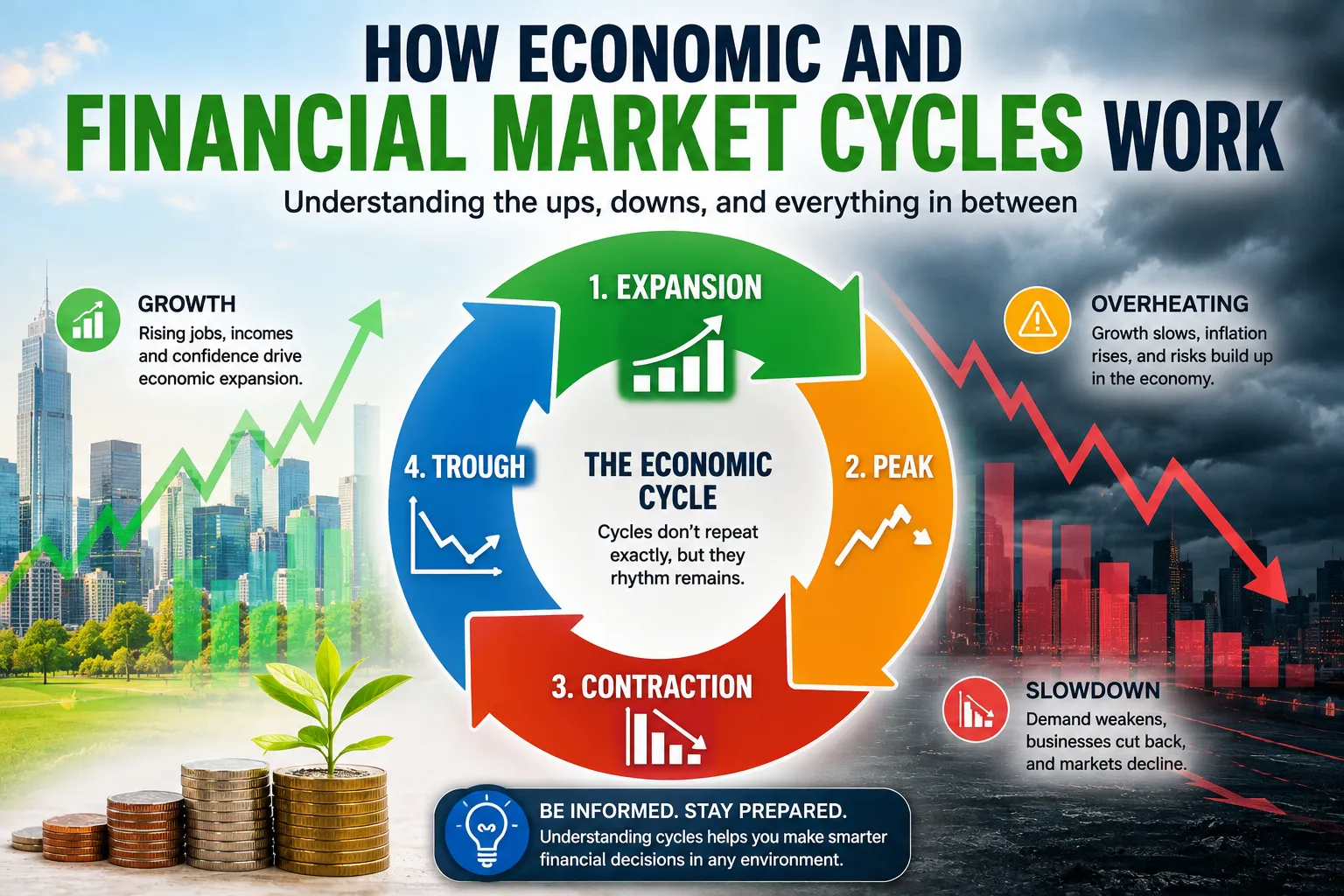
The cycle is often divided into four broad stages:
- Expansion
- Peak
- Contraction
- Trough
The economy then begins recovering and moves into another expansion.
These stages are not perfectly predictable, and they do not always occur with the same duration or intensity.
An economic expansion might last several years, while a downturn could be relatively short or develop into a severe recession.
The Four Main Stages of the Economic Cycle
1. Expansion
An expansion occurs when economic activity is generally increasing.
Businesses may experience stronger demand, leading them to:
- Increase production
- Hire more workers
- Invest in equipment
- Open new locations
- Increase inventories
- Develop new products
Consumers may also become more confident and increase spending.
As businesses earn more revenue and employment improves, household incomes can rise, creating additional demand.
This can produce a reinforcing cycle:
More employment → higher income → greater spending → stronger business revenue → more hiring and investment.
2. Peak
Eventually, economic growth can reach a point where it begins to lose momentum.
The economy may still be growing, but the pace of expansion can slow.
At this stage:
- Labor markets may be tight
- Businesses may face higher costs
- Capacity may become constrained
- Inflationary pressure may increase
- Interest rates may be relatively high
- Consumers may begin becoming more cautious
The peak represents a transition rather than a single moment that everyone can identify immediately.
Economists often recognize a peak only after subsequent data show that economic activity has begun to decline.
3. Contraction
A contraction occurs when economic activity weakens.
Businesses may experience lower demand and respond by:
- Reducing production
- Delaying investments
- Cutting expenses
- Slowing hiring
- Reducing inventories
If the slowdown becomes sufficiently broad and persistent, the economy may enter a recession.
Consumers may also become more cautious, particularly if unemployment increases or household finances deteriorate.
4. Trough
The trough represents the point at which economic activity reaches its lowest level before beginning to recover.
The economy may then stabilize.
Businesses begin responding to improving conditions, consumers regain confidence and investment can gradually increase.
This marks the beginning of a new expansion.
What Causes Economic Cycles?
Economic cycles do not have one universal cause.
They can result from combinations of changes in:
- Consumer spending
- Business investment
- Interest rates
- Credit availability
- Government spending
- Taxes
- Inflation
- Productivity
- Employment
- Housing activity
- Commodity prices
- International trade
- Financial conditions
- Consumer and business confidence
External shocks can also disrupt economic activity.
Examples include major natural disasters, financial crises, geopolitical disruptions, pandemics or sudden changes in energy prices.
The Role of Consumer Spending
Consumer spending is an important part of many economies.
When households feel financially secure, they may spend more on:
- Housing
- Cars
- Restaurants
- Travel
- Electronics
- Clothing
- Entertainment
- Services
Businesses respond to stronger demand by producing more goods and services.
If consumers become concerned about employment or their financial situation, they may increase savings and reduce discretionary spending.
That can weaken business revenue and slow economic growth.
The relationship between confidence, spending and saving is explored in what falling consumer confidence could mean for household spending and saving.
Business Investment Can Amplify the Cycle
Businesses do not simply respond to current economic conditions. They also make decisions based on what they expect to happen next.
During periods of optimism, companies may invest heavily in:
- Buildings
- Machinery
- Technology
- Research
- Employees
- Inventory
This investment supports economic growth.
But when businesses become pessimistic, they may postpone expansion.
A company that expects weak demand may decide not to build a new factory or purchase additional equipment.
If many businesses make similar decisions, investment can decline across the economy.
How Interest Rates Influence Economic Cycles
Interest rates are one of the most important links between monetary policy and economic activity.
When borrowing costs are low, households and businesses may find it easier to finance spending and investment.
Lower rates can encourage:
- Home purchases
- Business expansion
- Equipment investment
- Consumer borrowing
- Refinancing
When inflation becomes too persistent, central banks may raise interest rates to reduce demand.
Higher borrowing costs can discourage some spending and investment.
The effect is not always immediate.
Monetary policy can take time to influence households, businesses and financial markets.
For a deeper look at this relationship, see how monetary policy affects financial markets.
Why Inflation Often Changes During the Cycle
Inflation can behave differently at different points in the economic cycle.
During a strong expansion, demand may grow faster than businesses can comfortably supply goods and services.
Businesses may face:
- Higher labor costs
- Higher material costs
- Supply constraints
- Stronger consumer demand
They may respond by raising prices.
As economic activity slows, demand pressures can ease.
However, inflation does not automatically fall whenever growth weakens. Supply disruptions, energy prices, currency movements and other factors can continue influencing prices.
What Is a Financial Market Cycle?
A financial market cycle describes the rise and fall of asset prices and investor sentiment over time.
Financial markets can include:
- Stocks
- Bonds
- Real estate
- Commodities
- Currencies
- Credit markets
Market cycles often overlap with economic cycles, but they are not the same thing.
Financial markets are forward-looking.
Investors buy and sell assets based partly on what they expect the economy, corporate profits and interest rates to look like in the future.
As a result, markets can turn upward before the economy improves and decline before economic data officially show a recession.
The Typical Stock Market Cycle
A simplified stock market cycle can be described as:
Accumulation → Markup → Distribution → Decline
These stages reflect changes in investor expectations and sentiment.
Accumulation
After a major decline, some investors begin buying assets they believe are undervalued.
Economic conditions may still be weak.
Corporate profits may still be under pressure.
News may remain negative.
But investors who believe conditions will eventually improve begin positioning themselves early.
Markup
As economic expectations improve, more investors may become optimistic.
Stock prices rise.
Positive earnings reports can reinforce confidence.
More buyers enter the market, creating additional momentum.
Eventually, rising prices themselves can attract further investors.
Distribution
At some point, optimism may become excessive.
Investors who bought earlier begin taking profits.
Some businesses may still be performing well, but valuations can become increasingly dependent on strong future growth.
The market may become more sensitive to disappointing news.
Decline
When expectations deteriorate significantly, selling can accelerate.
Possible triggers include:
- Recession fears
- Rising interest rates
- Falling corporate profits
- Financial stress
- Geopolitical shocks
- Excessive valuations
Declines can sometimes become self-reinforcing as investors become more fearful.
Why Markets Can Fall Before a Recession
Financial markets are generally forward-looking.
Imagine investors expect corporate profits to decline six months from now.
They may begin selling stocks today.
Stock prices can therefore fall while economic data still look relatively strong.
Conversely, markets can begin rising while unemployment remains high because investors anticipate an eventual recovery.
This explains why stock-market performance and economic statistics do not always move together month by month.
The Relationship Between Stocks and the Economy
Corporate profits are influenced by economic activity.
When businesses sell more goods and services, revenue can increase.
If costs are controlled, profits may also rise.
Higher expected profits can support higher stock valuations.
But stock prices depend on more than current profits.
Investors also consider:
- Future earnings
- Interest rates
- Risk
- Growth expectations
- Valuations
- Investor sentiment
- Competition
- Government policy
This is why a strong economy does not guarantee rising stock prices.
How Bonds Behave During Economic Cycles
Bond markets also respond to changing economic conditions.
Bond prices and yields generally move in opposite directions.
When bond yields rise, existing bonds with lower fixed rates can become less attractive, causing their market prices to fall.
Interest-rate expectations therefore play a major role in bond markets.
During periods when investors expect weaker economic growth or lower future interest rates, demand for certain government bonds may increase.
During strong growth or rising-inflation environments, investors may demand higher yields.
Why Yield Curves Matter
The relationship between short-term and long-term interest rates is often called the yield curve.
A normal yield curve generally has longer-term rates above shorter-term rates because investors typically demand additional compensation for lending money over longer periods.
Sometimes short-term rates rise above long-term rates.
This is known as an inverted yield curve.
Market participants often monitor inversions because they have historically appeared before some recessions.
However, an inverted yield curve does not guarantee that a recession will occur, nor does it reliably identify exactly when one will begin.
The Role of Credit in Economic Cycles
Credit can amplify economic expansions and contractions.
During favorable conditions, banks and other lenders may become more willing to provide financing.
Businesses can borrow to expand.
Consumers can finance major purchases.
Investors can access additional capital.
This can increase economic activity.
But excessive borrowing can create vulnerabilities.
If economic conditions deteriorate, borrowers may struggle to repay their debts.
Lenders may then become more cautious, making credit harder to obtain.
That can further weaken spending and investment.
This dynamic is sometimes described as a credit cycle.
The Housing Market and Economic Cycles
Housing is closely connected to economic conditions.
When mortgage rates are low and household incomes are growing, demand for homes may increase.
This can support:
- Home construction
- Furniture sales
- Appliance purchases
- Renovation activity
- Real estate services
When mortgage rates rise or household confidence weakens, housing activity can slow.
Because housing purchases involve large amounts of money, changes in the housing market can have broader economic consequences.
Why Sentiment Matters
Economic decisions are not based entirely on current income or prices.
Expectations matter.
Consumers who feel confident about their financial future may be more willing to make major purchases.
Businesses that expect strong demand may invest more aggressively.
Investors who expect economic improvement may buy riskier assets.
When confidence falls, the opposite can happen.
This is why sentiment can sometimes reinforce economic cycles.
The Role of Employment
Employment is one of the most important indicators of household financial health.
During an expansion, businesses generally need more workers.
Employment rises and unemployment tends to decline.
During a downturn, businesses may reduce hiring or cut jobs.
Rising unemployment can weaken consumer spending, which can further reduce business demand.
However, employment indicators can also lag behind changes in economic activity.
Companies may initially reduce hiring before laying off existing workers.
Similarly, employers may continue hiring even after other areas of the economy begin weakening.
Why Productivity Matters
Economic growth is not driven solely by more workers.
Productivity—the amount of output produced from a given amount of labor and other inputs—also matters.
When productivity improves, businesses may be able to produce more efficiently.
Productivity gains can support:
- Higher output
- Higher wages over time
- Improved business profitability
- Lower production costs
- Greater economic growth
Strong productivity growth can therefore influence the long-term economic cycle by increasing the economy’s productive capacity.
Government Policy Can Influence Cycles
Governments can influence economic conditions through fiscal policy.
This includes:
- Government spending
- Tax policy
- Transfers
- Infrastructure investment
- Public-sector programs
During a severe downturn, governments may introduce measures intended to support demand.
During periods of strong demand and inflation, fiscal policy may have a different effect depending on its design.
Government policy can therefore influence both the pace and distribution of economic activity.
The relationship between government spending, taxation and economic activity is explained in fiscal policy, government spending, and taxes.
Central Banks and the Business Cycle
Central banks attempt to influence economic conditions primarily through monetary policy.
Depending on the country and institutional framework, they may adjust:
- Policy interest rates
- Liquidity conditions
- Asset purchases or sales
- Other monetary-policy tools
When inflation is too high, policymakers may tighten financial conditions.
When economic activity is weak and inflation is sufficiently controlled, policymakers may have more room to support demand.
The challenge is that policy decisions affect the economy with delays and uncertainty.
Why Every Cycle Looks Different
Economic cycles follow no perfectly repeatable schedule.
One expansion may end because of financial instability.
Another may weaken because inflation forces interest rates higher.
Another could be disrupted by an external shock.
Similarly, recoveries can differ significantly.
Some are powered by consumer spending.
Others are driven by business investment, exports, government spending or technological improvements.
This makes historical patterns useful for understanding economic behavior, but unreliable as precise forecasting tools.
Market Cycles Can Be Driven by Valuations
Investor sentiment is important, but valuation also matters.
Suppose two companies generate identical profits.
If investors are willing to pay much more for one company’s shares, its stock may have a higher valuation.
High valuations can make an asset more sensitive to disappointing news because investors have already priced in substantial future growth.
Lower valuations may provide more room for positive surprises, although low valuations can also reflect serious underlying problems.
The Difference Between Cyclical and Defensive Businesses
Some companies are particularly sensitive to economic conditions.
These are often described as cyclical businesses.
Examples can include companies involved in:
- Automobiles
- Travel
- Luxury goods
- Construction
- Certain industrial products
When economic conditions improve, demand can rise significantly.
When conditions deteriorate, consumers and businesses may cut these purchases.
Other industries provide products and services people continue to need regardless of the economic environment.
These are often described as defensive sectors.
Examples may include certain areas of:
- Healthcare
- Consumer staples
- Utilities
The distinction is not absolute, but it helps explain why different parts of the stock market can behave differently during economic cycles.
Why Diversification Matters Across Cycles
Different investments can perform differently at different points in a cycle.
For example:
- Some stocks may benefit from strong economic growth.
- Certain bonds may become more attractive when interest rates decline.
- Cash can provide stability and liquidity.
- Some commodities may respond to inflation or supply disruptions.
- Real estate can be sensitive to interest rates and economic activity.
Diversification can reduce dependence on one particular economic outcome.
It does not eliminate investment risk, but it can help prevent a portfolio from being excessively exposed to a single scenario.
Don’t Try to Predict Every Turning Point
Economic cycles are difficult to time precisely.
Even professional economists and investors can disagree about whether an economy is approaching a peak, entering a slowdown or beginning a recovery.
There is a difference between recognizing broad economic conditions and predicting the exact month when markets will turn.
Investors who constantly attempt to buy at the exact bottom and sell at the exact top can end up making decisions based on fear and short-term market movements.
Long-Term Investors Can Think in Cycles
A long-term investor may benefit from understanding cycles without trying to predict every movement.
The key questions can include:
- How diversified is the portfolio?
- Is the investment horizon long enough to tolerate volatility?
- How much risk is appropriate?
- Is there enough emergency cash outside the investment portfolio?
- Are investments based on a clear strategy?
- Has the portfolio become overly concentrated?
Thinking in these terms can be more useful than trying to forecast every economic headline.
Common Misconceptions About Economic Cycles
“Every Recession Is the Same”
It isn’t.
Recessions can have different causes, durations and effects.
“Markets Always Fall During Recessions”
Markets can decline before a recession and may begin recovering before the economy reaches its weakest point.
“A Strong Economy Always Means a Strong Stock Market”
Stock prices depend on expectations, valuations, interest rates and corporate profits, not just current economic growth.
“Interest Rate Cuts Always Make Stocks Rise”
Rate cuts can sometimes support asset prices, but the reason rates are being cut matters.
Cuts made because inflation is falling while growth remains healthy can be viewed differently from emergency cuts made because the economy is deteriorating rapidly.
“Cycles Can Be Predicted Precisely”
Economic indicators can provide clues, but there is no reliable calendar that tells investors exactly when every cycle will turn.
Indicators That Can Help Track the Cycle
Economists and investors monitor many indicators.
These can include:
Leading Indicators
These are designed to provide signals about future economic activity.
Examples can include:
- New orders
- Building permits
- Financial conditions
- Consumer expectations
- Stock-market trends
Coincident Indicators
These tend to move alongside current economic conditions.
Examples include:
- Employment
- Income
- Industrial production
- Retail activity
Lagging Indicators
These tend to change after broader economic conditions have already shifted.
Examples can include:
- Certain unemployment measures
- Business inventories
- Some lending indicators
No single indicator provides a complete picture.
A Simple Way to Think About the Entire Cycle
The relationship between the economy and markets can be summarized as a chain:
Economic conditions → business revenue → corporate profits → investor expectations → asset prices
But the process also works in reverse.
Financial conditions → borrowing costs → investment and spending → economic activity
This creates a feedback system in which the real economy and financial markets influence each other.
That is one reason economic cycles can become powerful and sometimes difficult to predict.
Understanding the Cycle Without Chasing It
Economic and financial market cycles are best understood as recurring patterns rather than predictable schedules. Expansions can produce stronger employment, spending and investment, while contractions can bring weaker demand, declining business confidence and financial stress. Markets respond to these conditions, but they also respond to expectations about what may happen next.
The most important distinction is that the economy and financial markets are connected but not identical. A recession does not automatically mean stocks will continue falling, just as strong economic growth does not guarantee that every asset will rise.
For households and investors, understanding these cycles can provide useful context without requiring constant attempts to forecast the next turning point. Building financial resilience, maintaining appropriate diversification, managing debt carefully and matching investments to long-term goals can be more valuable than trying to predict exactly when the next peak or trough will arrive.
Economic cycles will continue to change, but the underlying lesson remains consistent: markets move on expectations, economies move through phases, and neither follows a perfectly predictable timetable.