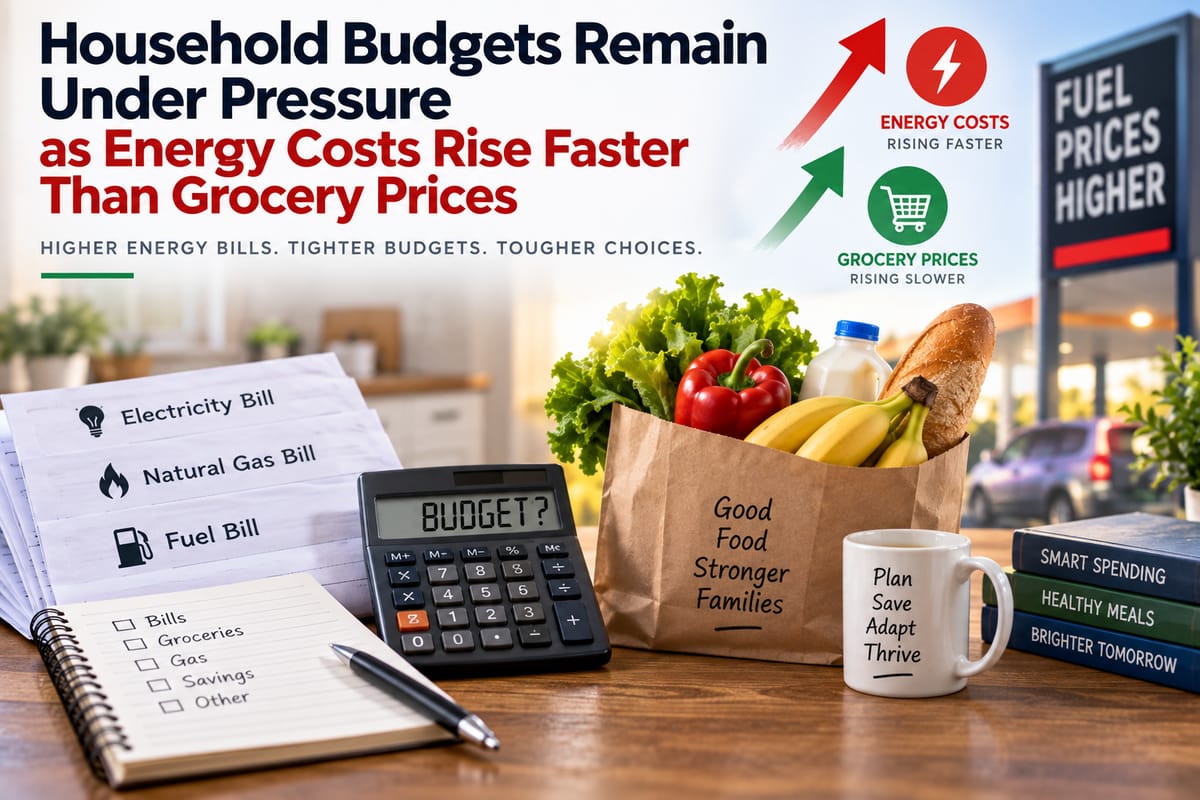
Household Budgets Remain Under Pressure as Energy Costs Rise Faster Than Grocery Prices
Household budgets are facing another source of pressure as energy costs continue to rise substantially faster than grocery prices, leaving families with less room to absorb increases in transportation, heating, cooling and other essential expenses.
The latest U.S. inflation data show just how wide the gap has become. In August 2026, the overall energy index was 16.3% higher than a year earlier, while the food index was up 2.7%. Grocery prices, measured by the food-at-home index, increased just 2.2% over the same period.
Gasoline has been an especially important contributor. Prices at the pump were 27.4% higher than a year earlier in August, while fuel oil prices were up 52%. Electricity increased 3.8% and natural gas rose 4.4% over the same period.
For households already operating with limited financial flexibility, these increases can change the way monthly income is allocated. A larger fuel bill can mean less money available for groceries, savings, debt payments, entertainment or unexpected expenses.
Energy Costs Are Moving Faster Than Grocery Prices
The difference between food and energy inflation has become one of the clearest features of the current household budget environment.
Food prices did increase in August, but only modestly. The overall food index rose 0.1% during the month, while food purchased for consumption at home was unchanged. Over the previous 12 months, food-at-home prices increased 2.2%.
Energy moved in the opposite direction.
The energy index increased 2.1% in August alone after declining during the previous month. Gasoline rose 3.9% during August, accounting for more than one-third of the month’s overall CPI increase.
That creates a different budgeting challenge from traditional grocery inflation.
Families can sometimes respond to higher grocery prices by changing brands, buying in bulk, reducing food waste or substituting less expensive ingredients. Energy expenses can be harder to adjust quickly because households still need to drive to work, transport children, heat or cool their homes and maintain basic utilities.
Gasoline Is Putting Pressure on Transportation Budgets
Gasoline has become one of the most visible sources of household cost pressure.
The August 2026 CPI data show gasoline prices were 27.4% higher than a year earlier and increased 3.9% during the month.
For households that depend heavily on private vehicles, the effect can extend well beyond the amount paid at the gas station.
Higher fuel costs can increase the expense of commuting, school transportation, errands, medical appointments and family activities. They can also affect businesses that pass higher transportation expenses through to consumers.
This makes fuel inflation particularly important for families living far from workplaces, schools or essential services.
A household may have little ability to reduce driving in the short term, meaning a higher gasoline bill can effectively behave like a fixed expense.
The relationship between fuel costs and household finances is explored in more detail in rising fuel prices and monthly budgets, particularly for families trying to balance transportation needs against other monthly obligations.
Household Energy Bills Can Create Seasonal Pressure
Gasoline is only one part of the energy equation.
Households also face electricity, natural gas and other fuel expenses. While these categories have not all increased at the same pace, the August data still showed year-over-year increases across several household energy components.
Electricity prices were 3.8% higher than a year earlier, while natural gas prices increased 4.4%. Fuel oil recorded a much larger 52% annual increase.
The impact can vary significantly by household.
A family in a warm climate may spend more on air conditioning during certain months, while households in colder regions can face substantially higher heating expenses during winter.
Energy efficiency also makes a difference. Older homes, inefficient appliances and poorly insulated buildings can require more energy to provide the same level of comfort.
As a result, two households with similar incomes can experience very different levels of energy-related financial pressure.
Why Grocery Inflation Can Feel Different
Although grocery inflation is currently rising more slowly than energy prices, food remains a major component of household spending.
The August data show food-at-home prices were 2.2% higher than a year earlier. Some categories increased faster than the overall grocery index. Fruits and vegetables were up 3.2%, cereals and bakery products rose 2.6%, and nonalcoholic beverages increased 3.7%.
Other categories moved more slowly. The index for meats, poultry, fish and eggs increased 1.1%, while dairy and related products declined 0.3% over the year.
This means consumers do not experience food inflation as a single uniform increase.
A family may notice significant increases in the specific foods it buys most frequently even when the overall grocery category is rising at a slower rate.
That is one reason household budgeting requires attention to actual spending patterns rather than relying only on national inflation averages.
Inflation Can Affect Different Households in Different Ways
Inflation statistics describe changes across broad groups of consumers, but individual households have their own spending patterns.
Someone who drives a long distance to work may feel gasoline inflation more strongly than someone who works from home. A household with an electric vehicle may have less exposure to gasoline prices but could be more sensitive to electricity costs.
Similarly, a family that spends a large portion of its income on groceries may feel food inflation more strongly than a household with a relatively small food budget.
This is why understanding how inflation affects everyday finances is about more than watching the headline inflation rate.
The important question for a household is how price changes interact with its own income and spending structure.
Rising Essential Costs Can Squeeze Savings
When essential expenses increase faster than income, households often have to decide where the adjustment will occur.
Some families may reduce discretionary spending. Others may temporarily save less, pay down debt more slowly or postpone major purchases.
The problem becomes more serious when there is already little room between monthly income and essential expenses.
A household that was previously putting $300 a month into savings could find that an additional $100 or $150 in transportation and utility costs consumes a substantial portion of that surplus.
The household has not necessarily become less disciplined about saving. Its financial circumstances have simply changed.
Over time, persistent increases in essential costs can therefore make it harder to build emergency savings or make progress toward longer-term financial goals.
Why Household Expenses Can Keep Increasing
Energy is only one piece of the household budget.
Housing, insurance, transportation, healthcare, communications, education and other services can all contribute to the overall cost of maintaining a household.
The August CPI report showed shelter prices were 3.0% higher than a year earlier, while transportation prices increased 6.2%.
This combination creates a more complicated financial environment than a simple comparison between food and energy.
A household may benefit from slower grocery inflation while simultaneously dealing with higher transportation, housing or utility costs.
Understanding why household expenses keep increasing can help put individual price increases into a broader household-finance context.
Budgeting Becomes More Important When Prices Diverge
When every major expense does not rise at the same rate, households need to pay attention to where their money is actually going.
A budget created when gasoline was significantly cheaper may no longer accurately reflect current transportation costs. Similarly, utility estimates based on previous years may underestimate future seasonal bills.
One practical response is to review spending categories periodically rather than treating the original budget as permanent.
Households can compare recent spending with planned amounts and identify categories where costs have changed materially.
That can make it easier to determine whether adjustments are temporary or likely to become part of the household’s new baseline.
Small Adjustments Can Create More Room
Not every response to higher costs has to involve major lifestyle changes.
For transportation, households might combine errands, reduce unnecessary trips, carpool when practical or compare fuel prices. For groceries, meal planning and reducing food waste can help prevent higher prices from turning into unnecessary spending.
Energy bills may offer another opportunity. Adjusting thermostat settings, improving insulation, maintaining HVAC equipment and using more efficient appliances can potentially reduce energy consumption over time.
The key is to distinguish between reducing waste and simply cutting essential spending.
A sustainable household budget should protect important needs while identifying expenses that can be adjusted without creating larger costs elsewhere.
Economic Indicators Help Explain the Bigger Picture
Household budgets do not exist separately from the broader economy.
Inflation, employment, interest rates, wages, energy markets and consumer demand can all influence household finances.
For readers who want a broader understanding of these relationships, a complete guide to economic indicators provides useful context for understanding how economic data can signal changes in prices, employment and overall economic activity.
The August inflation figures provide one example of why looking at several indicators matters.
Overall consumer prices increased 3.4% over the year, while prices excluding food and energy increased 2.4%. At the same time, energy prices were rising much faster than either measure.
That combination tells a more detailed story than the headline inflation number alone.
The Pressure May Be Uneven Through the Rest of the Year
Household financial pressure can change quickly when energy prices move sharply.
Unlike some expenses that change gradually, gasoline prices can respond rapidly to movements in global oil markets, refinery conditions, transportation costs and other factors.
Utility costs can also fluctuate seasonally, creating periods when households face substantially higher bills.
Food prices can move for different reasons, including agricultural conditions, transportation costs, labor expenses and supply-chain developments.
For that reason, households should avoid assuming that one month’s inflation figure will automatically determine their expenses for the rest of the year.
The more useful approach is to monitor actual household spending and maintain enough flexibility to respond when important costs change.
What Households Can Do Now
A period of faster energy inflation does not necessarily require a complete overhaul of a household’s finances.
Instead, families can start by identifying their most sensitive spending categories.
A practical review might include:
- Transportation: Calculate the actual monthly cost of fuel, insurance, maintenance and commuting.
- Utilities: Compare current energy bills with the same period last year.
- Groceries: Track spending by category instead of relying only on the total grocery bill.
- Subscriptions: Review recurring services that may no longer provide enough value.
- Debt: Check whether rising interest costs are consuming more of the monthly budget.
- Savings: Protect an emergency-fund contribution where possible, even if the amount temporarily needs to change.
- Discretionary spending: Identify flexible expenses that can be reduced without affecting essential needs.
The objective is not necessarily to spend as little as possible.
It is to make sure the household understands where its money is going and has a plan for absorbing changes in essential costs.
A More Flexible Household Budget May Be Necessary
The latest inflation figures show why household budgeting cannot remain static.
In August 2026, energy prices were rising dramatically faster than grocery prices, with the energy index up 16.3% over the year compared with 2.7% for food and 2.2% for food purchased at home. Gasoline alone was 27.4% more expensive than a year earlier.
Those figures do not mean every household is experiencing the same financial strain. Spending patterns, income levels, location and energy needs all influence the impact.
But they do show why essential expenses deserve close attention when building a monthly budget.
For families already operating with limited financial room, higher energy costs can quickly compete with groceries, savings and other priorities. A flexible budget that is regularly reviewed can give households more room to respond when one category begins consuming more of their income.
As food inflation moderates relative to energy, the challenge for many households may increasingly be less about one rapidly rising grocery bill and more about managing several essential expenses that continue to put pressure on the same monthly paycheck.