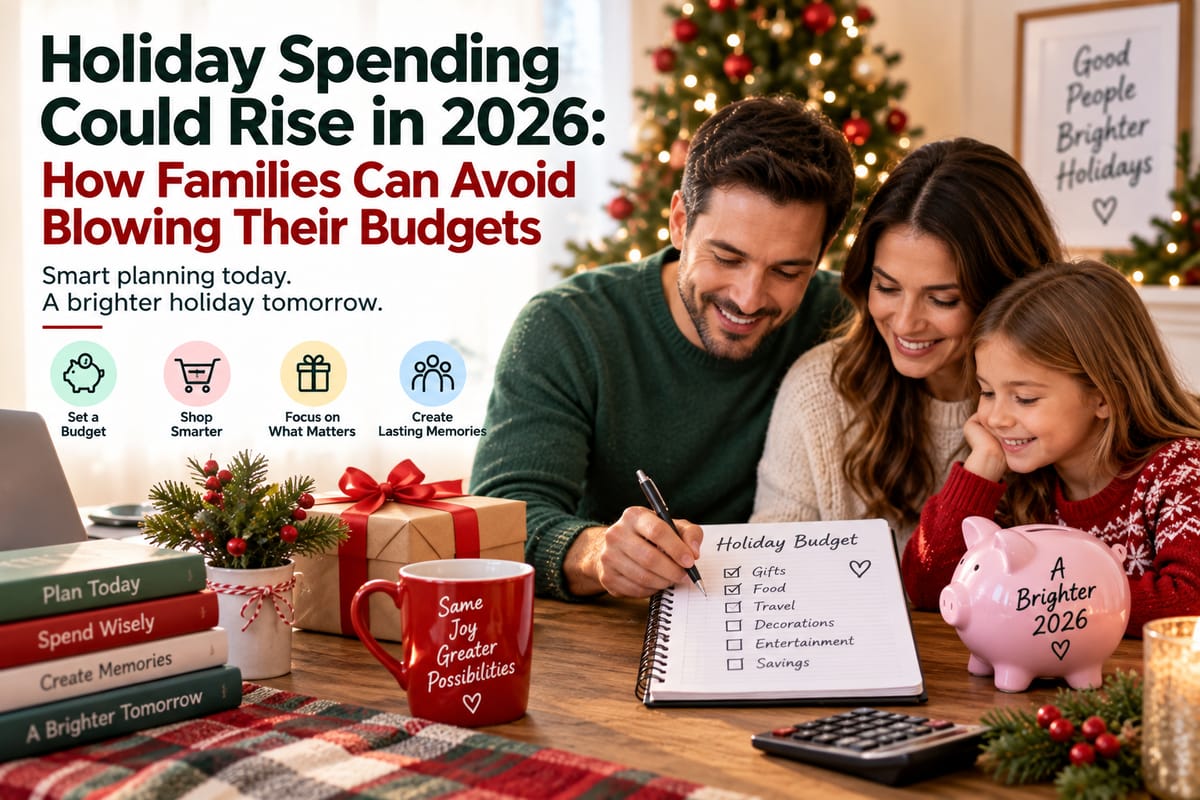
Holiday Spending Could Rise in 2026: How Families Can Avoid Blowing Their Budgets
The holiday season is supposed to be a time for celebration, family, generosity, and memorable experiences. But for many households, it can also become one of the most expensive periods of the year.
With gifts, food, travel, decorations, entertainment, charitable giving, and social events competing for the same household income, holiday spending can quickly exceed what a family originally intended to spend.
That challenge may be particularly important in 2026 as families continue navigating higher everyday costs and an uncertain economic environment. Even when incomes are rising, higher prices can make it surprisingly easy for a seemingly reasonable holiday budget to disappear.
The solution is not necessarily to eliminate the things that make the holidays special. Instead, families can plan earlier, establish realistic limits, prioritize what matters most, and avoid allowing temporary excitement to create financial problems that last into the new year.
Why Holiday Spending Can Get Out of Control
Holiday overspending rarely comes from one enormous purchase.
It often happens through dozens of smaller decisions.
A few extra gifts, a more expensive meal, an additional restaurant visit, upgraded decorations, last-minute shipping, travel expenses, and spontaneous purchases can gradually push spending far beyond the original plan.
There is also an emotional element to holiday shopping.
People may feel pressure to give impressive gifts, keep up with relatives or friends, take advantage of limited-time promotions, or create a memorable experience for their children.
Retailers understand this psychology and design the holiday shopping environment around urgency, convenience, and emotional appeal.
Without a clear spending plan, it becomes easy to confuse wanting something now with being able to afford it.
Start With a Total Holiday Budget
The most important step is to establish one overall holiday spending limit before shopping begins.
Instead of asking, “How much can we spend on gifts?” consider the entire cost of the season.
A household holiday budget might include:
- Gifts
- Food and groceries
- Travel
- Accommodation
- Decorations
- Entertainment
- Holiday clothing
- Charitable donations
- Hosting expenses
- Shipping and delivery
- Cards and wrapping supplies
- School or workplace events
- End-of-year celebrations
- Unexpected holiday expenses
Once the total amount is established, divide it among these categories.
Families that need help creating a broader household spending plan can start with How to Build a Family Budget.
The goal is to make holiday spending part of the household’s financial plan rather than treating it as a completely separate period when normal budgeting rules no longer apply.
Create a Gift List Before You Shop
One of the simplest ways to control holiday spending is to decide who you are buying for before entering a store or opening a shopping app.
Create a list of recipients and establish a spending limit for each person.
For example:
| Recipient | Planned Amount |
|---|---|
| Child 1 | $150 |
| Child 2 | $150 |
| Partner | $200 |
| Parents | $100 |
| Siblings | $75 |
| Friends | $50 |
| Teachers or coworkers | $30 |
The actual amounts will depend entirely on the household’s financial situation.
The important part is that every amount is decided before emotions take over.
If the total is higher than the family can reasonably afford, reduce the limits before shopping begins.
Separate Needs From Holiday Extras
Not every holiday expense has the same financial importance.
Some purchases may be necessary, while others are purely discretionary.
For example, a family may need to buy groceries for a holiday gathering but may not need an expensive collection of decorations.
A child may need a winter coat but not necessarily the most expensive version available.
Separating needs from extras helps families determine where their money should go first.
This approach can also make it easier to cut spending without making the holiday feel completely different.
Use a Spending Cap for Every Category
An overall holiday budget can still fail if there are no limits within individual categories.
Suppose a family has $1,500 available for the holiday season.
If $1,000 is spent on gifts during the first few weeks, there may not be enough remaining for food, travel, or other commitments.
Instead, assign separate limits.
For example:
- Gifts: $700
- Food: $300
- Travel: $250
- Entertainment: $100
- Decorations and supplies: $75
- Miscellaneous: $75
The categories can be adjusted according to each family’s priorities.
The purpose is to prevent one type of spending from consuming the entire budget.
Account for Irregular Holiday Expenses
Some expenses do not happen every month, which makes them easy to overlook.
Travel, annual memberships, holiday events, large family meals, charitable contributions, and seasonal purchases can all fall into this category.
Families can make these costs easier to manage by planning for them before the holiday season arrives.
The principles in How Families Can Budget for Irregular Expenses can also be applied to holiday spending.
The earlier these expenses are identified, the less likely they are to become financial surprises.
Start Saving Before the Holiday Season
Waiting until December to find money for holiday expenses puts unnecessary pressure on a household budget.
A better approach is to save throughout the year.
For example, a family expecting to spend $1,200 on the holidays could set aside approximately $100 per month for 12 months.
Another household might use a different amount based on its income and goals.
The advantage is that holiday spending becomes a planned expense rather than a sudden financial event.
Even small monthly contributions can add up over time.
Be Careful With “Buy Now, Pay Later”
Deferred-payment offers can make expensive purchases appear more affordable than they actually are.
A $400 purchase may seem manageable when divided into several payments, but the household still owes the full amount.
Multiple installment purchases can become particularly dangerous when several are active simultaneously.
Before using a payment plan, ask:
- Can we afford the full purchase without financing?
- What is the total amount we will pay?
- Are there fees or interest charges?
- When are payments due?
- Will these payments overlap with existing obligations?
- Will the purchase still be affordable after the holidays?
If the answer to these questions is unclear, the purchase deserves another look.
Credit Cards Can Make Overspending Easier
Credit cards can be useful financial tools, but holiday shopping can make it easier to spend beyond available cash.
The psychological distance between buying something and actually paying for it can encourage larger purchases.
Families using credit cards for holiday expenses should ideally have a clear repayment plan.
If the balance cannot reasonably be paid off, the true cost of the holiday may become much higher once interest is included.
A festive purchase is rarely worth carrying expensive debt for months afterward.
Look for Value Rather Than the Lowest Sticker Price
Saving money does not always mean buying the cheapest item.
A very inexpensive product that breaks quickly may ultimately cost more than a durable alternative.
Families should consider:
- Quality
- Expected lifespan
- Warranty
- Maintenance costs
- Replacement costs
- Reviews
- Actual usefulness
The goal is to get the most value from the money available.
This is especially important when buying appliances, electronics, children’s equipment, clothing, or other products that are expected to last.
Compare Prices Before Buying
Online shopping has made price comparison much easier, but convenience can also encourage impulse purchases.
Before buying an expensive item, check multiple retailers and compare the complete cost.
Consider:
- Product price
- Shipping
- Taxes
- Delivery charges
- Discounts
- Membership requirements
- Return policies
A product advertised as a major bargain may not actually be the best deal once all costs are considered.
Comparison shopping can also reduce the pressure to purchase immediately.
Be Wary of Fake Urgency
Holiday promotions frequently use phrases such as:
- “Limited time”
- “Only a few left”
- “Ends tonight”
- “Last chance”
- “Biggest sale of the year”
Some offers are genuinely temporary, but urgency can also encourage people to make decisions before thinking about whether they actually need something.
A useful rule is simple:
If you were not planning to buy it before seeing the promotion, pause before purchasing it.
A discount on something you do not need is still money spent.
Reduce Unnecessary Household Spending Before the Holidays
One way to create more room for holiday expenses is to temporarily examine ordinary household spending.
Look for recurring or discretionary expenses that can be reduced without affecting essential needs.
Potential examples include:
- Unused subscriptions
- Frequent restaurant meals
- Impulse online purchases
- Excessive delivery fees
- Entertainment expenses
- Convenience purchases
- Unused memberships
- Expensive brand alternatives
The goal should not be to eliminate every enjoyable expense.
Instead, families can identify spending that provides relatively little value.
For more ideas, see How to Reduce Unnecessary Household Spending.
Set a Food Budget for Holiday Meals
Food can become one of the largest holiday expenses, especially when families host gatherings.
Before shopping, determine:
- How many people are attending
- Which meals will be prepared
- Which ingredients are already available
- What can be prepared in advance
- Which dishes are essential
- What guests can contribute
A detailed shopping list can reduce food waste and prevent unnecessary purchases.
Families can also consider simplifying menus.
A memorable meal does not necessarily require dozens of dishes or expensive ingredients.
Avoid Shopping for Food While Hungry
This familiar advice is particularly useful during the holidays.
Shopping while hungry can make it easier to purchase snacks, desserts, prepared foods, and other items that were not included in the original plan.
Eating beforehand and shopping with a specific list can help keep grocery spending under control.
Consider Shared Meals
Holiday gatherings do not have to place the entire financial burden on one household.
If several families or groups are attending, consider dividing responsibilities.
One person could bring a main dish, another could provide dessert, and another could handle drinks or side dishes.
This can reduce both cost and preparation time while creating a more collaborative experience.
Rethink Expensive Travel
Travel can be one of the biggest holiday expenses.
Transportation, accommodation, meals, luggage, parking, and activities can add up quickly.
Before committing to a trip, calculate the total cost, not just the transportation ticket.
Ask whether the trip fits comfortably within the holiday budget.
If not, consider alternatives such as:
- Traveling for fewer days
- Visiting during less expensive dates
- Staying with relatives
- Choosing a closer destination
- Sharing transportation
- Holding a virtual celebration
- Hosting relatives at home instead
The objective is to create a meaningful holiday without allowing travel costs to create financial stress afterward.
Plan for Major Holiday Purchases
Some families combine holiday spending with large purchases such as televisions, computers, furniture, appliances, or vehicles.
These purchases should not automatically be added to the gift budget.
Instead, they should be evaluated as major financial decisions.
The principles in How Families Can Plan Financially for Major Purchases can help households determine whether a large purchase fits their broader financial goals.
A holiday promotion should not be the only reason a family decides to make an expensive purchase.
Give Experiences Instead of More Things
Not every meaningful gift needs to be a physical product.
Families can consider:
- A special meal
- A day trip
- Tickets to an event
- A museum visit
- A cooking experience
- A family game night
- A weekend activity
- A class
- A shared hobby
Experiences can sometimes be less expensive than buying multiple physical gifts while creating memories that last longer.
The best choice depends on the recipient and the family’s circumstances.
Set Expectations With Children
Children can easily develop unrealistic expectations around holiday spending, particularly when exposed to advertising and social media.
Parents can help by discussing the family’s approach to gifts ahead of time.
This does not require making children responsible for household finances.
Instead, parents can emphasize ideas such as:
- Choosing meaningful gifts
- Appreciating what they already have
- Giving to others
- Spending time together
- Avoiding waste
- Understanding that families have different budgets
These conversations can help reduce pressure to compete with what other children receive.
Consider a Gift Exchange
Large families and groups of friends can dramatically reduce spending by changing how gifts are exchanged.
Instead of everyone buying something for everyone else, each person can purchase one gift for a randomly selected recipient.
A predetermined spending limit keeps the arrangement predictable.
Other alternatives include:
- Homemade gifts
- Group experiences
- Family games
- Books
- Consumable gifts
- Charitable donations
- Shared meals
The objective is to preserve the social element of giving without creating unnecessary financial pressure.
Use Cash or Dedicated Savings When Possible
Some households find it easier to control spending when holiday money is physically separated from everyday funds.
A dedicated savings account or other designated holiday fund can provide a clear boundary.
When the money is gone, the household knows it has reached the planned limit.
This can be psychologically different from placing everything on a credit card and worrying about the total later.
Leave Room for Unexpected Costs
A holiday budget should not use every available dollar.
Unexpected expenses can appear at almost any time.
Someone may need emergency travel, a replacement gift, additional groceries, or another unplanned expense.
A small buffer gives the household room to respond without immediately turning to debt.
Even a modest reserve can make a holiday budget more resilient.
Do Not Sacrifice Essential Financial Goals
Holiday spending should not come at the expense of essential financial priorities.
Families should be cautious about using money intended for:
- Rent or mortgage payments
- Utilities
- Insurance
- Emergency savings
- Debt payments
- Retirement contributions
- Education expenses
- Necessary medical care
Celebrating the holidays is important, but financial stability throughout the rest of the year matters too.
If the only way to maintain a holiday spending level is to stop saving or miss important payments, the budget needs to be adjusted.
Watch Spending as You Go
Creating a holiday budget is only the first step.
Families should track actual spending throughout the season.
A simple spreadsheet, budgeting application, notebook, or banking tool can work.
After each purchase, subtract the amount from the appropriate category.
This makes it easier to see when a category is approaching its limit.
It also creates an opportunity to adjust before the budget is exceeded.
Have a Rule for Unplanned Purchases
Impulse spending becomes easier to control when the household has a predetermined rule.
For example:
Any unplanned purchase above a certain amount requires a 24-hour waiting period.
The exact threshold can vary.
The purpose is to create space between wanting something and buying it.
That pause can reveal whether the purchase is genuinely valuable or simply a reaction to advertising, excitement, or limited-time pressure.
Remember That the Holidays Are Not a Competition
One of the biggest sources of holiday financial pressure is comparison.
Social media can create the impression that everyone else is traveling farther, buying more expensive gifts, hosting larger celebrations, or decorating more elaborately.
But families rarely see the complete financial picture behind those displays.
Someone else’s spending level does not need to become your household’s spending target.
A smaller celebration that fits comfortably within your means can be more enjoyable than an expensive one followed by months of financial stress.
Start Planning for Next Year’s Holidays Early
Once the 2026 holiday season is over, record what you actually spent.
Compare the result with your original budget.
Ask:
- Which categories were underestimated?
- Which purchases were unnecessary?
- Which expenses were worth the money?
- Which traditions should continue?
- What should change next year?
Then begin saving for the following holiday season.
This turns holiday budgeting into an ongoing financial habit rather than an annual emergency.
Make the Holiday About More Than Spending
The easiest way to protect a holiday budget may be to redefine what makes the season valuable.
Time together, shared meals, traditions, volunteering, conversations, games, music, outdoor activities, and meaningful gifts can all contribute to a memorable celebration.
None requires a household to spend beyond its means.
Money can certainly make some experiences easier, but spending more does not automatically create more happiness.
The most sustainable holiday budget is one that allows families to celebrate generously while still protecting their financial future.
A Holiday Budget Should Protect January Too
The true test of holiday spending is not how impressive the celebration looks in December.
It is how the household feels when the new year begins.
A successful holiday budget should allow families to enjoy the season without facing a pile of unaffordable bills, depleted savings, missed financial goals, or unnecessary debt afterward.
Planning early, setting category limits, comparing prices, resisting artificial urgency, controlling food and travel costs, and keeping a reserve can make a meaningful difference.
Most importantly, families do not need to choose between enjoying the holidays and being financially responsible. With a realistic plan, the two goals can work together—and the celebration can end without the financial hangover becoming the first problem of the new year.