Higher Interest Rates Put Credit Card Debt Back in the Household Budget Spotlight
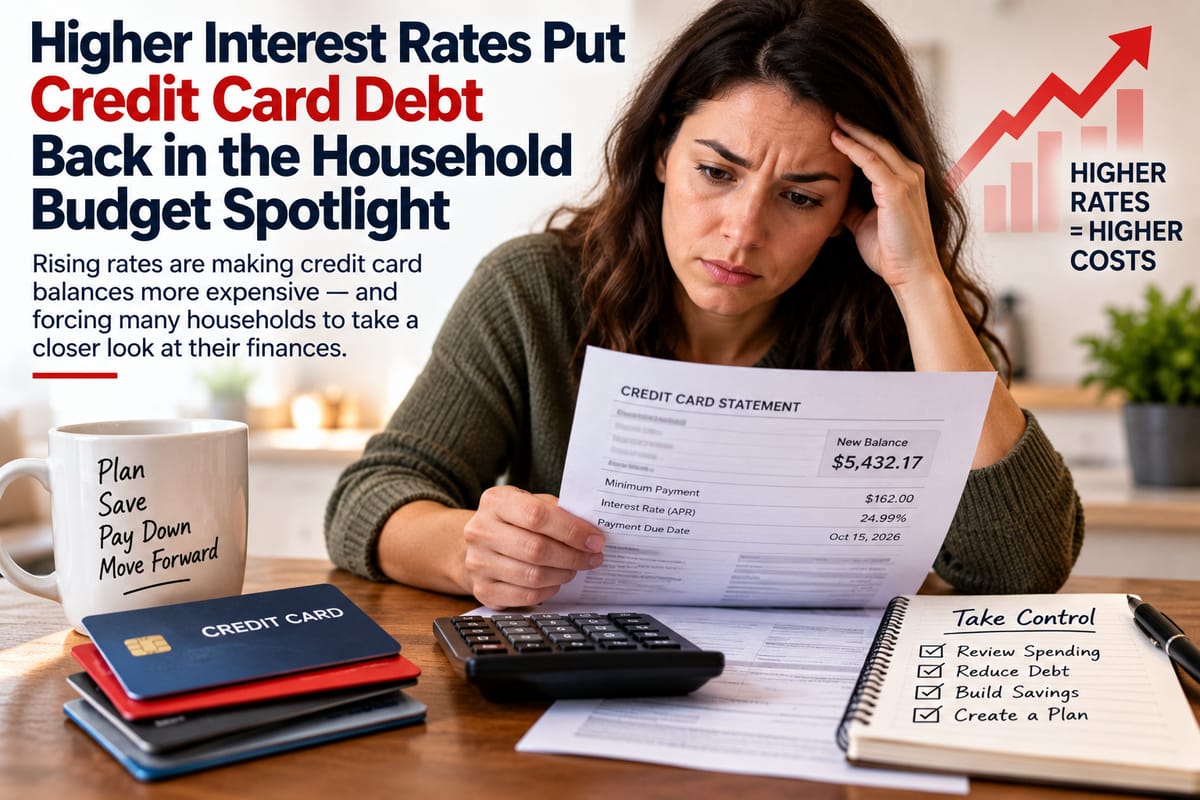
Credit card debt can become considerably more expensive when interest rates rise, putting renewed pressure on household budgets and making debt management more important for families trying to control monthly expenses.
Unlike some forms of borrowing that carry fixed interest rates, many credit cards have variable rates that can change as broader interest-rate conditions change. When the cost of carrying a balance increases, even households that have been making regular payments can find that more of their money is going toward interest rather than reducing the underlying debt.
The result is a familiar financial challenge: a balance that seemed manageable can take much longer to pay off when interest charges consume a larger portion of each payment.
Why Higher Interest Rates Matter for Credit Cards
Credit card interest is typically calculated based on the balance carried from one billing period to another. If a cardholder does not pay the full statement balance by the due date, interest can generally begin accumulating according to the card’s terms.
When interest rates increase, the annual percentage rate, or APR, on variable-rate credit cards can also rise.
For households carrying balances, that can translate into higher financing costs without any increase in spending.
For example, someone who regularly carries a $5,000 balance could pay substantially more interest over time at a higher APR than at a lower one. The exact amount depends on the card’s interest rate, payment schedule, average daily balance and other terms.
Understanding these mechanics is an important part of the Complete Guide to Credit Cards and How They Work.
Credit Card Debt Can Quietly Consume More of the Budget
One of the challenges with revolving debt is that the monthly payment can make the balance appear manageable even when the underlying debt is expensive.
A household may make the required payment every month while seeing only a relatively small reduction in the principal balance.
This can happen because part of the payment goes toward interest and fees before the remainder is applied to the balance.
When rates are higher, the interest portion can become more significant.
That means families may need to devote more money to existing debt simply to maintain their previous repayment pace.
Minimum Payments Can Stretch Debt Over Years
Credit card minimum payments are designed to keep an account current rather than necessarily eliminate the balance quickly.
A minimum payment may cover interest, fees and only a small portion of the principal. If new purchases continue to be added, the balance can remain elevated for an extended period.
Paying only the minimum can therefore make a credit card balance much more expensive over time.
A higher interest rate makes this problem more pronounced because more of each payment can be absorbed by financing costs.
Consumers who are carrying balances should therefore look beyond the minimum payment and consider how much they are actually paying toward principal each month.
Higher Rates Change the Cost of Everyday Spending
Credit cards can be useful payment tools, but carrying a balance effectively turns previous purchases into debt that continues to generate financing costs.
A $100 purchase may no longer feel like a $100 expense if it remains on a high-interest credit card for months.
This can be particularly important for household expenses such as groceries, utilities, transportation and unexpected repairs.
When budgets are already tight, families may use credit cards to bridge temporary gaps in cash flow. If those balances are not quickly repaid, however, the interest charges can create a new recurring expense.
That is why understanding How Bank Fees and Interest Charges Affect the Cost of Everyday Banking can help households see how seemingly small financial charges can accumulate.
Rewards Do Not Always Offset Interest Costs
Credit card rewards can make cards attractive.
Cash-back programs, travel points and other rewards can provide value when a card is used responsibly and the statement balance is paid in full.
The calculation changes when a balance is carried from month to month.
A household could earn rewards on purchases while simultaneously paying substantial interest on the unpaid balance. Depending on the interest rate and repayment period, those financing costs can outweigh the value of the rewards.
The How Credit Card Rewards, Points and Cash Back Work guide provides more context on how these programs operate.
The important distinction is between using a credit card as a payment method and using it as a long-term source of borrowed money.
Why Household Budgets Feel the Pressure
Credit card interest does not exist in isolation.
Households may already be dealing with higher costs for housing, transportation, food, insurance, utilities and other necessities. When credit card financing becomes more expensive at the same time, there may be less room for savings or discretionary spending.
A higher debt payment can also compete with other financial priorities.
For example, a household may have to choose between:
- Paying down high-interest debt
- Building an emergency fund
- Saving for retirement
- Covering upcoming household expenses
- Paying for children’s education
- Funding major home or vehicle repairs
The right balance depends on the household’s circumstances, but expensive revolving debt deserves attention because interest can continue accumulating until the balance is eliminated.
The Difference Between Interest Rate and Interest Paid
A credit card’s APR is important, but consumers should also pay attention to the actual dollar amount of interest appearing on their statements.
Two households with identical balances can pay different amounts of interest depending on their APRs and repayment behavior.
Similarly, someone who makes additional payments during the billing cycle may reduce the balance on which interest is calculated, depending on the card’s terms.
This is why reviewing monthly statements can be more informative than simply looking at the headline interest rate.
Consumers should examine:
- Current balance
- APR
- Minimum payment
- Interest charged
- Fees
- Payment due date
- Available credit
- Recent purchases
Knowing these numbers makes it easier to determine whether debt is shrinking or simply being carried forward.
Paying More Than the Minimum Can Make a Difference
When financially possible, paying more than the required minimum can accelerate debt repayment.
Additional money directed toward the balance reduces the principal, which can lower future interest costs.
Even relatively modest additional payments can change the repayment timeline.
For example, instead of making only the minimum payment, a household might establish a fixed debt-payment amount each month and treat it as a regular budget expense.
The important part is consistency.
Consider Which Debt Costs the Most
Households with multiple debts may benefit from identifying which balances carry the highest interest rates.
A high-interest credit card balance can be particularly expensive compared with lower-interest forms of borrowing.
One common approach is to direct extra money toward the debt with the highest interest rate while continuing to make required payments on other accounts.
Another approach focuses on paying off the smallest balance first to create quick milestones.
Neither method works identically for every household, and the most appropriate strategy depends on the balances, rates, income and financial priorities involved.
Consolidation May Change the Interest Cost
Some consumers consider consolidating multiple debts into another loan or transferring balances to a different credit card.
The potential benefit is a lower interest rate or a simpler repayment structure.
However, consolidation does not automatically make debt cheaper.
Consumers need to examine:
- Introductory interest rates
- The length of promotional periods
- Balance-transfer fees
- Annual fees
- The rate after the promotional period
- Loan origination costs
- Monthly payments
- Whether additional debt can be avoided
A lower rate can be useful if it genuinely reduces the cost of repayment, but fees and promotional terms can change the calculation.
Avoid Turning a Debt Solution Into New Debt
One of the biggest risks in debt management is freeing up available credit and then using it again.
For example, someone might pay down a credit card and then quickly rebuild the balance through new purchases.
This can leave the household with the same debt problem despite months of repayment.
A debt-reduction plan works more effectively when it is accompanied by a realistic spending plan that addresses why the balance accumulated in the first place.
If the original problem was irregular expenses, insufficient emergency savings or spending consistently above income, those issues may need to be addressed alongside the debt.
Building an Emergency Fund Can Reduce Credit Dependence
Unexpected expenses are one reason people turn to credit cards.
A vehicle repair, medical bill, appliance replacement or temporary income disruption can quickly create a budget shortfall.
An emergency fund can provide an alternative source of cash for eligible unexpected expenses.
It does not need to be built overnight.
Some households may begin by setting aside a small amount from each paycheck and gradually increase their savings as their financial situation improves.
The goal is to create a buffer that reduces the likelihood of using high-interest credit for every financial surprise.
Household Debt Requires a Complete View
Credit cards are only one part of household debt.
Families may also have mortgages, auto loans, student loans, personal loans and other obligations.
Looking at each account separately can make it difficult to understand the full financial picture.
A household can instead create a simple debt inventory showing:
| Debt | Balance | Interest Rate | Minimum Payment |
|---|---|---|---|
| Credit Card A | $ | % | $ |
| Credit Card B | $ | % | $ |
| Auto Loan | $ | % | $ |
| Personal Loan | $ | % | $ |
This makes it easier to identify which debts are costing the most and how much money is committed to minimum payments each month.
For households managing several balances, How to Manage Household Debt and Pay Off Multiple Debts offers a broader framework for organizing repayment.
Small Budget Changes Can Create Debt-Payment Room
Finding additional money for debt repayment does not always require dramatic lifestyle changes.
Small recurring expenses can sometimes create room in a monthly budget.
A household might review:
- Subscription services
- Restaurant spending
- Delivery fees
- Unused memberships
- Impulse purchases
- Insurance costs
- Mobile phone plans
- Streaming services
- Interest and banking fees
The objective is not necessarily to eliminate every enjoyable expense.
Instead, the goal is to identify spending that can be redirected toward a financial priority.
An extra $50 or $100 per month may not eliminate a large balance immediately, but consistently applying it to debt can help accelerate repayment.
Higher Rates Make Financial Planning More Important
Interest rates affect more than new borrowing.
They can influence the cost of existing variable-rate debt, the attractiveness of savings products and the financial decisions households make about borrowing and spending.
For people carrying credit card balances, the key issue is that interest compounds the cost of maintaining debt over time.
This makes repayment planning increasingly important when borrowing costs are elevated.
A household that understands its balances, interest rates, minimum payments and monthly cash flow is in a better position to make informed decisions about where its money goes.
When Credit Cards Can Still Be Useful
Higher interest rates do not make credit cards inherently unsuitable.
For consumers who pay their balances in full every month, the interest rate may have little or no effect on purchases because interest generally does not accrue on purchases when the full statement balance is paid by the due date, subject to the card’s terms.
Credit cards can also provide convenience, fraud protections and rewards.
The central issue is whether the card is being used as a payment tool or as ongoing borrowing.
The distinction can make a major difference to the household budget.
A More Deliberate Approach to Credit Card Spending
When interest rates are high, households carrying balances may benefit from treating credit card spending more deliberately.
Before making a purchase, consumers can ask:
Can this purchase be paid off when the statement arrives?
If the answer is no, the purchase effectively becomes borrowing, and its cost will depend on the card’s interest rate and how long the balance remains unpaid.
That simple question can help separate routine spending from debt-financed spending.
Keeping Debt From Taking Over the Budget
Higher interest rates can expose weaknesses that were less noticeable when borrowing was cheaper.
A credit card balance that once seemed manageable can become more expensive when its APR rises. Meanwhile, minimum payments can keep the account current without necessarily reducing the balance quickly.
The most useful response is often a combination of awareness and consistent action: understand the terms of each account, track interest charges, avoid unnecessary new balances, pay more than the minimum when possible, and create savings that can absorb unexpected expenses.
For households already carrying substantial debt, the priority is not simply finding a way to borrow more cheaply. It is creating a sustainable path toward reducing the amount of money owed and eventually freeing more of the household budget for savings, essential expenses and longer-term financial goals.