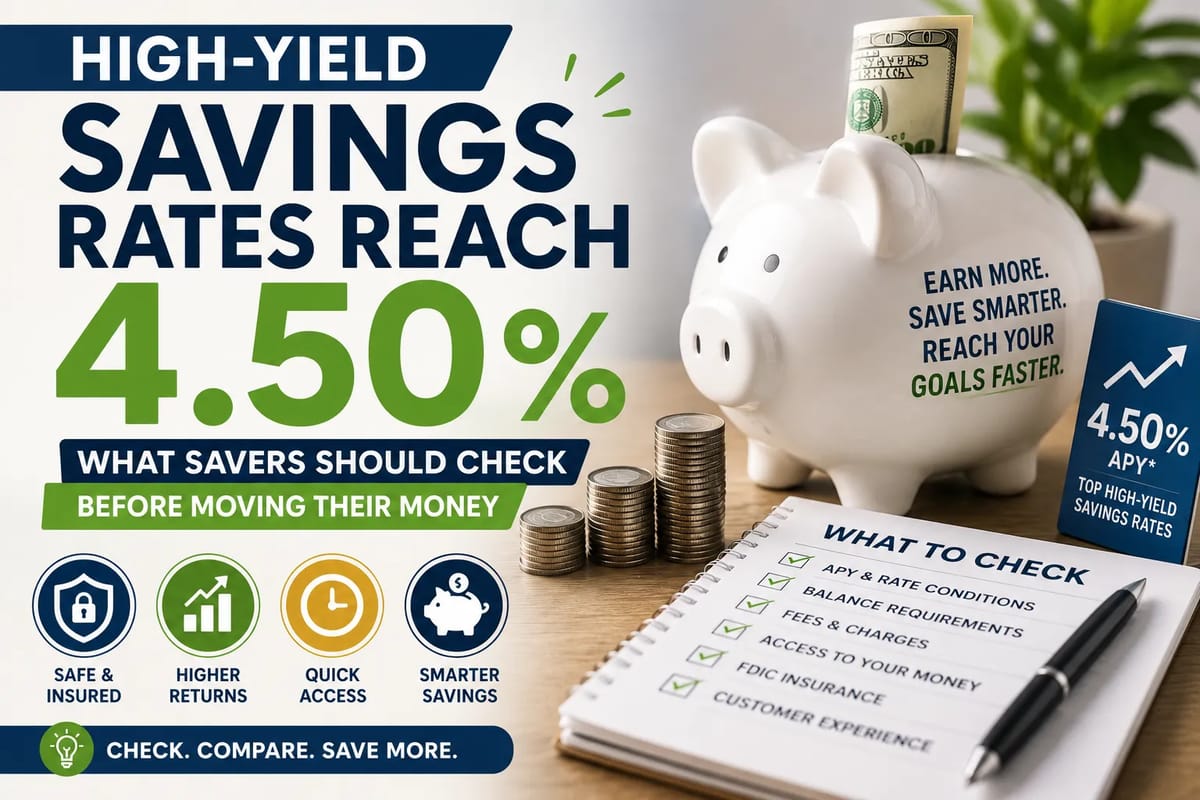
High-Yield Savings Rates Reach 4.50%: What Savers Should Check Before Moving Their Money
For savers looking for a better return on cash, high-yield savings accounts are once again attracting attention.
As of August 2026, the highest advertised high-yield savings rates are reaching 4.50% APY, while the national average savings rate remains far lower at about 0.38%, according to recent rate data.
At first glance, moving money from a traditional savings account earning a fraction of 1% to an account offering 4% or more can look like an obvious decision.
But the headline rate is only part of the story.
Some of the highest advertised APYs may apply only to certain balances, require specific qualifications or come with conditions that can reduce the effective return. Before transferring an emergency fund or other savings, consumers should examine the account’s terms, accessibility, fees, insurance coverage and whether the rate is likely to remain competitive.
For a broader look at the different types of deposit accounts and how they fit into everyday banking, see this complete guide to bank accounts and account types.
Why 4.50% Savings Rates Are Getting Attention
The appeal of a 4.50% APY is straightforward: savers can earn substantially more interest without exposing emergency savings to the market volatility associated with stocks or other investments.
Recent market data shows that top high-yield savings accounts are offering rates as high as 4.50%, although some of the strongest offers have balance limits or other requirements.
That distinction matters.
An account advertising 4.50% on the first $5,000 is very different from an account paying 4.50% on a $50,000 emergency fund.
For someone with $5,000 in qualifying savings, a 4.50% APY would generate roughly $225 in interest over a year if the rate remained unchanged and interest compounded according to the account’s terms.
On $20,000, the same rate would represent roughly $900 in annual interest.
Those are illustrative calculations, not guaranteed returns, because savings rates are variable and can change.
What Is a High-Yield Savings Account?
A high-yield savings account is a deposit account that generally pays a higher interest rate than a conventional savings account.
These accounts are often offered by online banks, digital banking providers and some credit unions.
The higher rate can allow savers to earn more on money that they want to keep relatively accessible.
A high-yield savings account can be appropriate for money such as:
- Emergency savings
- A home down payment
- A vehicle fund
- Upcoming tuition
- A vacation fund
- Money reserved for major purchases
- Cash that has not yet been allocated to a long-term investment
The key characteristic is that the money remains relatively liquid rather than being locked away for a fixed period.
APY Is More Important Than the Advertised Interest Rate
When comparing savings accounts, pay attention to APY, or annual percentage yield.
APY reflects the effect of compounding and is generally the more useful figure for comparing deposit accounts.
An account may advertise an attractive interest rate while its APY is different because of compounding.
For consumers comparing multiple accounts, using APY helps create a more consistent comparison.
However, APY alone still does not tell the whole story.
You also need to know:
- Whether the rate is variable
- Whether there is a promotional period
- Whether a minimum balance applies
- Whether direct deposit is required
- Whether only part of the balance earns the advertised rate
- Whether there are monthly fees
- Whether withdrawals or transfers have restrictions
The 4.50% Rate May Not Apply to All Your Money
This is one of the most important details for savers to check.
A bank can advertise an APY of 4.50% while limiting that rate to a particular balance.
Recent rate comparisons, for example, identify an account offering 4.50% APY on balances up to $5,000.
Suppose you have $25,000 to save.
If only $5,000 qualifies for the top rate while the remaining $20,000 earns a much lower rate, the account’s overall return will be considerably less than simply multiplying $25,000 by 4.50%.
This is why consumers should look beyond the large APY displayed in advertisements.
Check the Balance Requirements
Some high-yield accounts require customers to maintain a minimum balance.
Others may offer different rates depending on how much money is deposited.
Before opening an account, determine:
- Minimum opening deposit
- Minimum balance
- Maximum balance eligible for the advertised APY
- Rate paid on amounts above the qualifying threshold
- Consequences of falling below the required balance
A high APY is less useful if maintaining the required balance creates financial stress or forces you to keep too much money in one account.
For more guidance on matching an account to your balance, access needs and financial goals, see how to choose the right bank account for your financial needs.
Look for Direct Deposit Requirements
Some banking products tie their best rates or benefits to direct deposits.
That can be perfectly reasonable if you already receive your salary through direct deposit.
But it can become inconvenient if you are moving savings specifically to capture a higher APY and have to restructure your banking arrangements to qualify.
Read the terms carefully to determine:
- What counts as a qualifying direct deposit
- How frequently deposits must occur
- Whether there is a minimum amount
- What happens if the requirement is missed
Do not assume that simply transferring money between your own accounts will satisfy a direct-deposit requirement.
Watch Out for Promotional Rates
A particularly attractive rate may be promotional.
A bank might offer a higher APY to new customers for a limited period before moving the account to its standard variable rate.
This does not necessarily make the offer bad.
It simply means you need to know what happens afterward.
Before moving your money, ask:
What rate will apply once the promotional period ends?
Also check whether the promotional rate is automatically applied or requires enrollment.
Savings Rates Can Change
One of the biggest differences between a high-yield savings account and a certificate of deposit is that the savings account’s rate is generally variable.
The bank can change the APY.
Savings rates are influenced by broader interest-rate conditions and individual bank strategies.
The Federal Reserve has maintained its federal funds target range at 3.50% to 3.75% since the beginning of 2026, including its July 29 decision to leave the range unchanged.
That does not mean every savings account will move immediately or by the same amount.
Banks set their own deposit rates based on a variety of factors, including competition and their funding needs.
The important lesson for savers is simple:
Today’s highest APY is not necessarily next year’s highest APY.
Why the Federal Reserve Matters to Savers
The Federal Reserve does not directly set the APY on your savings account.
However, monetary policy influences the broader interest-rate environment.
When benchmark rates rise, banks often have greater incentive to compete for deposits and may raise savings yields.
When rates fall, savings rates can also decline.
The relationship is not perfectly mechanical.
Individual banks can move rates at different times and by different amounts.
As of late July 2026, the Fed said inflation remained elevated relative to its 2% longer-run objective and maintained the federal funds target range at 3.50% to 3.75%.
That makes future savings-rate movements something worth watching rather than assuming that current yields will remain unchanged.
Compare Your Current Account Before Switching
Before moving your money, find out exactly what your current account is paying.
The difference may be larger than expected.
The national average savings rate was about 0.38% in recent August 2026 data, while leading high-yield accounts were offering rates of up to 4.50%.
For example, consider $20,000 in savings:
| APY | Approximate annual interest |
|---|---|
| 0.38% | $76 |
| 1.00% | $200 |
| 2.00% | $400 |
| 3.00% | $600 |
| 4.00% | $800 |
| 4.50% | $900 |
These figures are simplified illustrations assuming the rate remains unchanged for a full year and do not account for taxes or differences in compounding.
The comparison demonstrates why the rate difference can matter as balances grow.
Calculate the Dollar Difference
Percentage rates can sound abstract.
Dollar differences are often easier to understand.
Suppose your existing account pays 1% and another account pays 4%.
On $10,000, the approximate annual difference is:
$400 − $100 = $300
On $50,000:
$2,000 − $500 = $1,500
That does not mean everyone should immediately switch.
It means the size of your balance can help determine whether the extra yield is worth the inconvenience of changing accounts.
For a very small balance, the difference may be modest.
For a substantial emergency fund, the difference can become meaningful.
Check for Monthly Fees
A higher APY can be undermined by fees.
Look for:
- Monthly maintenance fees
- Excess transaction fees
- Transfer fees
- Account closure fees
- Wire fees
- Paper statement fees
- Minimum-balance penalties
For example, earning an additional $200 in annual interest does not look as attractive if the account costs $15 every month in fees.
Many competitive savings accounts have no monthly maintenance fee, but consumers should verify the current terms rather than assuming.
For a broader explanation of common banking charges and ways consumers can reduce them, read banking fees explained and how to avoid them.
Consider How Easily You Can Access the Money
Emergency savings should be accessible when you actually need it.
Before moving your money, determine how withdrawals work.
Check:
- How long transfers normally take
- Whether the bank offers checking accounts
- Whether ATM access is available
- Whether external transfers are supported
- Whether there are transaction limitations
- Whether customer-service hours fit your needs
An account paying a slightly lower rate may be preferable if it gives you significantly better access to your money.
The purpose of an emergency fund is not simply to earn interest.
It is to be available when an emergency happens.
Online Banks Can Offer Competitive Rates
Many high-yield savings accounts come from online banks or digital banking platforms.
Because online institutions may operate with different cost structures from traditional branch-heavy banks, they can sometimes offer competitive deposit rates.
Recent comparisons show online institutions among the leading providers of high-yield savings rates.
But a higher APY should not be the only factor.
Consider the entire banking experience.
For some consumers, the ability to walk into a branch is worth more than an additional fraction of a percentage point.
For others, online banking is perfectly adequate.
If you are unfamiliar with how online and digital banking services operate, see how digital banking and online banking work.
Verify Deposit Insurance
Before transferring a significant amount of money, confirm that the institution is properly insured.
For eligible deposits at an FDIC-insured bank, the standard coverage limit is $250,000 per depositor, per insured bank, for each ownership category.
That is an important distinction because FDIC insurance applies to eligible deposit products, not every financial product that happens to be offered through a financial company.
Consumers should verify the actual bank holding their deposits and understand the applicable insurance structure.
If you have more than the standard insurance limit, do not assume the entire balance is automatically protected simply because the institution advertises itself as a financial-services company.
Don’t Confuse a Savings Account With an Investment
A high-yield savings account is still a deposit account.
It is not the same thing as investing in stocks, bonds or other securities.
The primary purpose of a savings account is generally to preserve accessible cash while earning interest.
That makes it particularly useful for short-term goals and emergency reserves.
Money intended for a decades-long retirement horizon may require a different strategy depending on the individual’s circumstances and risk tolerance.
A higher savings rate does not eliminate the need to think about the time horizon for each dollar you own.
High-Yield Savings vs CDs
Certificates of deposit can offer another way to earn interest on cash.
With a CD, you typically agree to leave money deposited for a specified period in exchange for a stated rate.
Recent market data shows that some short-term high-yield CDs are also offering rates around or above 4%, with top offers reaching approximately 4.55% in early August 2026.
The trade-off is flexibility.
A savings account generally provides easier access to your money, while a CD may impose an early-withdrawal penalty if you take funds out before maturity.
For money you may need unexpectedly, the flexibility of a savings account can be more valuable than a slightly higher fixed rate.
High-Yield Savings vs Money Market Accounts
Money market deposit accounts can also provide interest while allowing relatively convenient access to funds.
The exact features vary by institution.
When comparing one with a high-yield savings account, look at:
- APY
- Minimum balance
- Fees
- Withdrawal rules
- Check-writing availability
- ATM access
- Deposit insurance
- Rate conditions
The account with the highest advertised rate is not necessarily the best fit.
Don’t Move Your Entire Banking Relationship Automatically
A higher savings rate does not mean you have to move your checking account, direct deposits, credit cards and other financial relationships at the same time.
For many savers, the simplest approach is to move only the portion of cash intended for savings.
You can maintain your existing checking account for:
- Bill payments
- Direct deposits
- Everyday spending
- ATM access
And use a separate high-yield savings account for:
- Emergency funds
- Short-term goals
- Cash reserves
This can allow you to capture a better savings rate without unnecessarily disrupting your financial system.
Think About Your Emergency Fund First
Emergency savings should generally prioritize accessibility and stability.
The exact amount needed varies by household.
Factors include:
- Income stability
- Monthly expenses
- Job security
- Dependents
- Insurance coverage
- Debt obligations
- Major upcoming expenses
A high-yield savings account can be a useful place for this money because it combines liquidity with interest earnings.
However, the account should not be so complicated that you struggle to access the money during an actual emergency.
Don’t Chase Every Rate Change
Constantly moving money between accounts can become counterproductive.
If a new bank offers an APY that is only slightly higher, consider whether the difference justifies:
- Opening another account
- Updating transfers
- Learning a new banking platform
- Managing another login
- Closing an existing account
- Monitoring another set of terms
The goal is not to win every rate comparison.
The goal is to make your cash-management system simple, competitive and sustainable.
Watch the Rate on the Entire Balance
A particularly important question is:
What APY will my entire balance actually earn?
Suppose a bank advertises:
- 4.50% on the first $5,000
- 1.00% on amounts above $5,000
A customer with $25,000 would not effectively be earning 4.50% on the entire $25,000.
This is why the account’s rate tiers matter more than the headline number.
Always read the terms for the exact balance you plan to deposit.
Check Transfer Limits and Timing
Moving money between banks is generally straightforward, but transfer policies can differ.
Before transferring your emergency fund, understand:
- Incoming transfer limits
- Outgoing transfer limits
- Transfer processing times
- Holds on newly deposited funds
- Cutoff times
- Whether same-day transfers are available
- Whether linked external accounts must be verified
If you need your emergency fund immediately, transfer delays can matter.
Watch for New-Account Restrictions
Some banks impose temporary restrictions on newly opened accounts or newly deposited funds.
These measures can be designed to reduce fraud.
They can also affect how quickly you can move money.
Read the bank’s policies before making a large transfer, particularly if the funds are needed for an upcoming purchase.
Taxes Still Matter
Interest earned in a taxable savings account may be subject to income tax.
The exact tax treatment depends on your jurisdiction and individual circumstances.
That means the APY advertised by a bank should not necessarily be treated as the amount you will keep after taxes.
When comparing accounts, consider the after-tax effect if the interest income is significant for your financial situation.
A Better Way to Compare High-Yield Savings Accounts
Instead of ranking accounts solely by APY, create a simple comparison.
| Factor | Account A | Account B | Account C |
|---|---|---|---|
| APY | — | — | — |
| Rate conditions | — | — | — |
| Minimum balance | — | — | — |
| Maximum qualifying balance | — | — | — |
| Monthly fee | — | — | — |
| Direct deposit required | — | — | — |
| Transfer access | — | — | — |
| ATM access | — | — | — |
| Deposit insurance | — | — | — |
| Promotional period | — | — | — |
| Customer support | — | — | — |
This makes it easier to identify whether the highest advertised rate is actually the best deal for your situation.
Questions to Ask Before Moving Your Money
Before opening a high-yield savings account, ask:
- What is the current APY?
- Is the APY variable?
- Does the advertised rate apply to my entire balance?
- Is there a maximum balance eligible for the top rate?
- Are there minimum-balance requirements?
- Are there monthly fees?
- Is direct deposit required?
- Is the rate promotional?
- What happens when the promotion ends?
- How quickly can I access my money?
- Is the deposit institution FDIC- or NCUA-insured, as applicable?
- Are there transfer limits or holds?
- What customer-service options are available?
- What happens if the bank lowers the APY?
If you cannot find clear answers, that is a reason to slow down before transferring a large balance.
When Moving Your Savings Makes Sense
Switching accounts can make sense when:
- Your current APY is substantially below competitive rates.
- You have a meaningful savings balance.
- The new account has no problematic fees.
- The higher rate applies to the amount you actually plan to save.
- The institution is properly insured.
- Access to the money is convenient.
- The account’s conditions are easy for you to meet.
In that situation, the move can increase the return on cash without requiring you to take investment risk.
When Staying Put May Make Sense
Moving money is not always worthwhile.
You may prefer your current bank if:
- The rate difference is very small.
- You frequently use branch services.
- The new account has restrictive conditions.
- You value having all your accounts together.
- The higher rate applies only to a small portion of your balance.
- Transfers are inconvenient.
- The account has fees that offset much of the additional interest.
Convenience has financial value too.
The Bigger Opportunity for Savers
A 4.50% APY is attractive, but the larger lesson is that savers should periodically examine where their cash is sitting.
Money left in an account paying almost no interest can gradually miss out on meaningful earnings, particularly when balances become substantial.
At the same time, chasing the highest headline rate without understanding the conditions can create unnecessary complications.
The best approach is somewhere in between.
Know what your money is earning, understand the terms, and choose an account that fits the purpose of the cash.
What Savers Should Watch Next
High-yield savings rates are likely to remain sensitive to the broader interest-rate environment.
The Federal Reserve’s July 2026 decision kept the federal funds target range at 3.50% to 3.75%, while officials continued to note that inflation remained elevated relative to the Fed’s 2% objective.
That means savers should not assume that today’s 4.50% headline rate will remain available indefinitely.
Instead, keep an eye on three things:
Your own APY: Check what your bank is actually paying rather than assuming it remains unchanged.
Competitive rates: Periodically compare your account with other insured deposit accounts.
Federal Reserve policy: Changes in the broader interest-rate environment can influence how aggressively banks compete for deposits.
The good news is that savers do not need to predict the next interest-rate move perfectly.
They simply need to make sure their cash is working reasonably hard without sacrificing safety, access or simplicity.
For someone whose money is sitting in a low-yield savings account, moving to a competitive high-yield account could make a noticeable difference. But the smartest move is not necessarily the account displaying the biggest number.
It is the account where the advertised rate applies to your balance, the requirements fit your circumstances, the fees are reasonable, the money remains accessible and the deposits have appropriate insurance protection.
In other words, 4.50% is a number worth investigating—not a reason to transfer your money without reading the fine print.