Fiscal Policy, Government Spending, and Taxes Explained
Fiscal policy is one of the most important forces shaping an economy, yet it can be difficult to understand when discussions about government spending, taxes, deficits, and debt become filled with technical language.
At its core, fiscal policy is about how a government uses spending and taxation to influence economic activity.
When an economy is slowing, policymakers may use fiscal measures to support demand. When inflation is persistent or government finances are under pressure, they may consider reducing spending, increasing taxes, or using other measures to restrain demand and improve the government’s financial position.
These decisions can affect households, businesses, investors, workers, and financial markets.
Understanding how fiscal policy works makes it easier to interpret economic developments and understand why government budget decisions can have consequences far beyond government agencies themselves.
For a broader look at the economic indicators that help explain these relationships, see this complete guide to economic indicators.
What Is Fiscal Policy?
Fiscal policy refers to government decisions about taxation, spending, and borrowing.
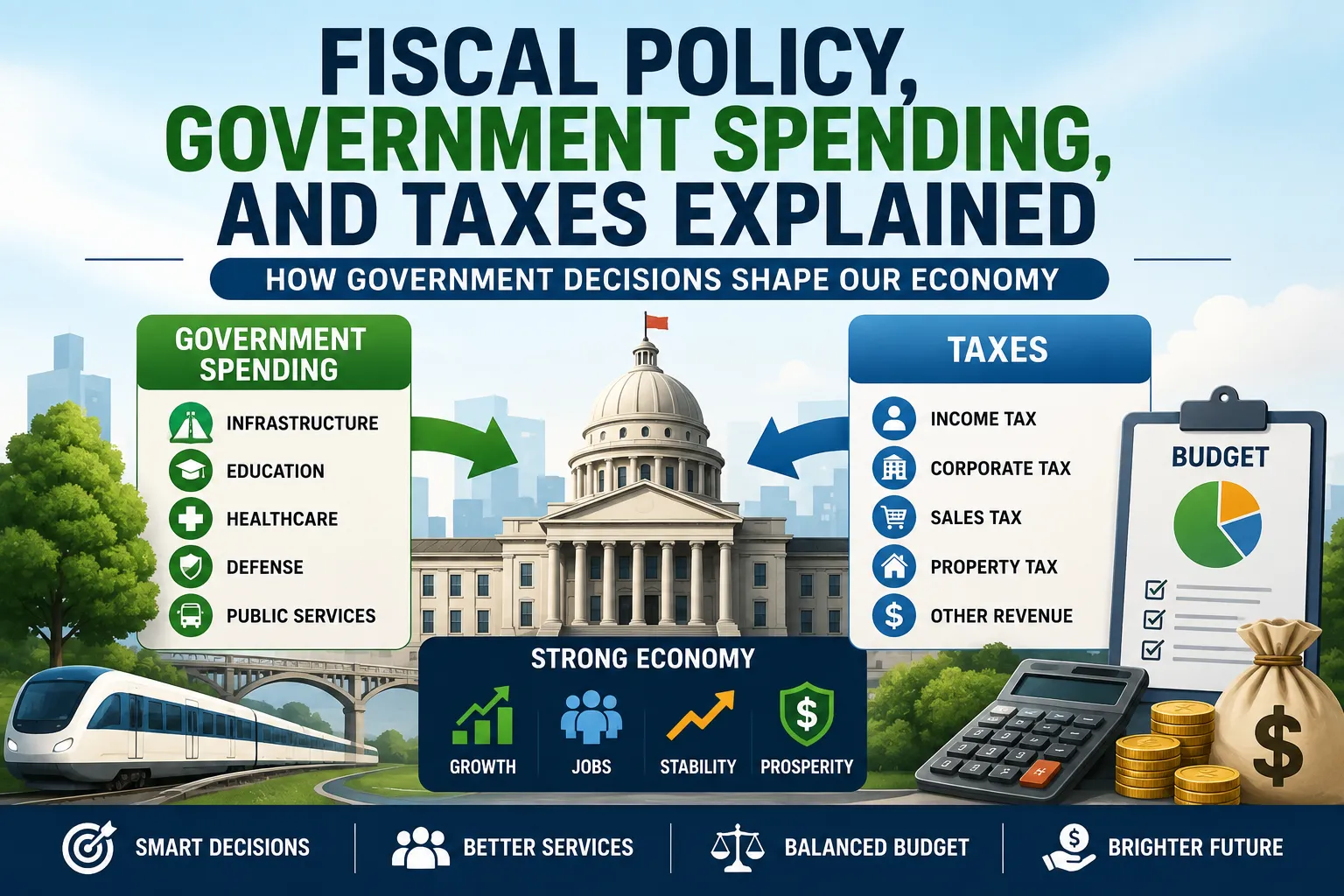
Governments collect revenue from sources such as:
- Income taxes
- Corporate taxes
- Sales and consumption taxes
- Property taxes
- Customs duties
- Social insurance contributions
- Fees and other government revenues
They then use those resources to finance public services and programs.
Government spending can include:
- Healthcare
- Education
- Infrastructure
- Defense
- Public-sector salaries
- Social benefits
- Pensions
- Public transportation
- Government administration
- Interest payments on government debt
When government revenue is not enough to cover spending, the government generally has a budget deficit and must borrow to finance the difference.
When revenue exceeds spending, the government has a budget surplus.
Why Fiscal Policy Matters
Government budgets are much more than accounting documents.
They influence the amount of money flowing through the economy and can affect economic growth, employment, inflation, household incomes, business activity, and government debt.
For example, a government that increases infrastructure spending may create demand for construction, engineering, transportation, materials, and related services.
A tax reduction can leave households with more disposable income, potentially encouraging consumption.
Conversely, higher taxes or reduced government spending can reduce demand in the economy.
The effects depend on the size and design of the policy, economic conditions, and how households and businesses respond.
Fiscal Policy Versus Monetary Policy
Fiscal policy is often confused with monetary policy, but they are controlled by different institutions and work through different mechanisms.
Fiscal Policy
Fiscal policy involves:
- Government spending
- Taxation
- Government borrowing
- Budget decisions
It is generally determined by governments and legislatures, depending on the country’s political and constitutional system.
Monetary Policy
Monetary policy generally involves:
- Interest rates
- Money and credit conditions
- Central-bank operations
- Inflation management
It is typically conducted by a country’s central bank.
The two policies can work in opposite directions.
For example, a government could increase spending to stimulate the economy while a central bank raises interest rates to control inflation.
Understanding the distinction is essential when analyzing economic policy. The relationship between monetary policy and financial markets is explored further in how monetary policy affects financial markets.
How Government Spending Affects the Economy
Government spending contributes to overall economic activity.
When a government purchases goods and services, hires workers, funds infrastructure, or provides benefits to households, money moves through the economy.
Consider a government infrastructure project.
The government may pay a construction company.
The company then pays:
- Employees
- Suppliers
- Contractors
- Transport companies
- Equipment providers
Those recipients spend some of their income on other goods and services.
This creates a chain of economic activity.
The scale of the resulting effect depends on factors such as the type of spending, the state of the economy, and how much of the additional income is saved or spent.
What Are Government Transfers?
Not all government spending involves directly purchasing goods and services.
Governments also make transfer payments.
Examples can include:
- Unemployment benefits
- Pensions
- Certain welfare payments
- Tax credits
- Income-support programs
Transfer payments can affect the economy by changing household income and purchasing power.
For example, a household receiving additional income may use some of it to pay bills, buy groceries, or cover other expenses.
The government is therefore influencing economic activity without necessarily purchasing a physical product or service itself.
What Happens When Governments Increase Spending?
An increase in government spending can stimulate economic activity, particularly when the economy has unused capacity.
Suppose businesses are experiencing weak demand.
A government infrastructure program could increase demand for construction and related services.
Businesses may respond by:
- Increasing production
- Hiring additional workers
- Purchasing more supplies
- Increasing investment
Workers who receive additional income may then increase their own spending.
However, increased government spending does not automatically produce stronger economic growth.
If the economy is already operating near capacity, additional demand can instead contribute to higher prices.
That is why the economic environment matters.
How Taxes Affect Households
Taxes directly influence the amount of income households have available to spend or save.
Consider an employee earning $60,000 before taxes.
The employee does not have $60,000 available for everyday spending because taxes and other deductions reduce take-home income.
If tax rates or tax liabilities increase, disposable income can decline.
If taxes decrease, households may have more money available for:
- Consumption
- Saving
- Investing
- Debt repayment
The response depends on household circumstances.
A financially stretched household may spend most of an additional dollar of income, while a higher-income household may save or invest a larger share.
How Taxes Affect Businesses
Businesses are also affected by taxation.
Corporate taxes can influence the amount of profit a company retains after taxes.
Other taxes can affect:
- Payroll costs
- Property expenses
- Sales
- Imports
- Investment decisions
- Business formation
Tax policy can therefore influence how businesses allocate capital.
A tax incentive for investment, for example, may encourage companies to purchase equipment or expand facilities.
A higher tax burden on a particular activity may discourage it.
However, businesses do not respond to tax rates in isolation. Consumer demand, financing costs, regulation, labor availability, and expected future profits also influence decisions.
What Is an Expansionary Fiscal Policy?
Expansionary fiscal policy is designed to increase economic activity.
Governments can pursue expansionary policy through measures such as:
- Increasing public spending
- Reducing certain taxes
- Increasing transfers to households
- Funding investment programs
The objective is generally to support demand and economic activity.
Expansionary policy can be particularly relevant during periods of recession or weak economic growth.
But it can create challenges if used when demand is already strong.
Additional spending or tax reductions can increase demand at a time when businesses are already struggling to keep up with existing demand.
That can contribute to inflationary pressure.
What Is Contractionary Fiscal Policy?
Contractionary fiscal policy is intended to reduce demand or slow economic activity.
It can involve:
- Reducing government spending
- Increasing taxes
- Reducing certain transfers
The goal may be to prevent an overheated economy from generating excessive inflation or to improve government finances.
The trade-off is that contractionary fiscal policy can also weaken economic growth.
This creates a difficult policy balance.
Policymakers must consider whether the greater risk is:
Too little economic activity or too much demand.
Automatic Stabilizers Explained
Not every fiscal response requires lawmakers to pass a new policy.
Some fiscal mechanisms operate automatically as economic conditions change.
These are known as automatic stabilizers.
Examples include progressive income taxes and certain unemployment benefit programs.
During an economic downturn:
- Household incomes may fall
- Income-tax payments may decline
- More people may qualify for unemployment benefits
The result can provide some support to household incomes without requiring a completely new government spending program.
During stronger economic conditions, tax revenues can increase while some benefit payments decline.
Automatic stabilizers therefore help moderate economic fluctuations.
What Is a Government Budget Deficit?
A budget deficit occurs when government spending exceeds government revenue over a particular period.
The basic relationship is:
Budget deficit = Government spending − Government revenue
For example, if a government collects $4 trillion in revenue but spends $5 trillion, it has a $1 trillion budget deficit.
The government generally finances the difference through borrowing.
A deficit is not necessarily a sign that government finances are out of control.
Governments may deliberately run deficits during recessions or periods of major investment.
The more important questions are why the deficit exists, how large it is relative to the economy, how it is financed, and whether the debt burden remains sustainable.
What Is a Government Budget Surplus?
A budget surplus occurs when government revenue exceeds government spending.
For example:
Revenue: $5 trillion
Spending: $4.7 trillion
Surplus: $300 billion
A government can use a surplus to:
- Reduce debt
- Build financial reserves
- Increase investment
- Reduce taxes
- Finance other priorities
A surplus can strengthen government finances, but running a surplus is not always the appropriate economic objective.
During a recession, aggressive efforts to produce a surplus could reduce demand when the economy already needs support.
Deficits and Government Debt Are Not the Same Thing
These two terms are closely related but describe different concepts.
Deficit
A deficit is a flow measured over a particular period, such as a fiscal year.
Debt
Government debt is the accumulated amount the government owes from past borrowing.
A simple way to think about the relationship is:
Annual deficits add to government debt.
Annual surpluses can reduce debt, all else being equal.
A country can therefore run a deficit for one year without its entire debt situation changing dramatically.
Persistent deficits, however, can cause government debt to grow over time.
Why Government Debt Matters
Government borrowing allows a country to spend more than it collects in revenue.
Borrowing can help finance:
- Infrastructure
- Emergency responses
- Public services
- Economic stabilization
- Long-term investments
But borrowing has a cost.
Governments must generally pay interest on outstanding debt.
As debt grows, interest payments can consume a larger share of government revenue.
That can leave less money available for other priorities.
The sustainability of government debt depends on several factors, including:
- Economic growth
- Interest rates
- Tax revenue
- Government spending
- Debt maturity
- Investor confidence
- The currency in which debt is issued
What Is the Debt-to-GDP Ratio?
One common way to evaluate government debt is to compare it with the size of the economy.
This produces the debt-to-GDP ratio.
For example, if a country’s government owes $2 trillion and its annual economic output is $4 trillion:
Debt-to-GDP ratio = 50%
The ratio does not tell the entire story, but it provides useful context.
A large economy may be able to support more debt than a smaller economy with the same absolute debt amount.
Debt sustainability also depends on borrowing costs and the government’s ability to generate revenue.
How Fiscal Policy Can Affect Inflation
Fiscal policy can influence inflation through its effect on aggregate demand.
Suppose the economy has substantial unused capacity.
An increase in government spending may increase production without immediately creating significant price pressure.
But suppose the economy is already operating close to capacity.
Additional government spending can increase demand for:
- Workers
- Raw materials
- Transportation
- Housing
- Energy
- Consumer goods
If supply cannot increase quickly enough, prices may rise.
This is one reason governments and central banks pay close attention to the interaction between fiscal policy and inflation.
Fiscal Policy and Interest Rates
Fiscal policy can also influence borrowing costs indirectly.
If government borrowing rises significantly, investors may demand higher yields to purchase government debt, depending on economic conditions and expectations.
At the same time, fiscal expansion can increase economic demand, potentially influencing the broader interest-rate environment.
Central banks independently set monetary policy according to their mandates, but fiscal policy can affect the economic conditions they are responding to.
The interaction between government budgets and central-bank policy is therefore an important part of financial-market analysis.
How Fiscal Policy Affects Financial Markets
Investors pay close attention to government budgets because fiscal decisions can influence economic growth, inflation, corporate profits, and interest rates.
Stock Markets
Government spending can benefit companies in sectors receiving increased demand.
Tax changes can also affect corporate earnings and household spending.
Bond Markets
Government borrowing affects the supply of government debt.
Investors also assess whether fiscal policy could increase inflation or borrowing requirements.
Currency Markets
Fiscal policy can influence expectations about economic growth, inflation, interest rates, and government finances.
These factors can affect demand for a country’s currency.
Commodity Markets
Large infrastructure programs or changes in economic activity can influence demand for energy, metals, construction materials, and other commodities.
What Is a Tax Cut?
A tax cut reduces the amount of tax individuals or businesses owe under a particular tax system.
Tax cuts can take many forms.
They may involve:
- Lower income-tax rates
- Higher tax deductions
- Expanded tax credits
- Lower corporate tax rates
- Changes to capital-gains taxation
- Reductions in consumption taxes
The economic effect depends heavily on who receives the tax reduction.
A tax cut targeted at households with limited disposable income may have a different spending effect from one targeted primarily at high-income households.
What Is a Tax Increase?
A tax increase raises the amount of revenue collected from individuals, businesses, or specific economic activities.
Governments may increase taxes to:
- Finance public services
- Reduce budget deficits
- Pay down debt
- Influence behavior
- Fund infrastructure
- Address distributional objectives
Higher taxes can reduce disposable income or business profits, but the overall economic effect depends on how the government uses the additional revenue.
If additional tax revenue finances productive infrastructure or education, for example, it may support longer-term economic capacity.
Progressive, Proportional, and Regressive Taxes
Tax systems can be categorized according to how the tax burden changes as income changes.
Progressive Taxes
A progressive tax generally takes a larger percentage of income as income rises.
Individual income taxes in many countries use progressive structures.
Proportional Taxes
A proportional tax applies the same percentage rate across the relevant taxable income base.
Regressive Taxes
A tax is considered regressive when lower-income households effectively bear a larger burden relative to their income.
Consumption taxes can have regressive characteristics depending on how they are structured and which goods are taxed.
These classifications help explain why debates about taxation are not simply about the size of taxes.
They are also about who pays them.
Fiscal Policy and Economic Growth
Fiscal policy can influence economic growth in both the short and long term.
Short-term growth can be supported through government spending that increases demand.
Long-term growth can potentially be supported by investments that improve an economy’s productive capacity.
Examples include:
- Roads
- Ports
- Electricity infrastructure
- Education
- Research
- Digital infrastructure
- Public health
However, government spending is not automatically productive.
The quality of spending matters.
A large increase in spending on inefficient programs may produce less economic value than a smaller investment in highly productive infrastructure or human capital.
Why Fiscal Multipliers Matter
Economists sometimes use the concept of a fiscal multiplier to describe how changes in government spending or taxation can affect economic output.
A simplified example:
If a government spends an additional $1 billion and total economic output eventually increases by $1.5 billion, the implied multiplier would be 1.5.
But multipliers are not fixed.
They can vary depending on:
- Economic conditions
- Interest rates
- Exchange rates
- Consumer behavior
- Business confidence
- The type of fiscal policy
- Whether the economy has unused capacity
Fiscal policy may therefore have a stronger effect during a recession than when an economy is already operating near capacity.
Fiscal Policy Has Trade-Offs
Almost every fiscal decision involves competing objectives.
A government may want to:
- Increase economic growth
- Keep inflation under control
- Reduce unemployment
- Maintain public services
- Keep taxes manageable
- Reduce debt
These objectives can conflict.
For example, increased spending could support economic growth but also increase inflationary pressure.
Higher taxes could improve government finances but reduce household purchasing power.
Lower spending could reduce deficits but weaken demand.
There is rarely a policy choice that produces benefits without costs.
Why Government Budgets Matter to Households
Fiscal policy can affect household finances in several ways.
Changes in taxes can alter take-home income.
Government spending can affect employment and business activity.
Changes to public programs can influence household costs.
Government borrowing can affect broader financial conditions.
For example, a household might experience a fiscal-policy change through:
- A change in income taxes
- A change in child-related benefits
- A change in healthcare support
- A public infrastructure project
- Changes in energy subsidies
- Changes in retirement benefits
This is why government budget announcements can be important even for people who do not closely follow economic policy.
Why Businesses Watch Fiscal Policy
Businesses pay close attention to fiscal decisions because government policy can change their operating environment.
A new infrastructure program might create opportunities for construction companies.
A change in corporate taxes could affect profits.
A new tax credit could influence investment.
A reduction in government spending could reduce demand for companies dependent on public contracts.
Businesses therefore monitor fiscal policy as part of their broader planning process.
Fiscal Policy and the Business Cycle
Economies tend to move through periods of expansion and contraction.
Fiscal policy can be used to moderate these cycles.
During an economic downturn, governments may use expansionary measures to support demand.
During periods of unusually strong demand, policymakers may consider measures that reduce fiscal stimulus.
The ideal response depends on the circumstances.
A policy that makes sense during a severe recession may be inappropriate when inflation is already elevated.
The broader relationship between expansions, contractions and financial markets is explained in how economic and financial market cycles work.
Structural Versus Temporary Fiscal Changes
Not all fiscal policy changes have the same duration.
Some are temporary.
For example, a government may introduce a one-time payment or temporary tax relief during an economic crisis.
Other changes are structural.
A permanent tax-rate change or long-term spending commitment can affect government finances for many years.
Distinguishing between temporary and structural measures is important when assessing the long-term impact of a budget.
What Makes Fiscal Policy Effective?
Effective fiscal policy generally requires more than simply spending more or taxing less.
Policymakers need to consider:
- Timing
- Scale
- Targeting
- Financing
- Economic conditions
- Long-term sustainability
- Administrative efficiency
A policy introduced too slowly may arrive after economic conditions have changed.
A policy that is too large may create unnecessary inflationary pressure.
A poorly targeted policy may provide limited economic benefit while creating significant costs.
Common Misunderstandings About Fiscal Policy
Several misconceptions frequently appear in discussions about government budgets.
“A deficit always means the economy is unhealthy.”
Not necessarily.
Governments can run deficits for legitimate reasons, including recession support or productive investment.
“A surplus is always better.”
Not necessarily.
Reducing spending aggressively during a recession could make economic conditions worse.
“Government debt is the same as household debt.”
Governments and households operate under very different financial structures, currencies, tax systems, and borrowing capacities.
“Tax cuts always stimulate the economy.”
The effect depends on the size, design, timing, and recipients of the tax cut.
“Government spending always creates growth.”
The economic value of spending depends on what the government purchases and how effectively resources are used.
How to Read a Government Budget
When a government releases a budget, do not focus only on the headline spending figure.
Look at several components.
Revenue
How much money does the government expect to collect?
Spending
Where will the government allocate funds?
Deficit or Surplus
Will spending exceed revenue?
Debt
How will borrowing change?
Interest Costs
How much revenue will be required to service existing debt?
Economic Assumptions
What growth, inflation, employment, and interest-rate assumptions are being used?
Long-Term Effects
Are policies temporary or permanent?
This provides a much clearer picture of the government’s fiscal position.
The Long-Term Importance of Fiscal Choices
Fiscal policy is ultimately about choices over scarce resources.
Governments have limited revenue and borrowing capacity, yet they face competing demands.
Money allocated to one priority cannot simultaneously be spent elsewhere.
That creates what economists call opportunity costs.
A government choosing to increase infrastructure spending may have fewer resources available for other programs unless it raises taxes or increases borrowing.
The quality of fiscal policy therefore depends not only on how much governments spend but also on whether that spending produces sufficient economic and social value.
Why Fiscal Policy Will Remain Central to the Economy
Fiscal policy sits at the intersection of government finances and everyday economic life.
Taxes determine how governments collect revenue. Spending determines how public resources are allocated. Borrowing helps bridge the gap when spending exceeds revenue. Together, these decisions can influence growth, employment, inflation, investment, interest rates, and household finances.
The most useful way to understand fiscal policy is therefore not to ask whether government spending or taxes are inherently “good” or “bad.”
The better questions are what the government is spending money on, who is paying for it, how the policy is financed, when it is being implemented, and whether the resulting economic benefits justify the costs.
Those questions will remain important whenever governments prepare budgets, economies enter periods of rapid growth or weakness, or policymakers confront the competing demands of economic stability and sustainable public finances.