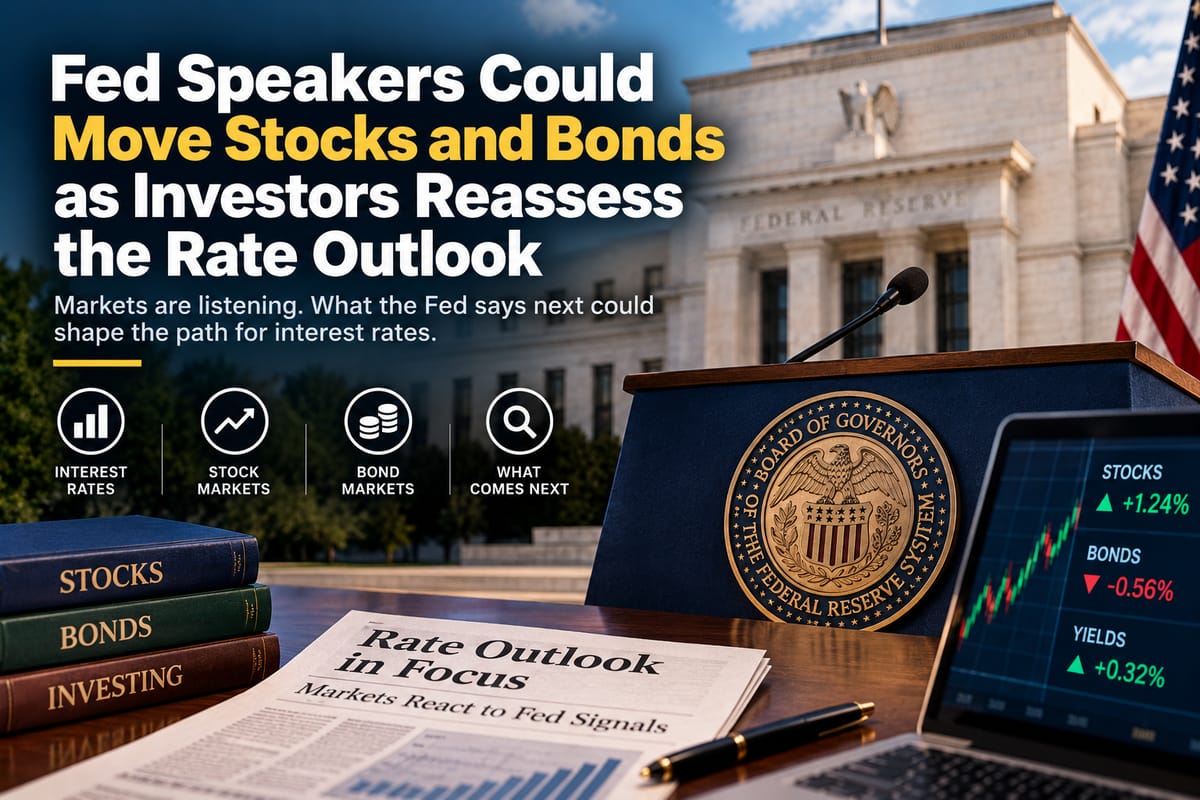
Fed Speakers Could Move Stocks and Bonds as Investors Reassess the Rate Outlook
Investors are heading into a busy stretch for Federal Reserve commentary with markets trying to determine what comes next after the central bank raised interest rates in September.
The Federal Reserve increased its target range for the federal funds rate by a quarter percentage point at its September 15–16 meeting, taking it to 3.75%–4%. It was the first rate increase in more than three years. The decision also came with projections showing that policymakers see the possibility of another increase before the end of 2026.
That has left investors particularly sensitive to comments from Fed officials.
With inflation still elevated and financial markets already adjusting to the possibility of additional tightening, even small differences in language from policymakers could influence Treasury yields, stock valuations and expectations for the next rate decision.
Why Fed Speakers Matter More After the September Hike
Before the September meeting, investors had spent months debating whether the Federal Reserve would remain on hold or eventually resume raising rates.
The September decision changed that discussion.
The Fed’s latest projections put the median federal funds rate at 4.1% at the end of 2026, compared with 3.8% in its June projections. The median projection also rises to 4.1% for 2027 before declining gradually in subsequent years.
Those projections are not promises about future policy. They represent individual policymakers’ assessments of the appropriate path for interest rates based on their economic outlooks.
That distinction is important because investors will continue watching incoming inflation, employment and growth data alongside public comments from Fed officials.
A policymaker who emphasizes persistent inflation could reinforce expectations for another hike. An official who places greater weight on economic risks could potentially push investors toward a different interpretation of the rate path.
Inflation Remains at the Center of the Debate
Inflation is one of the biggest reasons the Fed’s messaging has become so important.
The September projections showed median headline PCE inflation at 3.7% for 2026, 2.3% for 2027 and 2.1% for 2028. Median core PCE inflation was projected at 3.4% for 2026 before falling to 2.5% in 2027 and 2.2% in 2028.
Those numbers indicate that policymakers still expect inflation to remain above the Federal Reserve’s 2% longer-run objective for some time.
Recent comments from Minneapolis Fed President Neel Kashkari have also emphasized that inflation remains broad rather than being limited to energy prices. Kashkari supported the September rate increase and pointed to persistent price pressures across parts of the economy.
For investors, that creates a straightforward issue: if inflation proves more persistent than expected, interest rates could remain higher for longer.
Understanding the mechanics behind that relationship is useful when assessing markets. The understanding interest rates and their effects guide provides additional context on how changes in borrowing costs can affect households, businesses and financial assets.
Treasury Yields Could React Quickly
The bond market is likely to be one of the clearest places to see changing expectations.
Treasury yields respond not only to the current federal funds rate but also to expectations about where monetary policy will be in the future.
If Fed officials sound more concerned about inflation, investors may increase expectations for future rate increases. That can push short-term Treasury yields higher, particularly when traders believe the next policy move could come sooner than previously expected.
Longer-term yields can also move, although they are influenced by additional factors such as economic growth, inflation expectations, government borrowing and demand for Treasury securities.
Recent market trading illustrates how quickly rates can respond to Fed communication. Following the September rate increase, Treasury yields moved higher, with the two-year yield particularly sensitive to the change in expectations.
Investors looking to understand these relationships can use the complete guide to bond markets as a broader reference for how bond prices, yields and interest-rate expectations interact.
Stocks Face a Different Set of Pressures
Equities respond to interest-rate expectations through several channels.
Higher rates can increase financing costs for companies, reduce the present value assigned to future earnings and make lower-risk assets such as government bonds relatively more attractive.
Growth-oriented companies can be especially sensitive when investors place a large portion of their valuations on earnings expected many years in the future.
But higher rates do not automatically mean stocks will fall.
A strong economy can support corporate revenue and earnings even when borrowing costs are elevated. That makes the Fed’s assessment of economic growth just as important as its inflation outlook.
The September projections actually showed a stronger median GDP growth forecast for 2026 than in June, at 2.3% compared with 2.2%. The median unemployment forecast also improved to 4.1% for 2026 from 4.3% in the previous projection.
That combination creates a complicated market backdrop: inflation remains too high for policymakers to ignore, while economic activity has remained relatively resilient.
Why the Stock Market Can Become More Volatile
Markets tend to react most sharply when new information differs from what investors already expect.
If traders have largely priced in another rate increase, a Fed official confirming that possibility may have a smaller effect than an unexpected change in tone.
The opposite can also happen.
A surprisingly cautious comment could encourage investors to reconsider how much tightening is already priced into stocks and bonds.
This is one reason the how stock market volatility works guide is useful when thinking about Fed communication. Volatility is not simply about whether an asset rises or falls; it also reflects how quickly expectations change when new information arrives.
The Market Is Watching the Difference Between One More Hike and a Longer Tightening Cycle
One of the biggest questions facing investors is whether the September increase represents a limited adjustment or the beginning of a more extended tightening cycle.
The Federal Reserve’s latest projections show that policymakers expect the federal funds rate to remain around 4.1% at the end of 2027 before moving lower over the following years.
But individual officials can have different views about the appropriate path.
That means upcoming speeches could become important for determining how investors interpret the central bank’s internal debate.
If several officials consistently emphasize inflation risks, markets could place greater weight on the possibility of additional increases.
If officials instead emphasize economic weakness, employment risks or evidence that inflation is slowing, investors could focus more heavily on the possibility that the September increase is close to the end of the tightening cycle.
Monetary Policy Has a Wide Market Reach
The impact of Fed communication extends beyond Treasury bonds and major stock indexes.
Interest-rate expectations influence corporate borrowing costs, mortgage rates, currency markets, credit conditions and investment decisions.
A change in expectations can also affect how investors value companies in different sectors.
Banks, technology companies, utilities, real estate businesses and highly leveraged companies can respond differently to changing interest-rate conditions.
The broader transmission mechanism is explained in how monetary policy affects financial markets, which examines how central-bank decisions can spread through financial markets and the wider economy.
Oil Prices Add Another Complication
The Fed’s inflation outlook is also being shaped by developments outside traditional domestic economic indicators.
Oil prices have remained an important source of uncertainty because energy costs can influence headline inflation as well as transportation and production expenses.
Markets have recently been balancing elevated oil prices against signs that some Middle East supply risks could ease. On September 22, U.S. Treasury yields remained elevated even as oil prices moved lower from recent highs.
For the Federal Reserve, persistent energy-related inflation can complicate the policy outlook.
If higher oil prices feed into broader inflation expectations, policymakers may have less room to ease monetary policy. If energy prices stabilize or decline, some of that pressure could fade.
Investors Are Also Watching the Economy
Fed officials cannot make policy decisions based on inflation alone.
The central bank’s mandate also includes maximum employment, meaning labor-market conditions remain an important part of the outlook.
The September projections put the median unemployment rate at 4.1% in 2026, 2027, 2028 and 2029.
That suggests policymakers currently see relatively stable labor-market conditions over the next several years.
However, economic data can change quickly.
A meaningful deterioration in employment could alter the balance between inflation and growth risks. Conversely, continued economic resilience could make it easier for policymakers to keep rates elevated if inflation remains above target.
What Investors Will Listen For
The most important Fed speeches may not contain an explicit prediction about the next meeting.
Instead, investors will be listening for clues about how officials are interpreting three broad issues.
Inflation: Are policymakers becoming more confident that price pressures will decline, or are they increasingly concerned that inflation could remain elevated?
Growth: Do officials see economic activity as resilient enough to withstand restrictive monetary policy?
Policy duration: Are current rates expected to remain elevated for an extended period, or does the central bank see a path toward lower rates once inflation improves?
The answers could influence markets even without an immediate policy change.
Why the Rate Outlook Matters for Long-Term Investors
Short-term market reactions can be dramatic, but the longer-term significance of interest rates is more complicated.
Investors building diversified portfolios need to consider how different asset classes respond to changing economic conditions rather than focusing only on the next Fed meeting.
Higher rates can increase income opportunities in some fixed-income investments while simultaneously affecting equity valuations. Falling rates can have the opposite effects in some parts of the market.
That is why understanding the relationship between monetary policy, bonds, stocks and economic growth can be more valuable than attempting to predict every market move.
The Next Phase of the Fed Story
The Federal Reserve has already delivered an important change in policy direction with its September rate increase. The question now is how policymakers describe the path ahead.
Markets will be watching every speech through the lens of the latest inflation data, economic growth figures and the Fed’s updated projections.
For stocks, the focus will remain on how higher borrowing costs affect valuations and corporate earnings. For bonds, the central question will be how far and how quickly interest rates could move from here.
And for investors generally, the most important distinction may be between a single additional rate increase and a prolonged period of restrictive monetary policy.
As Fed officials take the microphone in the days ahead, their words could provide the next major clues about which of those scenarios investors should be preparing to navigate.