Fed Minutes Could Reveal What Comes Next for Interest Rates—and Your Savings
The Federal Reserve’s latest meeting produced an unusually divided decision, and the minutes due this week could offer a clearer picture of where interest rates are headed next.
The Federal Open Market Committee voted 9–3 on July 29 to leave the federal funds rate at 3.5% to 3.75%, but three members—Beth Hammack, Neel Kashkari and Lorie Logan—preferred a quarter-point rate increase. The Fed also said inflation remained elevated relative to its 2% goal.
Those details make Wednesday’s release particularly important.
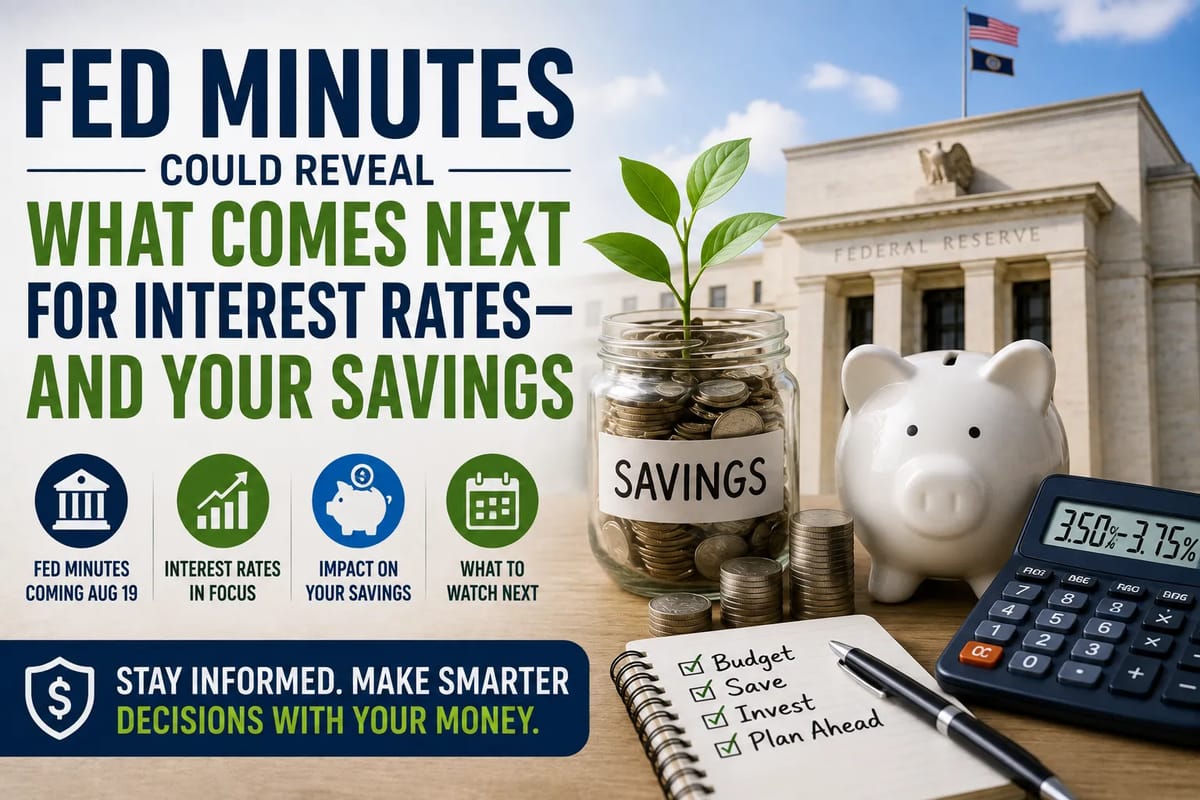
The minutes from the July 28–29 meeting are scheduled for August 19, three weeks after the policy decision. They could reveal how broad the disagreement was inside the committee, how officials assessed inflation and employment risks, and what conditions might push policymakers toward a rate increase, a cut or another pause.
For savers, the implications are significant.
The direction of Federal Reserve policy can influence the rates available on savings accounts, money-market products and certificates of deposit. It can also affect borrowing costs, which means the same decision that changes what savers earn can influence what consumers pay on loans and credit.
For a broader explanation of how monetary policy, inflation, employment and other economic data interact, see this complete guide to economic indicators.
Why the July Fed Decision Was Different
The Federal Reserve did not simply leave rates unchanged in July.
It did so while three voting members wanted rates to move higher.
That matters because the June meeting had ended with the target range unchanged at 3.5% to 3.75%, with no recorded dissent on that policy action.
By July, the disagreement had become more visible.
The official statement said economic activity was expanding at a solid pace, productivity growth and capital investment were strong, and job gains had kept pace with the workforce. At the same time, the Fed said inflation remained above its 2% objective, partly because of supply shocks affecting sectors including energy.
That combination creates a difficult policy problem.
If inflation remains too high, cutting rates could risk adding pressure to prices.
If the economy or labor market weakens significantly, keeping rates high for too long could unnecessarily restrict economic activity.
The minutes could show how officials are weighing those competing risks.
The Three Dissenting Votes Deserve Attention
The three officials who preferred a quarter-point increase are likely to be closely examined when the minutes are released.
Their dissent does not mean the Fed is preparing to raise rates at its next meeting.
It does, however, demonstrate that there is a meaningful hawkish argument inside the committee.
That could become particularly important if inflation remains stubbornly above target.
The minutes may reveal whether the three dissenters were isolated or whether a larger group of officials expressed sympathy with some of their concerns while ultimately voting for no change.
That distinction could influence how markets interpret the next meeting.
What the Minutes Could Reveal About a September Move
The Fed’s next scheduled policy meeting is September 15–16, and it will be a two-day meeting associated with a new Summary of Economic Projections.
That makes the August minutes one of the last major pieces of information from the July meeting available before September’s decision.
Investors and economists will therefore be looking for clues about how policymakers approached:
- Inflation
- Employment
- Economic growth
- Consumer spending
- Energy prices
- Financial conditions
- Risks surrounding monetary policy
- The appropriate path for future rates
The minutes will not provide a guarantee of what happens in September.
Federal Reserve officials will have access to new economic data between the July and September meetings, and the committee can change its assessment as conditions change.
Still, the discussion can reveal how officials were thinking at the time.
Why Savings Accounts Care About the Fed
The federal funds rate is not the rate consumers receive directly on ordinary savings accounts.
Instead, it is a key short-term interest-rate benchmark that influences broader financial conditions.
When the Fed raises or lowers its policy rate, banks and other financial institutions can adjust the rates they offer on deposits and charge on loans.
The relationship is not always immediate or one-for-one.
A bank may lower its savings rate by less than the Fed’s move, move at a different time or keep its rate unchanged because of its own funding needs and competitive strategy.
That means savers should not assume that a Fed decision automatically translates into the same percentage-point change in their account.
The relationship between policy decisions and borrowing and saving costs is also central to understanding interest rates and their effects.
Savers Have Already Seen How Rate Cycles Can Change
The difference between a low-rate and high-rate environment can be substantial for people holding significant amounts of cash.
When market interest rates are higher, financial institutions have more incentive to compete for deposits.
When rates fall, the incentive to offer exceptionally attractive savings yields can diminish.
That is why a saver who became accustomed to earning a relatively strong return on cash should not assume that rate will remain available indefinitely.
The broader direction of monetary policy will therefore remain relevant to anyone relying on interest income from cash.
High-Yield Savings Accounts Could Feel the Impact
High-yield savings accounts are among the deposit products most likely to respond to changes in the interest-rate environment.
These accounts can offer substantially more than traditional savings accounts, although the exact rate varies by institution and can change over time.
When the broader rate environment moves lower, high-yield account rates can also decline.
That does not necessarily make them unattractive.
A savings account can still provide liquidity, safety within applicable deposit-insurance limits and a competitive return relative to a traditional account.
But savers should understand that a high advertised annual percentage yield is not necessarily permanent.
CDs Offer a Different Choice
Certificates of deposit can provide another strategy for savers who do not need immediate access to their money.
A CD generally pays a stated rate for a specified period, subject to the account’s terms and any early-withdrawal restrictions.
That can make CDs particularly interesting when savers believe rates may decline.
Locking in a competitive rate for a fixed period can provide predictability even if new deposit rates fall later.
But there is a trade-off.
If rates rise after you lock your money into a CD, you may be stuck earning the older rate unless you accept any applicable early-withdrawal consequences.
The decision therefore depends partly on your expectations and, more importantly, when you will need the money.
A Fed Pause Can Be Good News for Some Savers
If the Federal Reserve keeps rates unchanged for an extended period, deposit rates may also remain relatively attractive compared with the low-rate environment that existed in earlier years.
For savers, a pause can provide more time to earn interest before rates potentially move lower.
But even in a stable-rate environment, banks do not have to maintain the same deposit rates indefinitely.
This is one reason it can be useful to compare accounts periodically rather than assuming the rate attached to an existing account remains competitive.
A Fed Hike Could Extend the Savings-Rate Window
The July decision is particularly interesting because three officials wanted higher rates.
If the Fed eventually raises rates, some deposit products could become more attractive or remain elevated for longer.
A higher policy rate generally increases the opportunity cost of keeping money in low-yield accounts, which can encourage banks to compete more aggressively for deposits in certain circumstances.
But savers should not interpret a dissenting vote as evidence that a hike is imminent.
The majority chose to hold rates steady, and future decisions will depend on incoming economic data.
A Fed Cut Could Change the Savings Equation
A rate cut would create the opposite challenge.
Banks could reduce deposit rates, particularly if the broader market moves lower.
For savers, that could mean less interest income from cash.
Someone earning 4% on $10,000, for example, receives roughly $400 in annual interest before taxes if that rate remains unchanged for a full year.
At 3%, the same balance would generate about $300.
That simple example illustrates why even seemingly small changes in interest rates can matter when balances are large or money remains saved for many years.
Actual returns will vary because rates can change, interest may compound, and taxes can affect the amount ultimately retained.
Savers Should Not Wait for the Minutes to Act Blindly
The release of the Fed minutes may influence financial markets, but personal savings decisions should not depend entirely on predicting the next Fed move.
Trying to guess whether rates will rise or fall can lead to unnecessary decisions.
Instead, consider the purpose of your money.
Emergency savings generally need accessibility and stability.
Money needed for a purchase within the next year may require a different strategy from retirement savings that will not be touched for decades.
A long-term investor also has different options from someone who simply wants a safe place to hold cash.
The right account depends on the job the money needs to perform.
Emergency Savings Should Prioritize Access
An emergency fund exists primarily to protect against unexpected expenses.
That could include:
- Medical bills
- Vehicle repairs
- Home repairs
- Job loss
- Unexpected travel
- Major household expenses
Because emergencies do not follow interest-rate forecasts, accessibility matters.
A slightly higher yield may not be worth sacrificing convenient access to money when you need it.
This is why liquid savings accounts can remain useful even when CDs or other products offer potentially higher rates.
Don’t Ignore the Cost of Debt
The Fed’s decisions affect borrowers as well as savers.
Credit cards, variable-rate loans and other forms of borrowing can be influenced by changes in broader interest rates.
That means someone earning extra interest on savings may simultaneously be paying much more in interest on debt.
For a household carrying expensive revolving debt, paying down that balance can sometimes produce a more predictable financial benefit than chasing a slightly higher savings yield.
The mathematics depend on the specific rates and circumstances, but the principle is straightforward:
Look at both sides of your balance sheet.
Inflation Matters Just as Much as the Savings Rate
A savings account can pay interest while your money still loses purchasing power.
The reason is inflation.
If your account earns 3.5% but prices rise by 4%, the nominal balance is growing while its purchasing power is declining.
The Fed’s 2% inflation objective is therefore directly relevant to savers.
This does not mean cash is a bad place for money.
Cash serves an important role for emergencies, short-term goals and financial stability.
But long-term wealth building generally requires thinking about both nominal returns and purchasing power.
Savers also need to understand the household impact of changing prices, which is explained in how inflation affects everyday finances.
The Danger of Leaving Cash in a Low-Rate Account
One of the easiest mistakes savers can make is leaving money in an account that pays little interest simply because it is convenient.
A bank may have competitive checking services while paying a very low rate on savings.
If you have a large cash balance, the difference between a low-yield account and a competitive deposit product can become meaningful over time.
The Fed’s rate decisions create the broader environment, but individual banks still determine the rates they offer.
Consumers can therefore have some control over the outcome by comparing accounts.
What to Look for When Comparing Savings Accounts
Don’t focus exclusively on the headline rate.
Consider:
APY
The annual percentage yield shows the annualized return, taking compounding into account under the account’s stated assumptions.
Fees
A monthly maintenance fee can erase part of your interest earnings.
Minimum Balance Requirements
Some accounts require a minimum balance to earn the advertised rate.
Withdrawal Rules
Check how easily you can access the money and whether the account imposes restrictions.
Rate Conditions
Some promotional rates apply only for a limited period or require specific activities.
Deposit Insurance
Verify that the institution and account are covered by the applicable deposit-insurance system and understand the coverage limits.
Account Access
A high rate is less useful if accessing your money is unnecessarily difficult.
What the Fed Minutes Cannot Tell You
It is tempting to treat the minutes as a roadmap for the next interest-rate decision.
They are not.
The minutes describe the committee’s discussion around a specific meeting.
By the time the next meeting arrives, inflation, employment, energy prices, financial conditions and other economic indicators may have changed.
The Fed itself emphasizes that monetary policy decisions are made with attention to its dual mandate and evolving economic conditions.
The minutes can reveal the debate.
They cannot eliminate uncertainty.
The September Meeting Could Be Especially Important
The September meeting is scheduled for September 15–16 and is one of the 2026 meetings associated with a Summary of Economic Projections.
That makes it a particularly important date for markets.
The projections can provide additional information about how policymakers see the economy and the likely path of monetary policy.
For savers, September could therefore become a more important checkpoint than the August minutes alone.
The minutes may establish the debate.
The September decision and projections could show whether that debate has changed the Fed’s policy outlook.
How Different Scenarios Could Affect Your Savings
The simplest way to think about the situation is through three broad possibilities.
| Fed direction | Possible savings impact | What savers might consider |
|---|---|---|
| Rates stay higher for longer | Deposit yields may remain relatively attractive | Compare high-yield accounts and consider whether locking some money into a CD makes sense |
| Rates rise | Some deposit rates could move higher | Avoid assuming today’s rate is the peak; continue comparing accounts |
| Rates fall | Savings and CD yields could decline | Consider whether locking in a competitive fixed rate fits your goals |
These are broad possibilities rather than predictions.
Individual banks can move differently, and financial markets often anticipate Fed decisions before they happen.
Don’t Build Your Budget Around Today’s Savings Rate
A common budgeting mistake is treating interest income as guaranteed monthly income.
If your savings account currently pays a high yield, that rate can change.
A household relying heavily on interest income should therefore avoid assuming today’s APY will remain unchanged indefinitely.
Instead, consider using a conservative estimate when planning recurring expenses.
This is particularly important for retirees and others who rely on cash interest as part of their income.
Keep Short-Term Money Separate From Long-Term Investments
Not every dollar needs the same strategy.
A useful framework is to separate money according to when you expect to need it.
Immediate needs: checking or readily accessible savings.
Emergency fund: liquid savings or another low-risk, accessible vehicle.
Near-term goals: potentially savings, money-market products or CDs depending on timing and access requirements.
Long-term goals: investments appropriate for the time horizon and risk tolerance.
The Federal Reserve’s rate decisions matter to all of these categories, but they do not determine the right allocation by themselves.
The Bigger Message for Savers
The upcoming minutes arrive at an interesting moment.
The Fed has held the federal funds target at 3.5% to 3.75%, but the July decision was not unanimous. Three officials wanted a quarter-point increase, while the majority chose to remain on hold. Inflation was still described as elevated relative to the Fed’s 2% goal.
That combination suggests the interest-rate debate is far from settled.
The August 19 minutes could show whether the disagreement was deeper than the final vote suggested and how policymakers assessed the risks surrounding inflation, employment and economic growth.
For savers, the practical lesson is less about predicting the exact next Fed move and more about making sure your cash is positioned appropriately for several possible rate environments.
What Savers Can Do Before Wednesday
The Fed minutes may provide new clues, but you do not need to wait for them to improve your savings strategy.
Check the interest rate currently being paid on your savings account.
Compare it with competing accounts.
Review whether you have money sitting unnecessarily in a low-yield account.
If you have a CD coming due, consider your likely need for the funds and the range of rates available before automatically renewing it.
And if you are carrying high-interest debt, compare the guaranteed benefit of reducing that debt with the after-tax return available from your savings.
The Federal Reserve will determine monetary policy.
But you still have control over where you keep your money, how much interest you earn and whether your savings strategy is prepared for rates to move higher, stay elevated or eventually decline.