Complete Guide to Credit Scores and Credit Reports
Your credit history can influence how easily you borrow money, the terms a lender offers you, and how financial institutions assess your risk as a borrower.
Yet many people only think about their credit profile when they are applying for a loan and something goes wrong.
By then, an overlooked missed payment, outdated information, an account you don’t recognize, or an old debt can become an unpleasant surprise.
Understanding credit scores and credit reports gives you a chance to see what lenders may see before you need to apply for credit.
In Kenya, credit information is collected and managed through licensed Credit Reference Bureaus (CRBs), which operate under regulations overseen by the Central Bank of Kenya. The country’s credit-reporting framework allows positive as well as negative credit information to be shared, giving lenders a broader picture of a borrower’s credit history.
Whether you’re planning to apply for a personal loan, mortgage, business financing, credit card, or simply want to understand your financial position better, this guide explains how credit scores and credit reports work and what you can do to maintain a healthier credit profile.
For a broader overview of credit cards, loans, debt management, and other credit-related tools, see the Complete Guide to Credit Tools.
What Is a Credit Report?
A credit report is a detailed record of your credit history.
It can contain information about your borrowing and repayment behavior, current credit obligations, payment history, and other information relevant to assessing your creditworthiness.
A typical report may include:
- Personal identification information
- Credit accounts
- Current and previous loans
- Repayment history
- Outstanding balances
- Late or missed payments
- Defaults
- Credit applications or inquiries
- Information supplied by participating credit providers
Kenya’s CRB regulations define credit information broadly to include positive and negative information relating to a person’s creditworthiness, credit standing, credit capacity, credit history, assets, and financial obligations.
Your credit report is therefore much more than a simple list of unpaid loans.
It is intended to provide a picture of how you have handled credit over time.
What Is a Credit Score?
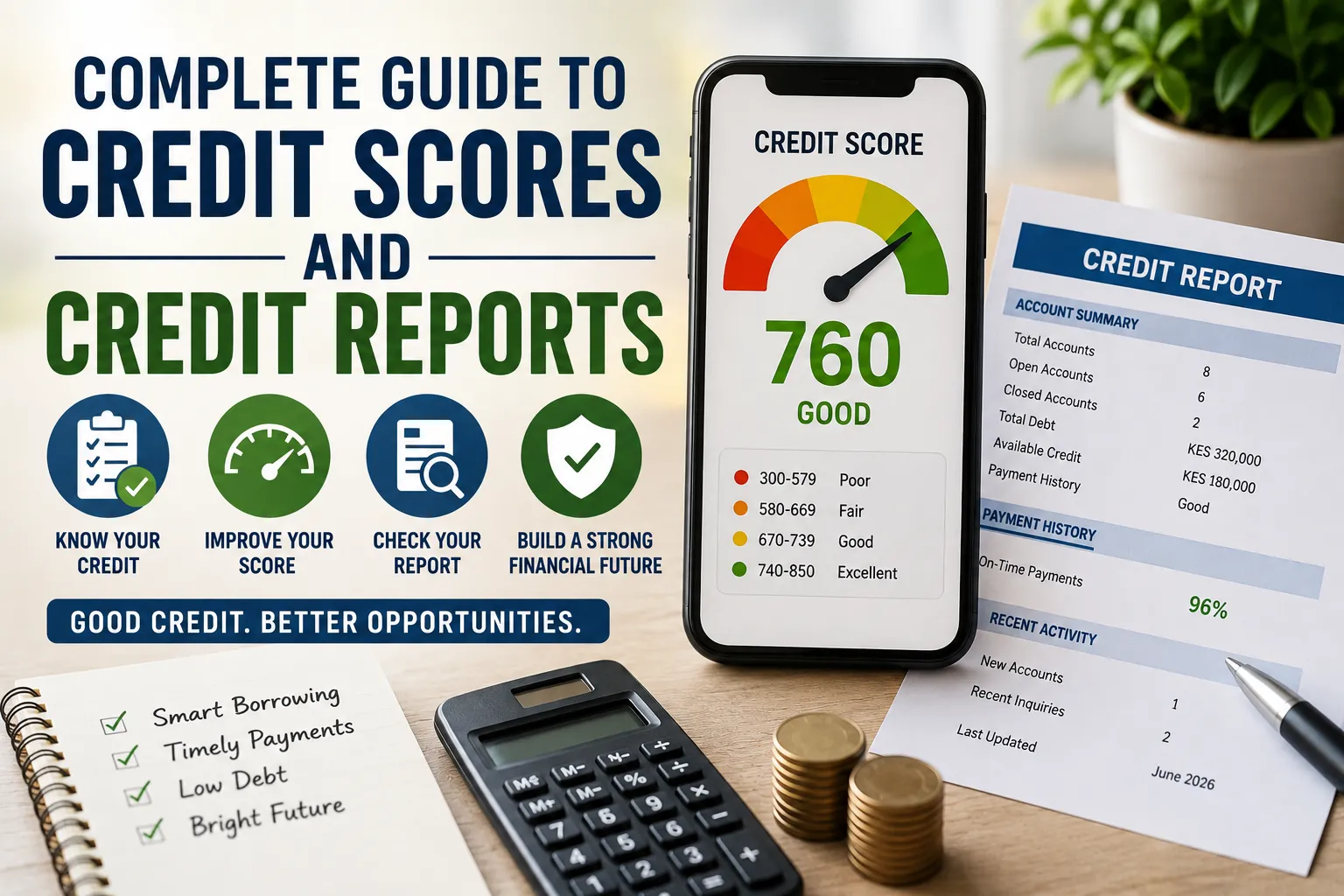
A credit score is a numerical assessment of credit risk based on information contained in a credit profile.
Instead of reading through an entire credit report, a lender can use a score as one indicator of how likely a borrower may be to repay credit according to agreed terms.
Credit scoring models can consider factors such as:
- Payment history
- Existing debt
- Credit utilization
- Length of credit history
- Recent credit activity
- Types of credit accounts
- Outstanding balances
- Previous defaults
However, there is no single universal credit score that every lender uses.
Different CRBs can use different scoring models and ranges. For example, Creditinfo Kenya describes its score as ranging from 250 to 900, while other providers may use different scales.
This is why comparing a score from one provider directly with a score from another can be misleading.
Credit Score vs. Credit Report: What’s the Difference?
The easiest way to understand the difference is to think of the report as the full story and the score as a summary assessment.
| Credit Report | Credit Score |
|---|---|
| Detailed record of credit history | Numerical assessment of credit risk |
| Contains account-level information | Summarizes risk using a scoring model |
| Shows repayment information | Indicates how the scoring model views the information |
| Can contain positive and negative information | Can change as underlying information changes |
| Useful for identifying errors | Useful as a quick indicator of credit standing |
You should ideally review both.
A score can tell you that something has changed, but the report can help you understand why.
How Credit Scores Work in Kenya
Credit scoring in Kenya is not based on a single nationwide formula that produces an identical number for everyone.
Different CRBs have their own scoring methodologies.
Credit scoring can take information such as repayment behavior and indebtedness into account.
That means there isn’t a universal rule such as:
“If you have exactly this number, every Kenyan lender will approve your loan.”
Lenders may use a credit score alongside other information, including income, affordability, employment or business circumstances, existing obligations, and their own lending policies.
A good credit score can improve your prospects, but it does not guarantee loan approval.
What Factors Can Affect Your Credit Score?
Although scoring models differ, certain behaviors commonly matter.
1. Payment History
How you repay credit is one of the most important parts of a credit profile.
Regularly paying according to your loan agreement can help demonstrate responsible credit behavior.
Late payments, missed payments, and defaults can have the opposite effect.
This is one reason financial experts repeatedly emphasize paying obligations on time.
2. Existing Debt
The amount of debt you already carry can influence how lenders view your ability to take on additional obligations.
Someone with several outstanding loans may be considered a higher risk than someone with relatively little existing debt, depending on income and repayment capacity.
3. Credit Utilization
For revolving credit such as credit cards, the amount of available credit you’re using can be relevant.
For example, consistently using nearly all of an available credit limit may indicate greater financial pressure than using a smaller portion.
The exact effect depends on the scoring model and lender.
4. Credit History
A longer history of responsibly managed credit can provide more information about how you behave as a borrower.
However, simply having a long credit history does not guarantee a high score.
Responsible repayment remains important.
5. Recent Credit Activity
A sudden increase in loan applications can sometimes affect how lenders perceive your credit behavior.
Multiple applications in a short period may suggest that a borrower is actively seeking additional credit.
This doesn’t mean you should avoid applying for necessary credit. It means you should apply deliberately rather than submitting applications indiscriminately.
6. Defaults and Arrears
Serious payment problems can have a significant impact on a credit profile.
If an account becomes non-performing, the lender may report the relevant information according to applicable regulations and procedures.
In Kenya, the CRB framework includes requirements concerning notification when loans become non-performing and when information is first listed.
What Is a CRB Listing?
A CRB listing refers to credit information submitted to a Credit Reference Bureau.
It is important to understand that being listed with a CRB does not automatically mean you are a bad borrower.
CRB records can contain both positive and negative information.
The idea that “being on CRB” automatically means someone has a negative credit record is therefore misleading.
What matters is what the report actually says.
What Does Being “Blacklisted” Mean?
“Blacklisted” is a common term in everyday conversations about CRBs, but it can oversimplify what a credit report actually contains.
A person can have a credit record without being in default.
The more useful questions are:
- What accounts appear on the report?
- Are payments up to date?
- Are there outstanding defaults?
- Is the information accurate?
- Has the debt actually been settled?
- Are there accounts you don’t recognize?
Instead of asking whether you’re “blacklisted,” ask for your credit report and examine the underlying information.
Why Your Credit Report Matters
Your credit report can help you understand your financial position before you apply for credit.
Regularly reviewing it can help you:
- Detect inaccurate information
- Identify accounts you don’t recognize
- Check whether repayments are being reflected correctly
- Understand outstanding obligations
- Monitor changes in your credit profile
- Identify potential identity theft
- Prepare for future borrowing
A report is especially valuable when you’re planning a major financial application.
You don’t want to discover a reporting problem on the same day you are applying for a mortgage or business loan.
How to Get Your Credit Report in Kenya
Kenya’s CRB framework gives individuals rights relating to access to their credit information, including access to a personal credit report and correction of erroneous or outdated information under applicable rules.
Kenya has licensed CRBs through which consumers can access credit information.
The safest approach is to use the official channels of a licensed CRB rather than giving your personal identification information to an unknown website or intermediary.
Why You Should Check Your Report Before Applying for a Loan
Imagine applying for a loan and being told that your credit profile contains an unresolved default.
You believe you’ve already paid the debt.
If you haven’t checked your report, you may not know whether:
- The lender failed to update the account
- The payment was allocated incorrectly
- A balance remains outstanding
- The information belongs to another account
- The record is outdated
- There is an identity or data error
Checking beforehand gives you time to investigate and resolve potential problems.
What to Look for on Your Credit Report
Don’t simply download your report and put it away.
Read it carefully.
Check Your Personal Details
Make sure your name and identification information are accurate.
Incorrect personal information can create confusion and may need correction.
Check Every Credit Account
Look through the listed accounts.
Ask yourself:
Do I recognize this lender?
If an account doesn’t look familiar, investigate it immediately.
Check Outstanding Balances
Compare reported balances with your own records.
If you’ve recently cleared a loan, check whether the relevant information has been updated.
Review Payment History
Look for missed payments or arrears you don’t recognize.
If something appears incorrect, keep evidence of your payments.
Check Recent Credit Applications
Review inquiries or applications associated with your profile where the report provides that information.
Unrecognized activity can be a warning sign that requires investigation.
What If Your Credit Report Contains an Error?
Don’t ignore it.
If you find inaccurate or outdated information, contact the relevant CRB and follow its dispute process.
Keep documentation such as:
- Loan statements
- Payment confirmations
- Bank statements
- Settlement letters
- Receipts
- Emails
- SMS confirmations
- Correspondence with the lender
Evidence can make it easier to establish what happened.
How to Dispute Incorrect Information
A practical process is:
Step 1: Identify the Error
Write down exactly what information is incorrect.
Step 2: Gather Evidence
Collect documents showing the correct information.
Step 3: Contact the CRB
Use the bureau’s official dispute-resolution process.
Step 4: Contact the Lender
If the lender supplied the incorrect information, notify the lender as well.
Step 5: Keep Records
Save copies of correspondence, reference numbers, receipts, and responses.
Step 6: Escalate When Necessary
If the issue isn’t resolved satisfactorily, applicable regulations provide avenues for further dispute resolution.
How Long Does It Take to Improve a Credit Score?
There is no universal timeline.
A credit score reflects information in your credit profile, and different scoring models respond differently to changes.
If you’ve made late payments in the past, simply paying one bill on time doesn’t instantly erase the history.
What helps is establishing a consistent pattern of responsible credit behavior.
That means:
- Paying on time
- Reducing excessive debt
- Avoiding unnecessary borrowing
- Keeping accounts in good standing
- Checking your credit report
- Correcting inaccurate information
Improvement is generally a process rather than a quick fix.
Does Paying Off a Loan Improve Your Credit Score?
Paying off debt is generally positive from a financial-management perspective, but the effect on a credit score isn’t necessarily immediate or identical across scoring models.
A paid-off account can become part of your credit history and demonstrate that an obligation was settled.
However, credit scoring considers multiple factors.
Paying off a loan doesn’t automatically produce a particular score increase.
The broader goal should be to maintain responsible credit behavior rather than trying to manipulate a score through isolated actions.
What Happens If You Have Never Borrowed?
Having no credit history isn’t necessarily the same as having bad credit.
If you’ve never used a credit product, there may simply be limited information available for a scoring model to assess.
Consumers who have never taken out credit may not have a credit score because they haven’t established a credit history on which the model can assess repayment behavior.
This can create a challenge for young adults or people who have historically relied entirely on cash.
It also highlights why a credit score should not be interpreted as a complete measure of someone’s financial health.
Good Credit Does Not Mean You Should Borrow More
A high credit score can make it easier to qualify for certain financial products.
But that doesn’t mean borrowing more is automatically a good idea.
A lender may be willing to give you a larger loan than you can comfortably afford.
Your credit score answers a different question:
How does your credit history indicate you may handle borrowed money?
It doesn’t answer:
Should you borrow this money?
Before accepting credit, consider your income, expenses, existing obligations, emergency savings, and the total cost of the loan.
Credit Score vs. Affordability
These are two different concepts.
Creditworthiness
How likely you appear to be to repay borrowed money based on your credit history and other relevant information.
Affordability
Whether your current income and financial obligations allow you to comfortably make the proposed payments.
You can have a good credit history and still be unable to afford a particular loan.
Likewise, someone with limited credit history may have a stable income and strong ability to repay.
Responsible lenders may therefore consider multiple factors rather than relying on a score alone.
Common Credit Score Myths
Myth 1: Being Listed With a CRB Is Automatically Bad
Not true.
CRB records can contain positive and negative information.
Myth 2: There Is One Universal Credit Score
Not necessarily.
Different CRBs and lenders can use different scoring models.
Myth 3: A Good Credit Score Guarantees a Loan
It doesn’t.
Lenders can consider income, affordability, existing debt, loan purpose, internal policies, and other information.
Myth 4: Paying a Debt Erases Its Entire History Immediately
Not necessarily.
Payment and settlement information may remain part of the broader credit history according to applicable reporting rules and the bureau’s records.
Myth 5: You Should Take Loans Just to Build a Score
Borrowing money you don’t need can create unnecessary costs and risks.
Credit should be used strategically, not simply to generate a score.
Myth 6: Checking Your Own Credit Report Is the Same as Applying for a Loan
A consumer checking their own report is different from a lender accessing credit information as part of a credit application.
The details can vary by system and report, so read the applicable bureau information carefully.
How to Build a Stronger Credit Profile
There is no shortcut that replaces responsible financial behavior.
Pay on Time
Treat loan and credit payments as fixed financial obligations.
Set reminders or automate payments where appropriate.
Borrow What You Can Afford
Don’t take the maximum amount simply because a lender offers it.
Avoid Unnecessary Defaults
If you’re struggling to make a payment, contact the lender early rather than waiting until the situation becomes severe.
Monitor Your Credit Report
Review your report periodically so you know what is being reported.
Correct Errors
Don’t allow incorrect information to remain unchallenged.
Manage Multiple Loans Carefully
Several small loans can still create a substantial monthly repayment burden.
Look at your total obligations rather than considering each loan separately.
If you have several debts to manage, structured repayment strategies can help. See How Debt Repayment Tools Help Plan Debt Payoff.
Keep Financial Records
Save proof of payments and loan settlements.
Documentation can be extremely useful if a reporting dispute arises.
What to Do If You Are Struggling With Debt
A damaged credit profile is often a symptom of a deeper financial problem.
If debt repayments are consuming too much of your income, focus on the underlying situation rather than simply trying to improve the score.
Start by listing:
- Every outstanding loan
- Interest rates
- Monthly payments
- Remaining balances
- Due dates
- Essential household expenses
Then look for ways to stabilize your cash flow.
Depending on the circumstances, this could involve reducing discretionary spending, increasing income, restructuring eligible debt, or speaking directly with creditors.
Ignoring the problem usually makes it harder to solve.
For another perspective on managing borrowing obligations, see How to Manage Household Debt and Pay Off Multiple Debts.
Protect Your Personal Credit Information
Credit reports contain sensitive personal and financial information.
Be cautious about where you enter:
- National identification details
- Phone numbers
- Bank information
- Loan information
- Passwords
- One-time passwords
- Account credentials
Use official CRB websites, applications, offices, or approved channels when accessing your credit information.
Never share an OTP or banking password with someone claiming they need it to “clear your CRB.”
A legitimate dispute process should not require you to surrender control of your banking credentials.
Be Wary of CRB-Clearing Scams
The financial consequences of a poor credit record can make people vulnerable to scams.
Be skeptical of anyone promising to:
- Instantly erase a legitimate default
- Guarantee a perfect credit score
- Remove every negative record for a fee
- Obtain a loan regardless of your credit history
- Circumvent a lender’s assessment
- “Hack” a CRB database
If information is genuinely inaccurate, use the formal dispute process.
If a legitimate debt exists, be cautious about anyone promising a magical way to make it disappear.
How Credit Scores Can Affect Borrowing Costs
A lender’s assessment of your credit risk can influence the terms offered to you.
Depending on the institution and product, creditworthiness can affect:
- Approval decisions
- Interest rates
- Credit limits
- Loan amounts
- Collateral requirements
- Other lending terms
However, these decisions are lender-specific.
A score is one piece of the lending process rather than a universal price tag attached to a borrower.
Prepare Your Credit Profile Before a Major Loan
If you’re planning to apply for a major loan, don’t wait until application day to check your credit history.
Several months beforehand:
- Obtain your credit report.
- Review all listed accounts.
- Check repayment information.
- Identify unfamiliar accounts.
- Resolve inaccurate information.
- Reduce unnecessary debt where possible.
- Avoid taking on unnecessary new credit.
- Organize proof of income and repayment records.
- Compare lenders based on the total cost of borrowing.
This preparation can help you enter the application process with a clearer picture of your financial position.
A Simple Monthly Credit-Health Routine
You don’t need to obsess over your credit score.
A simple routine can be enough.
Every Month
- Pay credit obligations on time.
- Review your loan balances.
- Check your budget.
- Avoid unnecessary borrowing.
- Keep payment confirmations.
Periodically
- Review your credit report.
- Check for unfamiliar accounts.
- Confirm that settled debts are reflected appropriately.
- Dispute inaccurate information promptly.
Before Major Borrowing
- Check your credit profile.
- Calculate affordability.
- Compare lenders.
- Read the complete loan agreement.
- Understand interest, fees, penalties, and repayment requirements.
What a Healthy Credit Profile Really Looks Like
A healthy credit profile isn’t necessarily one with a perfect score.
It is a profile that accurately reflects responsible financial behavior.
That usually means:
- Payments are made on time.
- Debt is manageable.
- Accounts are in good standing.
- Credit information is accurate.
- Defaults are addressed rather than ignored.
- Borrowing is deliberate.
- The borrower understands their obligations.
A score is useful because it summarizes some of this information.
But the underlying behavior matters more than the number itself.
Make Your Credit Report a Financial Checkup
Your credit report shouldn’t be something you see only after a loan application goes wrong.
Treat it like a financial checkup.
Just as you review a bank statement to understand where your money is going, reviewing your credit report can show you what lenders and credit providers may see about your borrowing history.
For Kenyan consumers, access to credit information and the ability to dispute inaccurate information provide useful tools for taking control of that record.
The most valuable habit is simple: know what is on your report before someone else needs to make a decision based on it.
A credit score can change. A financial setback can be recovered from. An error can potentially be corrected.
What matters is building a consistent pattern of responsible borrowing, timely repayment, careful debt management, and regular monitoring.
Your credit profile is not your entire financial identity—but understanding it can give you much more control over the financial opportunities that come next.
This article is for general educational purposes and is not personalized financial, legal, or credit advice. Credit-scoring models, reporting practices, lender policies, and regulations can change. For a specific dispute or borrowing decision, consult the relevant licensed CRB, lender, or qualified financial professional.