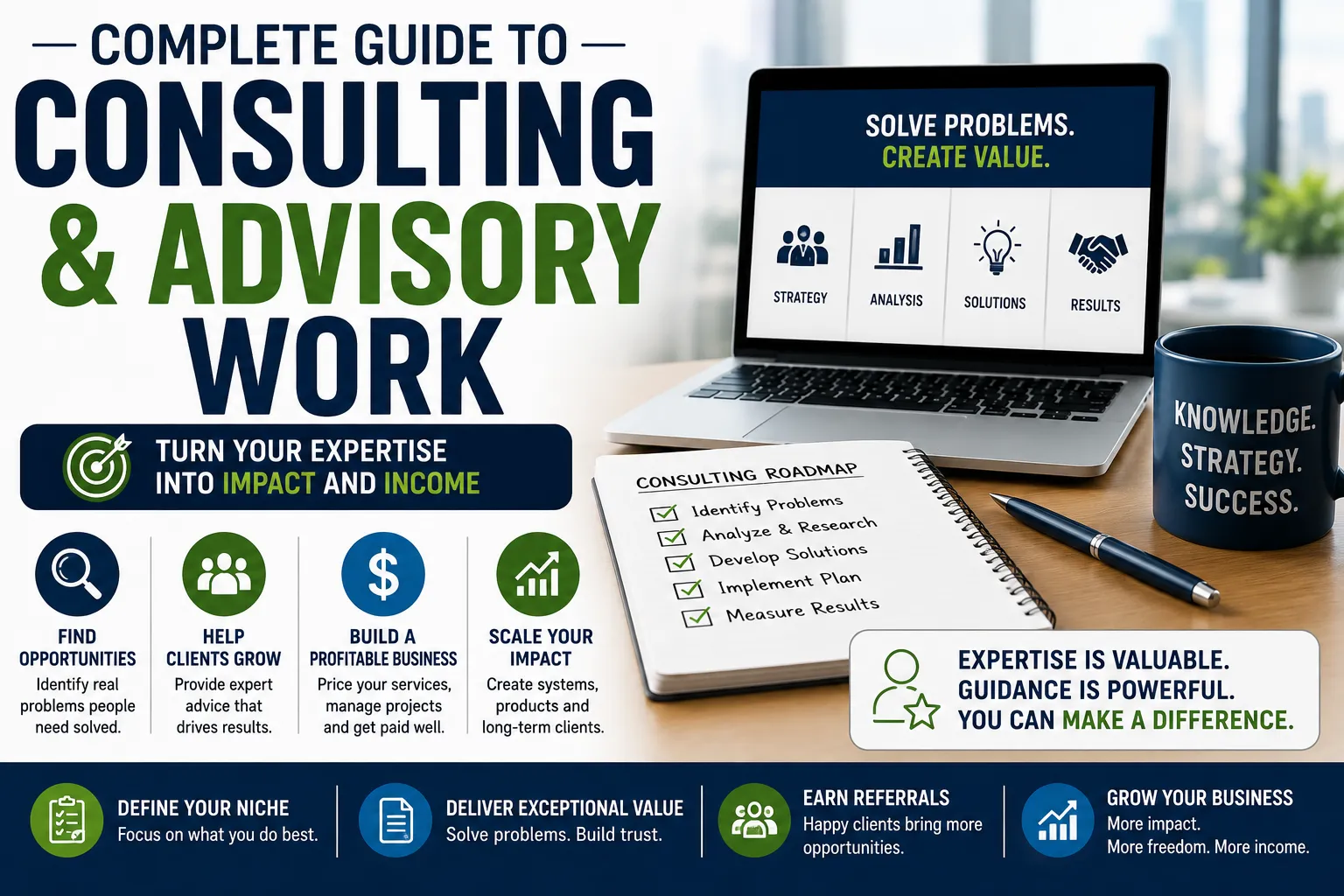
Complete Guide to Consulting and Advisory Work
Consulting and advisory work has become an increasingly accessible way for professionals to turn specialized knowledge into income.
You do not necessarily need a large company, expensive office or hundreds of employees to become a consultant. In many fields, businesses and individuals are willing to pay for expertise that helps them solve problems, improve performance, reduce costs, make decisions or reach specific goals.
A consultant might help a small business improve its marketing. A technology specialist might advise a company on software and cybersecurity. An accountant might provide financial guidance. A former executive might advise startups on strategy. Even highly specialized knowledge in areas such as human resources, operations, design, sales or project management can potentially become a consulting service.
But consulting is more than simply being good at something.
Successful consultants need to identify valuable problems, communicate solutions clearly, attract clients, structure projects, price their services and consistently deliver results.
This guide explains how consulting and advisory work operates, how to choose a niche, how to find clients, how to price your services and how to build a sustainable consulting business.
For a broader look at independent professional work, see the complete guide to freelancing and independent work.
What Is Consulting?
Consulting involves providing specialized knowledge, analysis, recommendations or services to a client in exchange for payment.
A consultant is generally brought in because the client:
- Has a problem they cannot easily solve internally.
- Needs specialized expertise.
- Wants an independent perspective.
- Needs additional capacity for a project.
- Wants to improve a particular area of the business.
- Is considering a major decision.
- Needs temporary expertise without hiring a full-time employee.
Consulting can be highly specialized or relatively broad.
For example, one consultant might help restaurants reduce operating costs, while another might help technology companies develop cybersecurity strategies.
The most successful consulting offers usually have one thing in common: they solve a problem that the client considers valuable enough to pay to fix.
Consulting vs. Advisory Work
The terms consulting and advisory are often used interchangeably, but there can be a useful distinction.
Consulting
Consulting often involves diagnosing a specific problem and helping the client develop or implement a solution.
For example:
“Our sales conversion rate has fallen. Help us identify why and improve it.”
Advisory
Advisory work can involve providing ongoing guidance, perspective and decision support.
For example:
“Meet with our leadership team each month and advise us on strategic decisions.”
The distinction is not absolute.
Many professionals offer both consulting projects and ongoing advisory relationships.
Why Businesses Hire Consultants
Hiring an external expert can make sense for several reasons.
Specialized Expertise
A company may need knowledge it does not have internally.
Independent Perspective
An outside professional may identify problems that internal teams have become accustomed to overlooking.
Temporary Capacity
A business may need additional expertise for a few months without creating a permanent position.
Speed
An experienced consultant may solve a problem faster than an inexperienced internal team.
Cost Efficiency
For a specific project, hiring a consultant may be more practical than employing a full-time specialist.
Change Management
Organizations sometimes need outside support when implementing major changes.
Types of Consulting
Consulting is not one profession. It is an enormous category covering many industries.
Some common areas include:
- Business strategy
- Marketing
- Sales
- Finance
- Accounting
- Human resources
- Information technology
- Cybersecurity
- Software development
- Operations
- Project management
- Supply chain
- Legal and compliance support
- Design
- Public relations
- Communications
- Real estate
- Education
- Healthcare
- Sustainability
- Executive coaching
- Career consulting
The more specific the expertise, the easier it can sometimes be to communicate exactly why a client should hire you.
Generalist vs. Specialist Consulting
One of the first decisions a new consultant faces is whether to position themselves broadly or specialize.
Generalist
A generalist might offer:
“Business consulting for small companies.”
This gives you a broad potential market but may make differentiation more difficult.
Specialist
A specialist might offer:
“Customer-retention consulting for subscription-based software companies.”
The market is narrower, but the value proposition is much clearer.
Neither approach is automatically better.
However, specialization can make marketing, referrals and positioning easier because potential clients can immediately understand what you do.
How to Choose a Consulting Niche
A strong consulting niche usually sits at the intersection of three things:
What you know
What clients need
What clients will pay for
Start by listing your strongest professional skills.
Then ask:
- What problems have I solved repeatedly?
- What do people regularly ask me for help with?
- What results have I achieved?
- Which industries understand the value of my expertise?
- Which problems are expensive or frustrating for businesses?
- What work do I enjoy enough to do repeatedly?
Look for problems rather than simply job titles.
“Marketing consultant” is broad.
“Help local service businesses generate more qualified leads from Google” is much more specific.
Sell the Outcome, Not Just Your Expertise
Clients rarely wake up thinking:
“I need to purchase 20 hours of consulting.”
They usually have a problem.
They may want to:
- Increase sales
- Reduce expenses
- Save time
- Improve customer retention
- Launch a product
- Fix operational inefficiencies
- Enter a new market
- Improve employee performance
- Automate repetitive work
- Reduce risk
Your consulting offer should connect your expertise to the outcome the client wants.
Instead of saying:
“I provide business strategy consulting.”
Consider:
“I help growing service businesses identify their most profitable customer segments and build a practical growth plan.”
The second statement gives the potential client a clearer reason to continue the conversation.
Identify the Client’s Pain Point
Before creating an offer, understand the problem from the client’s perspective.
Ask:
- What is currently going wrong?
- How much is the problem costing them?
- How frequently does it occur?
- What have they already tried?
- Why haven’t previous solutions worked?
- What would solving the problem be worth?
- What happens if they do nothing?
The financial value of a problem often determines how much a client is willing to spend to solve it.
Build a Clear Consulting Offer
A consulting offer should answer five basic questions:
- Who is it for?
- What problem does it solve?
- What will you do?
- What does the client receive?
- What outcome should the client expect?
For example:
Small Business Sales Audit
For: Small businesses with declining sales conversion.
Includes:
- Sales-process review
- Customer journey analysis
- Competitor review
- Sales-team interviews
- Conversion analysis
- Written recommendations
- Strategy session
Outcome: A prioritized plan for improving the sales process.
This is much easier to sell than simply offering “sales consulting.”
Productize Your Consulting Services
One way to make consulting easier to sell is to package services into defined products.
Instead of:
“Contact me if you need consulting.”
You might offer:
Business Audit
A fixed-scope review followed by a written report.
Strategy Workshop
A focused session designed to solve a particular business problem.
Implementation Project
Hands-on support putting recommendations into practice.
Monthly Advisory
Ongoing strategic guidance through regular meetings and communication.
Productized services make it easier for prospective clients to understand what they are buying.
Common Consulting Business Models
There are several ways consultants can charge clients.
Hourly Consulting
The client pays for each hour worked.
For example:
$100 per hour × 10 hours = $1,000
Hourly billing is straightforward, but it can create a problem: your income becomes closely tied to the number of hours you can work.
Daily or Session-Based Rates
Some consultants charge per day or per session rather than per hour.
For example:
Strategy consulting: $1,000 per day
This can be useful for workshops, intensive reviews or on-site engagements.
Fixed-Project Pricing
The consultant charges a predetermined amount for a defined project.
For example:
Marketing audit and strategy: $3,000
This approach allows the client to understand the total cost before work begins.
It also allows the consultant to benefit from becoming more efficient.
Retainer Consulting
A retainer involves an ongoing relationship where the client pays a recurring fee for a defined level of access or service.
For example:
$2,000 per month for up to two strategy meetings, email advisory support and monthly performance reviews.
Retainers can provide more predictable revenue than one-off projects.
Performance-Based Pricing
Some consulting arrangements involve compensation tied partly to measurable results.
For example, a consultant might receive a fee based partly on:
- Revenue generated
- Cost savings
- Leads generated
- Sales achieved
Performance pricing can be attractive, but it can also create disagreements over attribution.
Before using this model, clearly define how results will be measured.
Value-Based Pricing
Value-based pricing focuses on the value of the outcome rather than simply the consultant’s time.
Suppose a consultant can realistically help a company identify an opportunity worth hundreds of thousands of dollars.
Charging solely for the number of hours spent may undervalue the expertise involved.
Value-based pricing requires a strong understanding of:
- Client economics
- Expected outcomes
- Risk
- Scope
- Competitive alternatives
It is usually easier to use once you have established credibility and a strong track record.
How Much Should a Consultant Charge?
There is no universal consulting rate.
Pricing depends on:
- Expertise
- Industry
- Geography
- Client size
- Complexity
- Urgency
- Scope
- Expected value
- Competition
- Reputation
- Demand
A beginner should not automatically copy the rates of a highly established specialist.
At the same time, pricing too low can create its own problems.
Very low prices can:
- Attract clients who demand excessive work.
- Make profitability difficult.
- Signal low perceived value.
- Leave little room for unexpected work.
Calculate Your Minimum Sustainable Rate
Start with your financial requirements.
Estimate:
- Desired annual income
- Business expenses
- Taxes
- Insurance
- Software
- Marketing
- Professional services
- Equipment
- Unpaid administrative time
- Vacation
- Sick days
Then estimate how many hours you can realistically bill.
You may work 40 hours per week, but not all 40 hours will be billable.
Time is also needed for:
- Sales
- Proposals
- Administration
- Marketing
- Learning
- Accounting
- Client communication
Your consulting rate needs to account for the entire business, not just the hours spent delivering client work.
Why Billable Hours Matter
Imagine a consultant works 40 hours per week.
That does not necessarily mean 40 billable hours.
Suppose only 25 hours are billable after accounting for administration, marketing and sales.
The remaining 15 hours still need to be financed by those 25 billable hours.
This is one reason consulting rates can appear high compared with a traditional employee’s hourly wage.
The consultant is responsible for many costs that an employer normally covers.
How to Find Your First Consulting Clients
Getting the first client is often harder than delivering the work.
Start with people who already know your capabilities.
Potential sources include:
- Former colleagues
- Previous employers
- Professional contacts
- Friends
- Industry groups
- Existing business relationships
- Former clients
- Professional communities
Tell people clearly what you are offering.
Don’t simply announce:
“I’m now a consultant.”
Instead:
“I’m helping small technology businesses improve their customer onboarding process. I’m currently taking on a few projects.”
That gives your network something specific to refer.
Use Your Existing Professional Network
Your existing network can be one of your strongest assets.
Make a list of people who:
- Know your expertise
- Work in your target industry
- Know business owners
- Work with companies that might need your service
- Can introduce you to decision-makers
Reach out individually rather than sending generic mass messages.
A personalized conversation is often more effective.
Referrals Can Become a Major Growth Channel
Satisfied clients can become a source of future business.
At the end of a successful project, ask:
“Do you know another business that might benefit from this type of work?”
You can also make referrals easier by clearly describing your ideal client.
For example:
“I’m particularly interested in helping e-commerce companies with customer-retention problems.”
A client may immediately think of someone who fits that description.
Build a Professional Online Presence
You don’t necessarily need an elaborate website when starting.
At minimum, potential clients should be able to understand:
- Who you are
- What you do
- Who you help
- What problems you solve
- What experience you have
- How to contact you
A professional LinkedIn profile, website or portfolio can provide credibility.
The important thing is clarity.
A strong professional identity can also support personal branding for income, particularly when your name and expertise become closely associated with a specific problem or market.
Use Case Studies to Demonstrate Results
Case studies are powerful because they turn abstract expertise into evidence.
A simple case study can explain:
Situation
What problem did the client face?
Action
What did you do?
Result
What changed?
For example:
A growing retailer had a high rate of abandoned online purchases. We analyzed the checkout process, identified several friction points and redesigned the customer journey. Within the following period, the company recorded a measurable improvement in completed purchases.
Use real figures when you have permission to share them.
Never fabricate results.
Build a Portfolio Even Without Many Clients
If you are new to consulting, you may not have many client case studies.
You can demonstrate expertise through:
- Industry analysis
- Sample audits
- Demonstration projects
- Research
- Public case studies
- Educational articles
- Workshops
- Relevant professional experience
Your portfolio should show potential clients how you think and solve problems.
Content Marketing for Consultants
Writing useful content can establish expertise before a prospect ever contacts you.
Possible topics include:
- Industry trends
- Common mistakes
- Practical guides
- Case studies
- Data analysis
- Tutorials
- Frequently asked questions
- Strategic frameworks
For example, an HR consultant could publish:
“Seven Signs Your Employee Onboarding Process Is Costing You Good Staff”
Someone experiencing that problem may naturally become interested in the consultant’s services.
LinkedIn for Consulting
Professional networking platforms can be particularly useful for consultants.
Instead of posting constant advertisements, share useful information.
You might publish:
- Lessons from projects
- Industry observations
- Short analyses
- Case studies
- Practical tips
- Client problems you’ve solved
- Research findings
The goal is to become associated with a particular problem or area of expertise.
Networking Without Being Pushy
Good networking is about building relationships rather than immediately asking everyone to buy something.
Attend:
- Industry conferences
- Business events
- Professional associations
- Local networking events
- Workshops
- Online communities
Ask people about their work.
Learn what challenges they are experiencing.
Over time, opportunities can emerge naturally.
Cold Outreach for Consultants
Cold outreach involves contacting potential clients who do not already know you.
It can work, but generic messages often perform poorly.
Instead of:
“Hi, I offer business consulting services. Let me know if you need help.”
Try:
“I noticed your company recently expanded into a new market. I work with businesses during expansion to identify operational bottlenecks before they become expensive. I put together three areas I would review first if I were assessing the transition.”
The message demonstrates relevance rather than simply announcing a service.
How to Qualify Potential Clients
Not every prospect is a good client.
Before accepting work, consider:
- Do they have a genuine problem?
- Can you solve it?
- Do they have the budget?
- Are they the decision-maker?
- Is the timeline realistic?
- Are expectations reasonable?
- Can you communicate effectively?
- Do you have the necessary information?
- Does the project fit your expertise?
A poor-fit client can consume more time than a good client.
The Discovery Call
A discovery call is an initial conversation designed to understand the client’s situation.
Don’t spend the entire call talking about yourself.
Ask questions such as:
- What problem are you experiencing?
- How long has it existed?
- What impact is it having?
- What have you tried already?
- What would success look like?
- Why do you want to address it now?
- Who else is involved in the decision?
- What timeline are you working with?
Listen carefully.
The discovery call should help both sides determine whether the engagement makes sense.
Don’t Give Away the Entire Solution During the Sales Call
It is useful to demonstrate expertise.
But a discovery call should not become a free consulting session lasting several hours.
Explain:
- What you see
- Why the problem matters
- How you would approach it
Then explain what the paid engagement will provide.
This protects your time while demonstrating competence.
Writing a Consulting Proposal
A good proposal should make the engagement easy to understand.
Include:
Problem
What issue are you solving?
Objectives
What should the project accomplish?
Scope
What work will you perform?
Deliverables
What will the client receive?
Timeline
When will the work happen?
Investment
How much will it cost?
Responsibilities
What must the client provide?
Terms
What are the payment and cancellation conditions?
Clear proposals reduce misunderstandings later.
Define Scope Carefully
Scope creep is one of the biggest risks in consulting.
A client may initially request:
“Review our marketing strategy.”
Then the project gradually becomes:
- Website redesign
- Social media management
- Email marketing
- Sales training
- Competitor research
- Graphic design
Unless those services were included, they represent additional work.
Define what is included and what is not.
How to Handle Scope Creep
When a client requests additional work, don’t simply say no.
Explain:
“That’s outside the current project scope. I can add it as a separate workstream for an additional fee.”
This keeps the relationship professional while protecting your time.
Consulting Contracts Matter
A written agreement should establish the expectations of both parties.
Depending on the engagement, it may address:
- Scope
- Fees
- Payment schedule
- Deliverables
- Deadlines
- Confidentiality
- Intellectual property
- Data handling
- Liability
- Cancellation
- Dispute resolution
The appropriate contract depends on your location and the nature of the work.
For significant engagements, consider having a qualified lawyer review your agreement.
Payment Terms
Don’t leave payment arrangements vague.
A project might use:
- Full payment upfront
- Deposit plus final payment
- Monthly billing
- Milestone payments
- Retainer payments
For larger projects, milestone payments can reduce financial risk for both sides.
Whatever model you use, put it in writing.
Ask for Deposits on Project Work
A deposit can help demonstrate commitment and reduce the risk of completing substantial work without receiving payment.
For example, a project might require:
- 50% before work begins
- 25% at an agreed milestone
- 25% upon completion
The appropriate structure depends on the project and client.
Delivering a Great Consulting Engagement
Getting the client is only the beginning.
Strong delivery creates:
- Repeat business
- Referrals
- Testimonials
- Case studies
- Retainers
- Reputation
At the beginning of the project, confirm:
- Objectives
- Timeline
- Communication channels
- Decision-makers
- Deliverables
- Responsibilities
Good project management can be as important as technical expertise.
Communicate Progress Regularly
Clients generally dislike uncertainty.
Even when everything is going well, provide updates.
A simple weekly update might include:
Completed
What has been done?
Current
What are you working on?
Next
What happens next?
Blockers
What information or decision do you need?
This can prevent small problems from becoming major misunderstandings.
Focus on Business Outcomes
Clients generally care about outcomes more than how many hours you worked.
Instead of emphasizing:
“I spent 15 hours analyzing your sales funnel.”
Explain:
“The analysis identified three major points where prospective customers are dropping out, giving the team a clear priority list for improving conversion.”
The second statement connects your work to value.
Measuring Consulting Results
Whenever possible, establish measurable outcomes before beginning.
Possible metrics include:
- Revenue
- Profit margin
- Conversion rate
- Customer retention
- Lead volume
- Operating costs
- Employee turnover
- Processing time
- Productivity
- Customer satisfaction
Not every consulting project can be reduced to a single number.
But defining success clearly helps demonstrate the value of your work.
Turning One-Off Clients Into Retainers
A successful project can create an opportunity for ongoing advisory work.
For example:
Project
Analyze the company’s marketing strategy.
Retainer
Review marketing performance every month and advise the leadership team.
This transition makes sense when the client has an ongoing need.
Don’t create unnecessary retainers simply to generate recurring revenue.
The service should provide genuine continuing value.
Scaling a Consulting Business
There is a limit to how many hours one person can sell.
Once demand grows, you can explore several options.
Raise Your Rates
Earn more from the same amount of work.
Productize Services
Create repeatable packages.
Hire Other Consultants
Delegate delivery while you focus on sales and strategy.
Build Digital Products
Turn expertise into:
- Courses
- Templates
- Reports
- Toolkits
- Books
- Memberships
Develop a Consulting Firm
Build a team capable of handling larger engagements.
For consultants looking to make income less dependent on directly selling their time, how to build scalable income over time provides a broader look at scalable income models.
Consulting vs. Freelancing
The terms overlap, but there can be a useful distinction.
A freelancer is often hired to perform a specific task.
A consultant is often hired to diagnose a problem and recommend or guide a solution.
For example:
Freelancer: “I will create your company’s website.”
Consultant: “I will assess your digital customer journey and recommend the technology, structure and strategy needed to improve conversions.”
Many professionals do both.
Consulting vs. Coaching
Coaching generally focuses more heavily on helping clients develop their own skills, decisions or performance.
Consulting tends to involve providing specialized expertise and recommendations.
For example:
Coach: Helps a business leader develop decision-making skills.
Consultant: Analyzes the business and recommends a new operating strategy.
Again, the boundaries are not always rigid.
Some professionals combine coaching, consulting and advisory services.
How to Build Credibility
You don’t necessarily need decades of experience.
Credibility can come from:
- Relevant professional experience
- Demonstrated results
- Qualifications
- Case studies
- Testimonials
- Published work
- Industry knowledge
- Clear thinking
- Strong communication
The important thing is being able to demonstrate why a client should trust you with their problem.
Don’t Pretend to Know What You Don’t Know
Consulting depends heavily on trust.
If you don’t know something, say so.
You can respond:
“That’s outside my current expertise, but I can investigate it or recommend someone who specializes in that area.”
This is usually more credible than pretending to have an answer.
Knowing your limits is part of professional expertise.
Confidentiality Is Critical
Consultants may gain access to sensitive information such as:
- Financial records
- Customer information
- Business strategies
- Employee data
- Product plans
- Security information
- Trade secrets
Treat client information carefully.
Use appropriate security practices and comply with applicable confidentiality and data-protection obligations.
A single careless disclosure can seriously damage your reputation.
Avoid Conflicts of Interest
Consultants should consider whether relationships with multiple clients create conflicts.
For example, advising two direct competitors on highly sensitive strategies may create ethical and contractual problems.
Before accepting an engagement, consider:
- Who your existing clients are.
- What confidential information you possess.
- Whether the new project creates a conflict.
- What your contracts require.
When in doubt, disclose the situation and seek appropriate professional advice.
Taxes and Business Administration
Consulting income is still business income.
Depending on your location and business structure, you may need to account for:
- Income taxes
- Business taxes
- Sales or value-added taxes
- Professional licensing
- Invoicing requirements
- Record keeping
- Business registration
The rules vary significantly by jurisdiction.
A qualified accountant or tax professional can help you understand your obligations.
Separate Business and Personal Money
Once consulting income starts arriving regularly, consider keeping business finances separate from personal finances.
This can make it easier to track:
- Revenue
- Expenses
- Taxes
- Profit
- Client payments
- Business investments
It also creates cleaner financial records.
Track Your Consulting Metrics
Treat your consulting practice as a business.
Track:
- Leads generated
- Discovery calls
- Proposals sent
- Proposal acceptance rate
- Average project value
- Revenue
- Profit
- Client acquisition cost
- Repeat-client rate
- Referral rate
- Billable utilization
These numbers can reveal where the business is working and where it needs improvement.
Common Consulting Mistakes
Being Too General
“Business consultant” doesn’t immediately communicate your value.
Underpricing
Low prices can attract difficult clients and make sustainable delivery difficult.
Selling Hours Instead of Outcomes
Clients care about what changes because of your work.
Accepting Every Client
A poor-fit client can become expensive.
Failing to Define Scope
Unclear scope creates disputes and unpaid work.
Neglecting Sales
Great consulting skills don’t help if nobody knows you exist.
Ignoring Administration
Invoices, contracts and bookkeeping matter.
Overpromising Results
Never guarantee outcomes you cannot reasonably control.
Depending on One Client
A single client providing most of your income can create significant financial risk.
How to Build a Sustainable Consulting Pipeline
A healthy consulting business generally needs ongoing business development.
You can create a simple weekly routine:
Monday
Follow up with prospects.
Tuesday
Publish useful industry content.
Wednesday
Reach out to potential referral partners.
Thursday
Network with professionals in your target market.
Friday
Review pipeline and upcoming opportunities.
The exact schedule doesn’t matter as much as consistency.
Sales should continue even when you are busy delivering client work.
Create Multiple Revenue Streams
Experienced consultants can eventually generate income from several sources.
For example:
Consulting projects
Monthly advisory retainers
Workshops
Speaking
Courses
Digital products
Books or reports
This can reduce dependence on individual clients and make income more scalable.
How to Turn Expertise Into a Product
Suppose clients repeatedly ask you the same questions.
That could indicate an opportunity.
You might turn the knowledge into:
- A template
- A checklist
- A guide
- A workshop
- An online course
- A toolkit
- A diagnostic assessment
The consulting business becomes the testing ground for your intellectual property.
For consultants who want to develop products beyond client services, how to create and sell digital products for sustainable income explores one potential path.
The Power of Specialization Over Time
A consultant may start broadly and become more specialized after working with multiple clients.
For example:
Stage 1: Marketing consultant
Stage 2: Digital marketing consultant
Stage 3: Customer acquisition consultant
Stage 4: Customer acquisition consultant for B2B software companies
Stage 5: Specialist in reducing customer acquisition costs for early-stage B2B software companies
This progression can make positioning increasingly powerful.
A Simple Roadmap to Starting a Consulting Business
Step 1: Identify Your Expertise
List the problems you can solve.
Step 2: Choose a Target Client
Determine who benefits most from your expertise.
Step 3: Define the Problem
Identify a specific problem that matters to that client.
Step 4: Create an Offer
Package your expertise into a clear service.
Step 5: Set Pricing
Choose an appropriate pricing model.
Step 6: Build Proof
Create case studies, examples or demonstrations.
Step 7: Start Conversations
Contact your network and potential clients.
Step 8: Sell a Small Project
A focused initial engagement can reduce the risk for both sides.
Step 9: Deliver Excellent Results
Create measurable value.
Step 10: Request Referrals
Use satisfied clients to build momentum.
Step 11: Develop Repeatable Services
Turn successful processes into packages.
Step 12: Add Recurring Revenue
Introduce advisory retainers when there is genuine ongoing value.
A Consulting Business Checklist
Before launching, make sure you can answer:
- What problem do I solve?
- Who do I solve it for?
- Why should clients trust me?
- What exactly do I offer?
- What does the client receive?
- How will I price it?
- How will I find clients?
- What evidence can I show?
- How will I handle contracts?
- How will I invoice clients?
- How will I track expenses?
- What are my tax obligations?
- How will I protect client information?
- How will I handle scope changes?
- How will I generate repeat business?
When Consulting Is a Good Fit
Consulting may be a strong option if you:
- Have valuable specialized knowledge.
- Enjoy solving problems.
- Communicate well.
- Can work independently.
- Are comfortable selling your expertise.
- Can manage uncertainty.
- Enjoy working with different businesses or people.
It may be less attractive if you strongly prefer predictable responsibilities, a fixed salary and minimal client acquisition work.
Consulting offers flexibility, but that flexibility comes with responsibility.
The Skills Beyond Expertise That Consultants Need
Being technically excellent is only part of the job.
Successful consultants also need:
Sales
You need to convince potential clients that your service is worth buying.
Communication
Complex ideas must be explained clearly.
Project Management
Work needs to be delivered on time and within scope.
Negotiation
Pricing, deadlines and expectations often require negotiation.
Relationship Management
Long-term clients depend on trust.
Financial Management
Revenue does not automatically equal profit.
Adaptability
Every client has different circumstances.
The Most Valuable Consulting Skill
One of the most valuable skills is the ability to turn complexity into clarity.
Clients often hire consultants because they are overwhelmed by a problem.
They don’t simply need more information.
They need someone who can:
- Understand the situation.
- Identify what matters.
- Separate symptoms from underlying causes.
- Prioritize the most important issues.
- Recommend practical actions.
- Help implement those actions.
- Measure whether the changes worked.
That ability can be worth far more than simply providing information.
Turning Expertise Into a Business
Consulting and advisory work can be a powerful way to turn professional knowledge into income, but the business is built on more than expertise alone.
The strongest consulting practices solve specific, valuable problems for clearly defined clients. They communicate outcomes instead of simply listing qualifications, establish boundaries around their work, price services sustainably and build trust through consistent results.
If you’re starting from scratch, you don’t need to build a large consulting firm immediately. Start with one problem you understand well, one type of client you can genuinely help and one clearly defined service.
Deliver that service exceptionally well. Document the results. Ask for referrals. Refine the offer based on what clients actually need.
Over time, a single consulting service can develop into projects, recurring advisory relationships, workshops, digital products and other sources of income.
The real opportunity in consulting is not selling more hours. It is turning valuable knowledge into solutions that clients are willing to pay for—and building a business around delivering those solutions consistently.