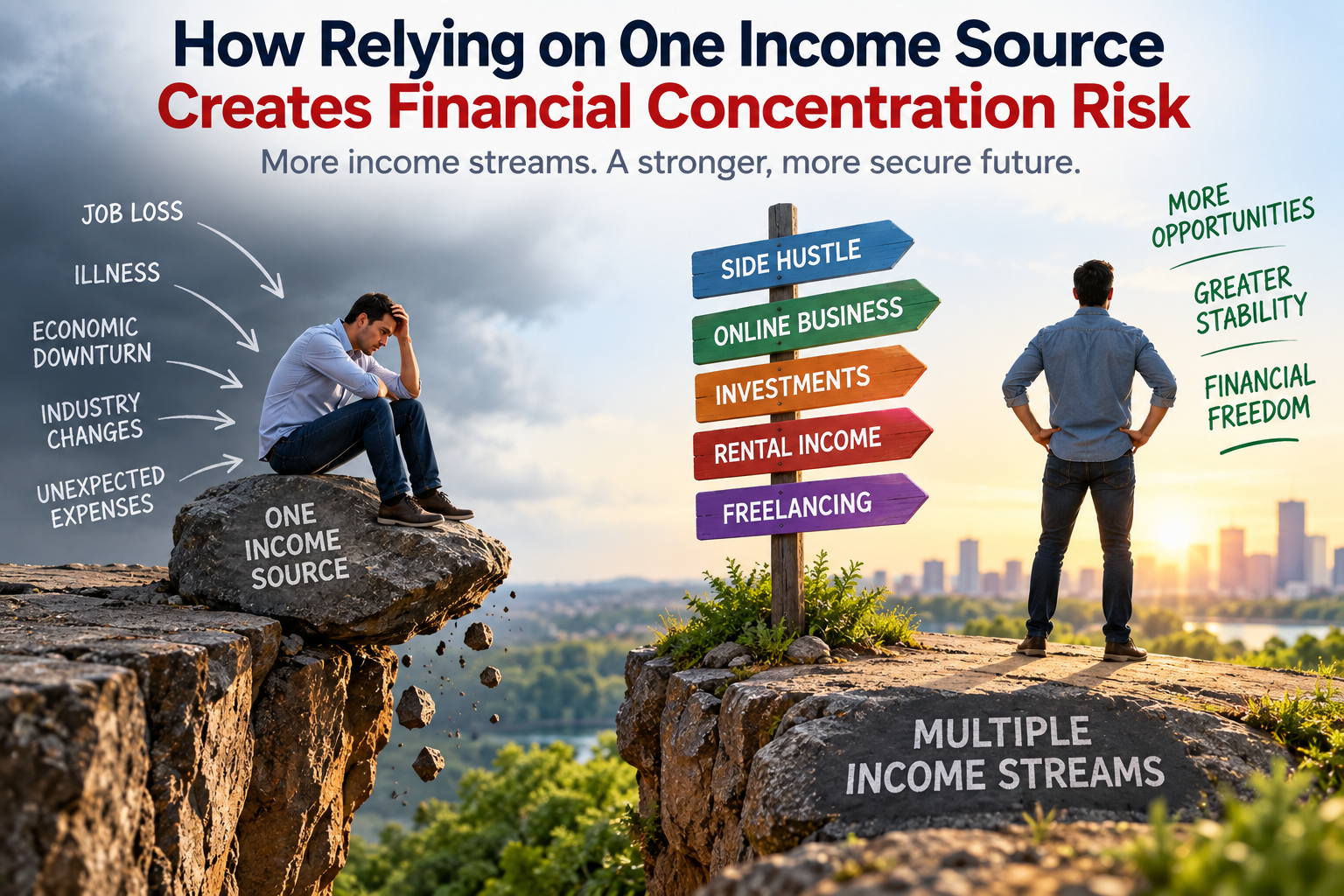
How Relying on One Income Source Creates Financial Concentration Risk
For many households, most or all earned income comes from one primary source. That source might be a full-time job, a small business, a freelance practice, or another form of work.
Having a dependable income source can make financial planning easier, but relying heavily on one source also creates what is known as financial concentration risk. If that source is interrupted, reduced, or eliminated, a large portion of the household’s cash flow can disappear at once.
Diversifying income does not guarantee financial security, and developing additional income sources can involve costs and risks of its own. However, understanding concentration risk can help people think more deliberately about how dependent their finances are on a single source of earnings.
What Is Financial Concentration Risk?
Financial concentration risk occurs when too much of a person’s financial position depends on one source, asset, customer, employer, industry, or other factor.
In the context of income, concentration risk is particularly straightforward.
Consider someone whose household expenses depend almost entirely on one salary. If that salary stops because of job loss, illness, a business closure, reduced working hours, or another disruption, the household may immediately face a significant gap between income and expenses.
The issue is not necessarily that the primary income source is unreliable. Even a stable source can become vulnerable to circumstances outside an individual’s control.
Why One Income Source Can Create Vulnerability
Income pays for recurring necessities such as:
- Housing
- Food
- Transportation
- Utilities
- Insurance
- Debt payments
- Education
- Healthcare
- Savings
- Other household expenses
Many of these costs continue regardless of whether income changes.
When one source provides nearly all available earnings, a disruption can therefore affect the entire household budget simultaneously.
A person with several independent sources may still experience financial pressure if one declines, but the impact can potentially be smaller because other sources continue producing income.
The Difference Between Income Concentration and Wealth Concentration
Income concentration and wealth concentration are related but different concepts.
Income concentration concerns where current earnings come from.
Wealth concentration concerns where accumulated assets and financial resources are held.
Someone might have diversified investments but still depend entirely on one salary for monthly expenses. Conversely, someone might have several income sources but have most of their savings invested in one asset.
Looking at both can provide a more complete picture of financial exposure.
Employment Is a Common Source of Concentration Risk
A full-time job often represents the largest source of income for a household.
Employment can provide predictable wages, benefits, retirement contributions, and other forms of compensation. However, employment remains dependent on the continued relationship between the worker and employer.
Changes in company finances, restructuring, industry conditions, business closures, or individual employment circumstances can affect that relationship.
This does not mean employees should automatically seek additional jobs. Rather, it highlights why households may benefit from understanding how much of their financial life depends on one employer.
Business Owners Face a Different Version of the Same Risk
Business owners can also experience significant income concentration.
A business may have multiple customers while still depending heavily on one major client. Alternatively, a company may sell several products but rely on one distribution platform or one market.
If a major customer leaves or market conditions change, revenue can decline quickly.
Business owners can therefore examine concentration at several levels:
- Number of customers
- Revenue by customer
- Products and services
- Sales channels
- Geographic markets
- Suppliers
- Platforms
- Industries served
Diversification can involve reducing excessive dependence on any one of these factors.
Freelancers Can Have Client Concentration Risk
Independent workers often face concentration risk when one client accounts for a large percentage of their earnings.
A freelancer who earns most of their revenue from one organization may effectively have a financial dependency similar to employment, even if they technically have an independent business.
Building a broader client base can potentially reduce this exposure.
At the same time, adding clients should not mean accepting every available project. Maintaining manageable workloads, profitable pricing, and professional relationships remains important.
Multiple Income Streams Can Spread Exposure
One way to address income concentration is to develop additional sources of earnings.
These might include:
- Freelance services
- Consulting
- Part-time work
- Digital products
- Online businesses
- Rental income
- Investment income
- Royalties
- Licensing
- Other entrepreneurial activities
The objective is not simply to accumulate as many income sources as possible.
Instead, the goal is to understand whether additional sources are sufficiently useful and independent to reduce dependence on the primary source.
How to Create Multiple Income Streams provides a broader framework for developing different sources of earnings.
A Side Hustle Can Be a Starting Point
For someone with a full-time job, a side business can provide an opportunity to test another source of income without immediately replacing the primary salary.
A side hustle might involve selling a skill, product, service, or creative work.
Examples include:
- Freelance writing
- Graphic design
- Tutoring
- Photography
- Web development
- Consulting
- Selling digital products
- Online education
- Specialized services
The activity should be evaluated based on its actual revenue, expenses, time requirements, and sustainability rather than its gross earnings alone.
People considering this route can explore How to Start a Side Hustle While Working Full-Time.
Not All Income Sources Are Truly Diversified
Having several income streams does not automatically eliminate concentration risk.
Suppose someone has three online businesses, but all three depend on the same social media platform. A major algorithm change or platform policy could affect all three simultaneously.
Similarly, someone might have several clients, but every client could operate in the same struggling industry.
This is sometimes called correlated risk: different income sources can be affected by the same underlying event.
True diversification therefore involves considering how independent the sources are from one another.
Complementary Income Sources Can Be More Efficient
Additional income sources can sometimes be built around existing skills.
A consultant might offer one-on-one services while also selling templates. A writer might provide freelance services while publishing educational material. A designer might sell services, digital assets, and licensing rights.
These activities can complement one another because they use related expertise and resources.
This can be more manageable than trying to build several completely unrelated businesses simultaneously.
Scalable Income Can Change the Equation
Traditional employment and many service businesses are closely connected to the amount of time a person can work.
Scalable income works differently. Some products, software, educational resources, licensing arrangements, and other business models can potentially serve additional customers without requiring a proportional increase in personal working hours.
This does not mean scalable income is effortless or guaranteed. Building a scalable business can require substantial upfront work, capital, marketing, and ongoing management.
Still, understanding the concept can help people distinguish between simply adding another job and developing an income source with different growth characteristics.
How to Build Scalable Income Over Time explores this approach in more detail.
Passive Income Still Has Risks
Passive income is often presented as a solution to dependence on employment, but it should not automatically be considered risk-free.
Different passive or relatively low-maintenance income sources carry different risks.
Investments can lose value. Rental properties can require repairs and periods without tenants. Digital products can lose demand. Royalties can fluctuate. Businesses that once required little daily involvement may still need maintenance.
A realistic approach recognizes that reducing one type of concentration can introduce another.
The broader concept is discussed in Passive Income.
Emergency Savings Provide Another Layer of Protection
Income diversification and emergency savings address financial resilience in different ways.
Additional income can provide continuing cash flow if one source declines. Savings can provide a financial buffer when income is temporarily disrupted or unexpected expenses occur.
An emergency fund may help cover essential expenses during periods of unemployment, reduced business revenue, or other financial disruptions.
The appropriate amount depends on individual circumstances, including income stability, household expenses, dependents, debt obligations, and access to other financial resources.
Fixed Expenses Can Increase Concentration Risk
The effect of losing an income source depends partly on how much money the household needs each month.
A household with substantial fixed expenses may have less flexibility when income falls.
Fixed commitments can include:
- Rent or mortgage payments
- Loan repayments
- Insurance premiums
- School fees
- Subscription contracts
- Vehicle payments
- Other recurring obligations
Reducing unnecessary fixed expenses can make it easier to withstand a temporary income reduction.
Income diversification is therefore only one part of managing financial concentration.
Calculate How Dependent You Are on One Source
A simple way to understand concentration is to calculate the percentage of total household income coming from each source.
For example:
| Income source | Monthly income | Share of total |
|---|---|---|
| Primary employment | $4,000 | 80% |
| Freelance work | $500 | 10% |
| Other income | $500 | 10% |
| Total | $5,000 | 100% |
In this example, the household still depends heavily on the primary job.
The calculation does not determine whether the situation is good or bad. It simply makes the dependency visible.
The same exercise can be repeated annually to see whether the income mix changes over time.
Consider Stability Alongside Size
The largest income source is not necessarily the least reliable, and the smallest source is not necessarily the safest.
When evaluating income streams, consider characteristics such as:
- How predictable the income is
- How long it has existed
- How dependent it is on one customer
- How sensitive it is to economic conditions
- How much ongoing work it requires
- How easily it can be replaced
- How much capital is at risk
This provides more useful information than looking only at the amount earned.
Avoid Creating New Financial Problems
Trying to diversify income can itself create financial risk.
A person might borrow heavily to start a business, purchase expensive equipment before validating demand, or invest too much money into an untested idea.
The additional income source may then create debt or expenses that make the household more vulnerable rather than less.
Starting small, testing demand, tracking costs, and increasing investment gradually can help limit unnecessary exposure.
Time Is Also a Resource
Every income source requires some combination of money, attention, and time.
Someone working full-time may have limited capacity for a demanding second business. Adding too much work can affect sleep, family responsibilities, personal wellbeing, and performance in the primary job.
A useful diversification strategy therefore considers the time concentration of income as well as the financial concentration.
An additional income source that requires excessive hours may not provide meaningful improvement in overall financial resilience.
Income Diversification Does Not Mean Abandoning Stability
There can be a temptation to view a single salary as something that must immediately be replaced.
That is not necessary.
A primary job can remain the foundation of a household’s finances while smaller income sources are gradually developed around it.
The additional source can then be evaluated based on actual performance rather than assumptions about how much it might eventually earn.
Over time, some people may choose to expand a secondary activity, while others may decide that maintaining a small supplemental source is sufficient.
Review Concentration as Circumstances Change
Financial concentration is not permanent.
A person might start with one job, add freelance work, build a business, purchase investments, or experience changes in household income.
Similarly, a secondary income source might disappear.
Reviewing the income mix periodically can reveal whether financial dependence has increased or decreased.
Major life changes such as marriage, having children, changing jobs, starting a business, taking on significant debt, or approaching retirement can also make a review useful.
Building Greater Financial Flexibility
Relying heavily on one income source can make a household particularly sensitive to events affecting that source. The risk becomes more significant when essential expenses continue at the same level while earnings suddenly decline.
Building additional income sources can potentially reduce that dependence, particularly when those sources are based on different customers, markets, skills, or economic drivers.
However, diversification should be approached carefully. New income streams require time and resources, and they can introduce their own risks.
The practical goal is not to create an unnecessarily complicated collection of side businesses. It is to build greater flexibility by combining sustainable earnings, manageable expenses, adequate financial reserves, and carefully considered additional sources of income.
Over time, that approach can make a household less dependent on any single paycheck while keeping financial decisions grounded in actual resources and realistic expectations.