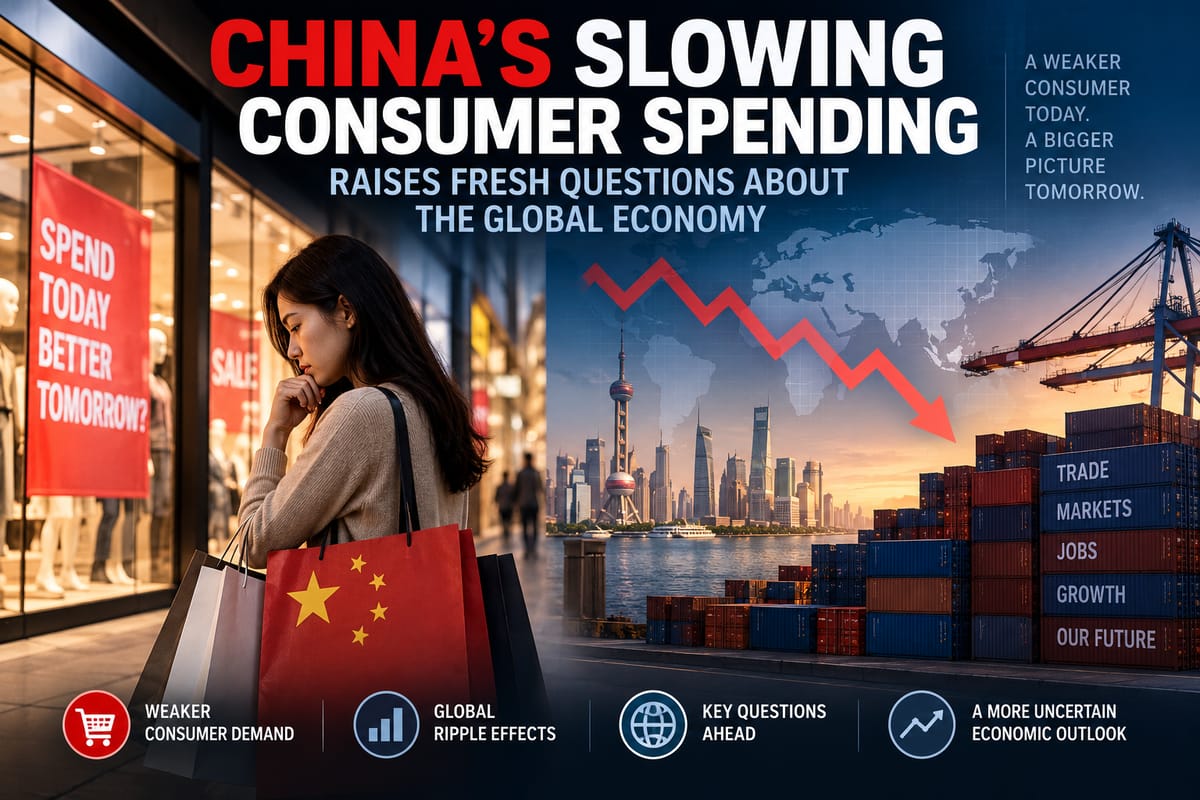
China’s Slowing Consumer Spending Raises Fresh Questions About the Global Economy
China’s consumers are showing signs of caution, raising fresh questions about the strength of domestic demand and what a slower spending environment could mean for the wider global economy.
The latest data point to an uneven picture. China’s industrial production strengthened in August, but retail sales growth slowed to 0.4% year over year, down from 0.6% in July and below economists’ expectations. Fixed-asset investment also weakened, while the property sector remained under pressure.
For households, businesses, and investors around the world, China’s consumption matters because the country is one of the world’s largest economies and an important market for everything from commodities and consumer products to luxury goods, automobiles, technology, and services.
The slowdown does not mean China’s economy has stopped growing. Instead, it highlights a growing imbalance between relatively strong industrial and export activity and weaker domestic demand.
Why Consumer Spending Matters to China’s Economy
Consumer spending is an important component of economic activity. When households purchase goods and services, businesses receive revenue, workers earn income, and companies have incentives to invest and expand.
A healthy consumer economy can therefore create a reinforcing cycle.
More spending can support business revenues. Stronger revenues can encourage hiring and investment. Higher employment and income can then support additional household spending.
When consumers become more cautious, the opposite process can occur.
Households may postpone major purchases, increase savings, reduce discretionary spending, or focus more heavily on essential goods and services. Businesses may then face weaker demand, making them more cautious about expansion.
Understanding how these relationships work is part of learning about economic conditions through the Complete Guide to Economic Indicators.
China’s Latest Numbers Show a Mixed Economy
The latest figures illustrate why China’s economic outlook is difficult to summarize with a single number.
Industrial output increased 5.2% year over year in August, accelerating from 4.5% growth in July. By contrast, retail sales increased only 0.4%, while fixed-asset investment fell 7.2% during the first eight months of the year.
That combination suggests that China’s manufacturing and export-oriented sectors are performing considerably better than parts of the domestic economy.
The divergence is important because strong production does not automatically translate into strong household demand.
Factories can increase output for export markets while consumers at home remain cautious about spending.
Why Are Chinese Consumers Being Cautious?
There is no single explanation for weaker consumer demand.
One major factor is the prolonged property downturn. Falling or weak home prices can affect household confidence because housing represents a large share of household wealth for many Chinese families.
When people are uncertain about the value of their homes or their future income, they may become more reluctant to make large discretionary purchases.
The property sector has remained weak in 2026, with home prices declining again in August and housing-related activity continuing to weigh on the broader economy.
Employment expectations, income uncertainty, and concerns about future economic conditions can reinforce this cautious behavior.
The Property Market Is Closely Connected to Consumption
Housing has a particularly important role in China’s economic story.
A prolonged property downturn can affect developers, construction companies, local governments, banks, suppliers, and households.
When property prices weaken, homeowners may feel less wealthy. Developers may reduce investment. Construction activity can decline, while local governments can face pressure on revenues.
These effects can spread through the economy.
The result is that a property slowdown is not simply a housing-market problem. It can influence consumer confidence and household spending as well.
Why Strong Industrial Output Does Not Solve Everything
China’s stronger industrial production figures provide an important counterpoint to the weaker consumption data.
Factories are continuing to produce goods for domestic and international markets, with technology-related manufacturing among the areas showing significant momentum.
But an economy can produce more goods without experiencing equally strong domestic consumption.
If households are not purchasing enough of the goods and services produced domestically, businesses may increasingly depend on foreign markets.
That creates another vulnerability because external demand depends on economic conditions in other countries, trade policies, exchange rates, and geopolitical developments.
Exports Are Becoming More Important
China’s strong export performance has helped offset some weakness in domestic demand.
However, greater dependence on exports can create its own challenges.
Other countries may respond to rising imports by introducing tariffs, trade restrictions, subsidies for domestic producers, or other measures designed to protect local industries.
This means China cannot necessarily rely indefinitely on exports to compensate for weak household consumption.
The International Monetary Fund has similarly highlighted the importance of shifting toward stronger domestic demand, noting that China’s prolonged property downturn and relatively weak social safety net have contributed to subdued consumption.
What Slower Chinese Consumption Means for Global Businesses
Global companies with significant exposure to Chinese consumers could feel the effects of slower spending.
Luxury brands, automobile manufacturers, technology companies, travel businesses, restaurants, entertainment providers, and consumer-goods companies can all be affected by changes in Chinese demand.
When consumers become more cautious, they may prioritize necessities and postpone discretionary purchases.
That does not mean every company exposed to China will experience weaker sales. Some categories can continue to grow even during a broader slowdown, particularly when they benefit from changing consumer preferences or structural trends.
Still, investors increasingly need to distinguish between China’s overall economic growth rate and the performance of individual parts of the consumer economy.
What It Could Mean for Commodity Markets
China is a major consumer of many commodities, including energy, metals, and industrial materials.
A prolonged slowdown in construction, manufacturing investment, or household demand could therefore affect global commodity markets.
Lower demand can put downward pressure on prices for some raw materials, although the relationship is complicated by supply conditions, geopolitical events, weather, inventories, and production decisions elsewhere.
Oil markets can be particularly sensitive to changes in expectations about China’s economic activity because China is one of the world’s largest energy consumers.
A weaker consumption outlook can therefore influence global commodity expectations even when the immediate change in Chinese demand is relatively modest.
Could Slower Chinese Spending Affect Inflation?
The global inflation effect can move in several directions.
If weaker Chinese domestic demand reduces commodity consumption, it could place downward pressure on some global commodity prices.
At the same time, China’s enormous manufacturing sector can continue producing large quantities of goods for international markets. Lower domestic demand may encourage manufacturers to seek additional overseas customers, potentially increasing competition in global markets.
For consumers in importing countries, cheaper manufactured products can help reduce certain costs.
For domestic manufacturers, however, increased competition can create pressure on prices, profits, and production.
This is one reason China’s economic trajectory matters far beyond its borders.
Why China’s Growth Model Matters
For years, China’s economic expansion has relied on a combination of investment, manufacturing, exports, infrastructure development, and rising consumption.
The current challenge is finding a more sustainable balance.
An economy that relies heavily on investment can eventually encounter diminishing returns, particularly when property construction and infrastructure spending become less productive.
An economy that relies heavily on exports is vulnerable to changes in foreign demand and trade policy.
That makes household consumption increasingly important.
The relationship between productivity, output, income, and living standards is explored in What Drives Economic Growth and How Productivity Affects Living Standards.
China’s Government Is Trying to Encourage Consumption
Chinese policymakers have recognized the importance of strengthening household demand.
The country’s 2026-2030 consumption plan aims to increase the role of household consumption in the economy and targets total retail sales of consumer goods of around 60 trillion yuan by 2030. The plan also emphasizes services consumption and measures intended to increase consumers’ ability and willingness to spend.
The challenge is turning policy goals into sustained changes in household behavior.
Consumers may need greater confidence in employment, income prospects, housing values, and future economic conditions before they significantly increase discretionary spending.
Why Savings Matter to Consumers
From a household perspective, higher savings can be a rational response to uncertainty.
Families may build larger emergency funds, reduce debt, postpone large purchases, or keep more money in liquid accounts when they are uncertain about future income.
That behavior can be financially sensible for individual households.
However, when millions of households simultaneously increase precautionary savings and reduce discretionary spending, the collective effect can weaken consumer demand.
This creates an important distinction between what is financially prudent for one household and what policymakers may want from the economy as a whole.
Could China’s Consumers Eventually Spend More?
A recovery in household consumption remains possible.
Improving employment conditions, stronger income growth, greater confidence in the property market, targeted government support, and stronger social protections could encourage households to spend more.
China’s service economy also offers potential for consumption growth.
Official data show that service retail sales grew faster than goods consumption during the first half of 2026, with areas such as tourism-related services and cultural, sports, and leisure activities showing strong growth.
This suggests that the consumption story is not simply about people buying fewer products. The composition of spending is also changing.
The Importance of Looking Beyond GDP
A country’s GDP growth rate can provide a useful overview, but it does not capture every important aspect of household economic conditions.
Consumers care about employment, wages, housing costs, debt, savings, prices, and their expectations for the future.
That is why economic indicators need to be considered together rather than individually.
A country can record positive GDP growth while households remain cautious about spending. Similarly, strong industrial production can coexist with weak retail demand.
For consumers trying to understand how economic developments eventually affect their personal finances, What Does the Latest GDP Report Actually Mean for Your Paycheck, Spending and Savings? offers a useful framework.
How the Global Economy Could Respond
The effects of China’s slower consumption could appear through several channels.
Trade
Countries that sell consumer products, commodities, food, energy, and services to China could experience weaker demand if the slowdown becomes more persistent.
Manufacturing
Global manufacturers competing with Chinese producers may face stronger price competition if Chinese companies increasingly focus on overseas markets.
Commodities
Changes in Chinese demand can affect global expectations for oil, metals, agricultural commodities, and other raw materials.
Financial Markets
Investors may reassess earnings forecasts, currency expectations, commodity prices, and economic growth assumptions when China’s domestic demand changes.
Central Bank Policy
If weaker Chinese demand contributes to lower global commodity prices or cheaper manufactured goods, it could influence inflation expectations in other economies.
The exact impact will depend on the duration and severity of the slowdown.
Economic Cycles Can Amplify the Effects
China’s consumption slowdown is occurring within a broader global economic environment.
Countries move through periods of expansion, slower growth, contraction, and recovery. Financial markets can respond to these changes before they become obvious in economic data.
The relationship between economic activity and market behavior is explained in How Economic and Financial Market Cycles Work.
Understanding these cycles is important because China’s current weakness does not exist in isolation. Global trade conditions, interest rates, commodity markets, currency movements, and geopolitical developments can all influence how the situation evolves.
Why China’s Consumer Story Matters for Ordinary Households
The impact may seem distant to households outside China, but global economic connections can eventually reach everyday budgets.
A shift in Chinese demand can influence commodity prices. Commodity prices can affect transportation and energy costs. Manufacturing competition can influence the prices of electronics, appliances, vehicles, and other goods.
Exchange rates and global interest-rate expectations can also respond to changes in economic growth.
The transmission is rarely immediate or straightforward, but China’s size means that sustained changes in its economy can influence conditions elsewhere.
The Bigger Question Is Whether Domestic Demand Can Recover
China’s latest economic data highlight a difficult contrast: industrial activity remains relatively strong, while household consumption and investment are struggling to maintain momentum.
Retail sales growth of just 0.4% in August is particularly notable because consumer demand is central to Beijing’s longer-term goal of creating a more balanced growth model.
The question for the months ahead is whether policy support, stronger services consumption, improving household confidence, and a stabilization of the property sector can encourage consumers to spend more.
If domestic demand strengthens, China could move toward a more balanced expansion that relies less heavily on exports.
If consumers remain cautious, policymakers may face greater pressure to introduce additional measures to support household incomes, confidence, and spending.
For the global economy, the distinction matters. China is too large and too deeply connected to international trade, commodities, manufacturing, and financial markets for a prolonged domestic slowdown to remain purely a domestic issue.
The most important signal to watch may therefore be whether Chinese households begin feeling confident enough to spend again—not simply whether factories continue producing at high levels.