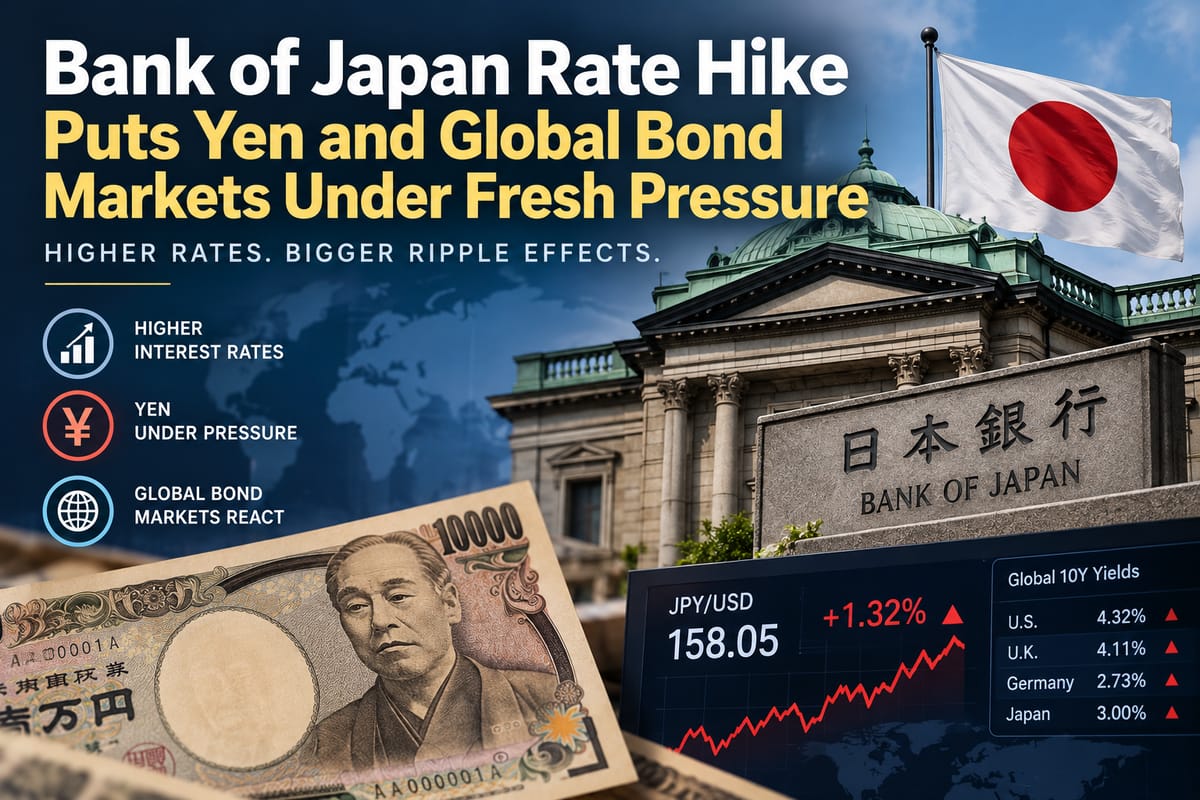
Bank of Japan Rate Hike Puts Yen and Global Bond Markets Under Fresh Pressure
The Bank of Japan has raised its policy interest rate to 1.25%, taking borrowing costs to their highest level in more than three decades as policymakers respond to persistent inflation pressures.
The September 18 decision marked the second rate increase in three months and was approved by a 7-2 vote. The BOJ said underlying inflation was approaching its 2% price-stability target and indicated that it would continue adjusting monetary accommodation in response to economic and price developments.
Yet the immediate market reaction was not straightforward. Instead of strengthening, the Japanese yen weakened sharply after the decision as investors focused on the split vote and the central bank’s cautious approach to future increases. That combination has left currency traders, bond investors and policymakers watching Japan particularly closely.
BOJ Pushes Rates to 1.25%
The rate increase moves Japan further away from the ultra-low interest-rate environment that shaped global markets for decades.
Under the new policy setting, the BOJ will guide the uncollateralized overnight call rate to around 1.25%. The change becomes effective September 24. Two board members opposed the increase, arguing that economic and price conditions did not yet justify higher rates.
The central bank said Japan’s economy has been recovering moderately, although some weakness remains. It also pointed to high crude oil prices, a weaker yen, wage increases and rising business-to-business prices as factors affecting the inflation outlook.
The BOJ expects consumer-price inflation to move clearly above 2% during the second half of fiscal 2026 before eventually easing toward around 2% later in its projection period.
For investors trying to understand how such decisions move through currencies, equities and fixed income, the Complete Guide to Financial Markets and How They Work provides useful background.
Why the Yen Fell After a Rate Increase
Normally, higher interest rates can make a country’s currency more attractive because they can improve the return available on assets denominated in that currency.
The yen’s reaction on September 18 demonstrated why the relationship is not automatic.
The dollar rose as much as 1.3% against the yen to around ¥158.05 after the BOJ decision, with traders focusing on the absence of a stronger signal about the pace of future rate increases. The two dissenting votes also contributed to uncertainty about how quickly the central bank might tighten policy from here.
The contrast is particularly striking because the yen had strengthened considerably ahead of the meeting as investors anticipated faster BOJ tightening and considered the possibility of Japanese capital returning home.
The latest move therefore reflects a familiar feature of currency markets: expectations about future interest-rate differentials can matter as much as the rate decision itself.
The Interest-Rate Differential Still Matters
Japan’s policy rate remains considerably below rates in several other major economies.
That difference has helped support the yen carry trade, in which investors borrow in a relatively low-yielding currency and invest in assets offering higher returns elsewhere.
When Japanese rates rise, the economics of that strategy can change.
If investors expect Japanese rates to continue moving higher while foreign rates remain elevated or begin falling, the gap between borrowing costs and investment returns can narrow. Investors may then reconsider positions that were attractive when Japanese financing costs were extremely low.
The mechanics are closely connected to the broader relationship between borrowing costs, asset prices and economic activity explained in Understanding Interest Rates and Their Effects.
Japanese Bond Yields Are Becoming More Important
The rate decision also matters because Japanese government bond yields have already climbed substantially.
Japan’s 10-year government bond yield reached 3% earlier in September, the first time it had reached that level since 1996. The increase has changed the relative attractiveness of Japanese fixed-income assets for domestic investors.
Higher domestic yields can give Japanese pension funds, insurers and other institutional investors greater incentive to hold more assets at home.
That matters beyond Japan.
For years, Japanese investors have been significant participants in overseas bond markets. If domestic Japanese bonds become more attractive on a risk-adjusted or currency-hedged basis, some investors may reduce purchases of foreign debt or repatriate capital.
Reuters has reported that rising Japanese yields are already beginning to encourage a shift in global capital flows, although there is no evidence that Japanese investors are simply abandoning overseas markets altogether.
Why Global Bond Investors Are Watching Japan
Bond prices and yields generally move in opposite directions. When yields rise, existing bonds with lower coupons can become less attractive, putting downward pressure on their market prices.
Japan’s changing rate environment therefore matters to anyone following global fixed-income markets.
The country’s investors hold substantial overseas assets, including U.S. Treasuries and other sovereign debt. A meaningful change in the allocation of Japanese capital could affect demand for foreign bonds and potentially contribute to higher borrowing costs elsewhere.
That is one reason Japan’s bond market has become an increasingly important part of the global fixed-income story.
Investors looking for a broader explanation of these relationships can explore the Complete Guide to Bond Markets.
The impact should not be overstated, however. Global bond yields are being influenced by many forces at the same time, including inflation expectations, government borrowing needs, energy prices and monetary policy in the United States and Europe.
Japan is an important factor, but it is not operating in isolation.
Global Central Banks Are Also Tightening
The BOJ’s decision comes during a broader period of renewed concern about inflation.
The U.S. Federal Reserve also raised its policy rate by 25 basis points during the same week, taking its target range to 3.75%-4%. Reuters reported that other major central banks were also dealing with renewed inflation pressure linked partly to elevated energy costs.
That creates a more complicated environment for investors.
Japan is moving away from its historically loose monetary policy while the United States and other economies are also dealing with questions about how much additional tightening may be necessary.
As a result, currency markets are being driven by several competing forces rather than a single central-bank decision.
The Yen Carry Trade Faces a New Test
The yen carry trade has become particularly sensitive to changes in Japanese monetary policy.
For years, very low Japanese interest rates provided an inexpensive source of funding. Investors could borrow yen and seek higher returns in other markets, provided the exchange-rate risk did not overwhelm the interest-rate advantage.
A stronger yen can make those trades less attractive because investors ultimately have to account for currency movements when repaying yen-denominated funding.
Reuters reported earlier in September that the yen’s rally had already begun disrupting the long-established carry trade as investors reconsidered their positions ahead of the BOJ meeting.
The September 18 yen decline does not eliminate those concerns. Instead, it demonstrates how quickly expectations can change when investors reassess the likely path of Japanese interest rates.
What Higher Japanese Rates Could Mean for Investors
The BOJ’s move creates several areas worth watching.
Japanese government bonds
Higher policy rates can place upward pressure on short-term Japanese government bond yields. Longer-term yields will depend on expectations for inflation, government borrowing and the future path of BOJ policy.
The yen
The yen could remain sensitive to the gap between Japanese and foreign interest rates. A stronger policy outlook could support the currency, while uncertainty about the pace of future hikes could work in the opposite direction.
Overseas bonds
If Japanese investors find domestic bonds increasingly attractive, demand for foreign fixed-income assets could change. The effect would depend on the scale and speed of any portfolio adjustments.
Carry trades
Higher Japanese borrowing costs can reduce the appeal of strategies built around funding positions in yen and investing in higher-yielding assets elsewhere.
Equity markets
Changes in bond yields and currency values can affect company financing costs, export competitiveness and investor valuations, particularly in Japan and other markets closely connected to Japanese capital flows.
Monetary Policy Is Becoming a Bigger Market Driver
The BOJ decision illustrates how monetary policy can affect multiple asset classes simultaneously.
A rate increase can influence the currency through interest-rate differentials, bonds through changes in expected yields, stocks through valuation and financing costs, and commodities through movements in the currency and broader economic expectations.
The transmission is rarely immediate or predictable.
The BOJ itself emphasized that future rate increases will depend on developments in economic activity, prices and financial conditions rather than following a predetermined timetable.
That leaves investors focused not only on the current 1.25% policy rate but also on inflation data, wage growth, energy prices, currency movements and future statements from Japanese policymakers.
For a broader explanation of how central-bank decisions move through markets, How Monetary Policy Affects Financial Markets provides useful context.
A New Phase for Japan’s Financial Markets
Japan is entering a markedly different interest-rate environment from the one that defined much of the past decade.
The BOJ’s move to 1.25% signals that policymakers are increasingly focused on preventing inflation from becoming entrenched above their target. At the same time, the yen’s decline after the decision shows that higher rates alone do not guarantee a stronger currency.
For global investors, the more important question may be how Japan’s changing yields alter capital flows.
If Japanese bonds continue offering higher returns, domestic assets could become increasingly competitive with foreign alternatives. That could gradually influence demand for U.S. Treasuries, European government bonds and other international fixed-income assets.
Meanwhile, the yen remains caught between Japan’s tightening policy and still-higher interest rates abroad.
The result is a market environment in which the next move may depend less on the headline rate itself and more on what investors believe comes after it.