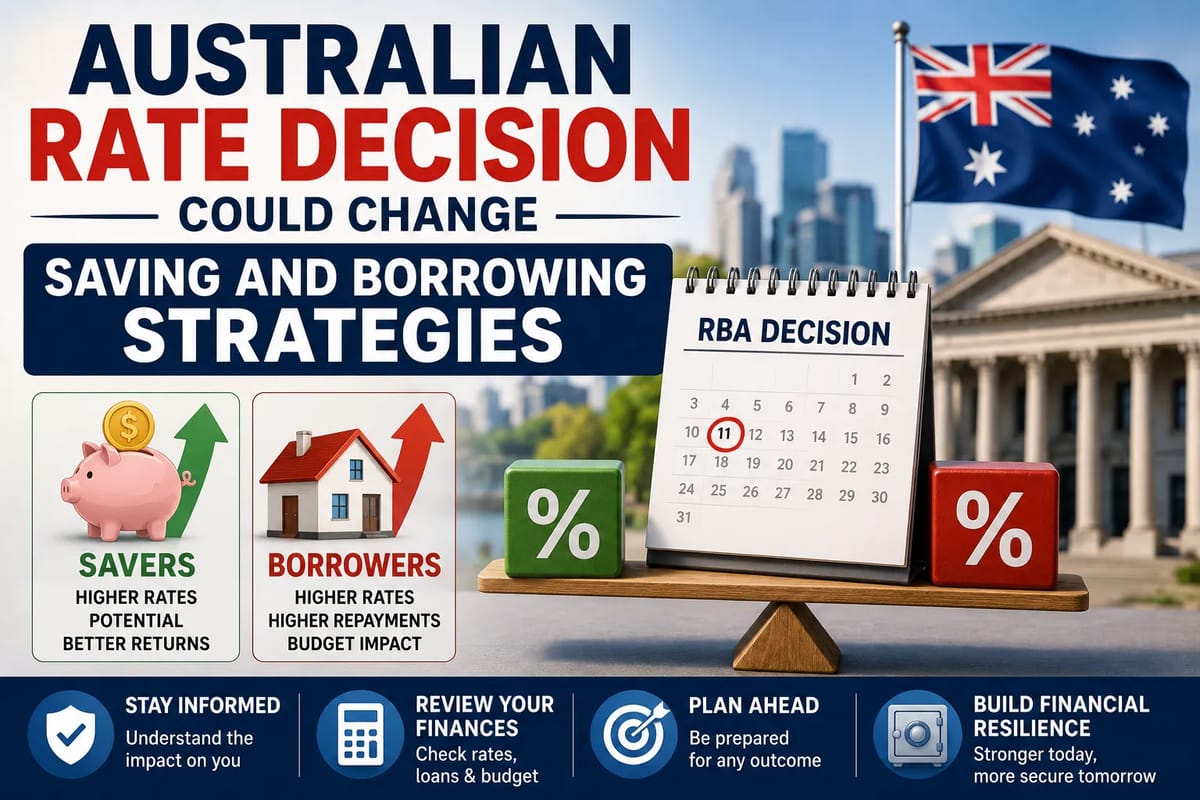
Australian Rate Decision Could Change Saving and Borrowing Strategies
Australia’s next interest-rate decision is arriving at a delicate moment for households.
The Reserve Bank of Australia (RBA) is due to announce its August monetary policy decision on 11 August 2026, with the cash rate currently sitting at 4.35%. The decision comes as inflation has eased slightly but remains above the RBA’s 2–3% target range, leaving households facing an uncertain outlook for mortgages, savings accounts, personal loans and other forms of credit.
For savers, another period of relatively high rates could keep deposit returns attractive. For borrowers, however, the same environment means financing remains expensive.
That makes the upcoming decision important even for people who are not following monetary policy closely.
A rate increase could make borrowing more expensive and potentially improve returns on some savings products. A hold could provide greater stability, while an eventual reduction could change the balance between saving aggressively and paying down debt.
The key for households is not trying to predict the RBA perfectly. It is preparing for the different possibilities.
For a broader understanding of how different bank accounts work and where savings and transaction accounts fit into everyday banking, see the complete guide to bank accounts and account types.
Why the RBA Decision Matters to Everyday Households
The RBA’s cash rate is the interest rate at which banks borrow and lend funds in the overnight money market. Changes in the cash rate influence other interest rates across the economy, including mortgage and deposit rates.
That means monetary policy can affect several parts of a household budget at once.
A homeowner with a variable-rate mortgage may see borrowing costs respond to changes in lending rates. Someone with money in a savings account or term deposit may benefit when banks offer higher deposit rates.
Credit cards, personal loans and other forms of variable-rate borrowing can also be affected by the broader interest-rate environment.
The result is an unusual situation in which the same rate decision can be good news for one household and bad news for another.
Where Interest Rates Stand Before the Decision
The RBA’s cash rate target is currently 4.35%, following three increases earlier in 2026. The Bank last left the rate unchanged at its June meeting, saying headline and underlying inflation remained too high and noting that financial conditions had tightened following the earlier rate increases.
The RBA has also emphasized that it will continue assessing domestic demand, inflation, labour-market conditions and developments in the global economy when deciding where monetary policy should go next.
Understanding how monetary policy affects commercial banks can provide useful context for these changes. See how central banks affect commercial banks.
The August meeting therefore comes after a significant period of policy tightening rather than in isolation.
Inflation Has Eased, But the Problem Is Not Gone
The latest Consumer Price Index data provide some relief but not enough to remove the inflation question.
According to the Australian Bureau of Statistics, consumer prices rose 3.8% in the year to June 2026, down from 4.0% in May. Underlying inflation, measured by the trimmed mean, remained at 3.6%.
That is still above the RBA’s target range.
Housing remains a particularly important source of pressure. Annual housing inflation reached 6.8% in June, with electricity and new dwelling costs among the contributors. Electricity prices were 22.4% higher than a year earlier, partly reflecting the end of government rebates.
For households, this matters because falling headline inflation does not necessarily mean that everyday expenses have suddenly become affordable.
What Markets Expect
The latest market and banking expectations suggest that a rate increase is not currently the base case for the August meeting.
Australian shares were under pressure on 10 August ahead of the decision, with investors generally expecting the RBA to leave rates unchanged.
That expectation is important, but it is not a guarantee.
The RBA is making its decision based on economic conditions, not simply on market pricing.
For households, that means preparing for the decision rather than building an entire financial plan around one predicted outcome.
What a Rate Increase Could Mean for Savers
If the RBA raises rates, banks may respond by increasing some deposit rates.
That could make saving more attractive, particularly for people who have money sitting in low-interest accounts.
A higher rate can be especially useful for:
- Emergency funds
- Short-term savings goals
- House deposits
- Money earmarked for large purchases
- Cash that will be needed within the next few years
However, savers should not assume that every bank will automatically pass on the full increase.
Deposit rates vary considerably between institutions and products.
Compare Savings Rates Instead of Assuming Your Bank Is Competitive
When rates change, it is worth checking whether your existing savings account is still competitive.
Look at:
- Base interest rate
- Bonus interest conditions
- Minimum deposits
- Withdrawal restrictions
- Monthly fees
- Introductory periods
- Balance limits
A headline interest rate can look attractive while the conditions make it difficult to qualify for the advertised return.
For people with substantial cash savings, even a small difference in interest can become meaningful over time.
Readers comparing different account options can also explore how to choose the right bank account for your financial needs.
Consider Whether a Term Deposit Fits Your Plans
A term deposit can provide a fixed interest rate for an agreed period.
This can appeal to savers who value certainty, particularly when they believe rates may eventually fall.
But locking money away also reduces flexibility.
Before choosing a term deposit, consider when you will need the money and what happens if you withdraw it early.
A higher rate is not necessarily better if accessing the money later creates unnecessary penalties or inconvenience.
What a Rate Increase Could Mean for Borrowers
For borrowers, a rate increase generally creates the opposite pressure.
Higher lending rates can increase the cost of servicing debt.
This is particularly significant for households with variable-rate mortgages.
A borrower with a large mortgage may see a relatively small change in the interest rate translate into a noticeable change in monthly repayments.
The impact depends on:
- Outstanding loan balance
- Remaining loan term
- Interest rate
- Repayment frequency
- Loan structure
- Whether the loan is fixed or variable
Paying Extra Into a Mortgage
When interest rates are high, making additional mortgage repayments can become more attractive.
Every dollar used to reduce principal can reduce the amount on which future interest is calculated.
However, borrowers should consider their entire financial position before directing every spare dollar toward the mortgage.
An emergency fund remains important.
So do flexibility and access to cash.
A household with a large mortgage payment but no emergency savings may be vulnerable when an unexpected expense arrives.
Offset Accounts Can Offer Flexibility
For borrowers with an eligible mortgage, an offset account can allow savings to reduce the balance used to calculate interest while keeping the money accessible.
The value of an offset depends on the loan structure, account fees and interest rate.
It should therefore be compared with alternatives such as a high-interest savings account rather than assumed to be automatically superior.
Don’t Ignore Refinancing Opportunities
A changing rate environment can be a good reason to review an existing mortgage.
Borrowers can compare:
- Current interest rate
- New-loan rates
- Fees
- Offset features
- Redraw facilities
- Fixed versus variable options
- Remaining loan term
But refinancing is not free.
Application fees, discharge costs and other charges can reduce the benefit of switching.
The right comparison is the total cost, not simply the advertised interest rate.
What If the RBA Holds Rates at 4.35%?
A rate hold would provide some stability.
Borrowers would not face an immediate RBA-driven increase, while savers could continue benefiting from relatively elevated deposit rates.
But a hold would not necessarily mean rates are staying at 4.35% indefinitely.
The more important question would become:
What does the RBA’s accompanying outlook suggest about the next move?
If policymakers signal that inflation is still a concern, households may need to remain prepared for rates to stay high for longer.
If the Bank becomes more comfortable with the inflation outlook, expectations for future reductions could strengthen.
Borrowers Should Use a Rate Hold as an Opportunity to Prepare
A stable interest rate can create breathing room.
Instead of immediately increasing spending, borrowers could use the period to:
- Build emergency savings
- Reduce high-interest debt
- Make additional mortgage repayments
- Review household expenses
- Compare mortgage products
- Test whether the budget could handle a future increase
Preparing during a stable period is usually easier than trying to reorganize finances after repayments have already increased.
What If Rates Eventually Fall?
A future rate reduction would change the equation for households.
Borrowers could benefit from lower interest costs if lenders pass on reductions.
But falling rates would not necessarily mean that households should immediately increase spending.
For borrowers, one useful approach could be to continue making repayments at roughly the higher level they have become accustomed to, if their budget allows.
The difference could potentially be directed toward:
- Mortgage principal
- Emergency savings
- Investments
- Other high-interest debt
This can help households use lower rates to strengthen their finances rather than simply increase discretionary spending.
Falling Rates Could Be Less Attractive for Savers
The reverse applies to people who rely heavily on deposit income.
If interest rates eventually decline, savings accounts and term deposits may offer lower returns.
That does not mean savers should abandon cash.
Emergency funds and short-term goals still require appropriate levels of liquidity.
But people saving for longer-term objectives may want to review whether their overall portfolio remains aligned with their goals, risk tolerance and time horizon.
The Biggest Mistake Is Chasing the Rate
Interest rates naturally attract attention when they change.
But the highest available rate is not necessarily the most important number in a household’s financial plan.
A better approach is to consider the entire picture.
For savings:
Rate + conditions + access + safety + purpose
For borrowing:
Interest rate + fees + loan term + flexibility + repayment capacity
A product with a slightly lower rate but fewer restrictions may sometimes be more useful than one offering a higher headline rate.
Build a Budget That Can Handle Different Rate Scenarios
One of the most useful responses to interest-rate uncertainty is scenario planning.
Instead of asking:
“What will the RBA do?”
ask:
“What happens to my budget if rates move?”
Create three versions of your household budget:
Scenario One: Rates Stay Where They Are
Calculate your normal mortgage or loan repayments and savings capacity.
Scenario Two: Rates Rise
Work out how much additional money would be required each month.
Scenario Three: Rates Fall
Decide in advance what you will do with the money saved through lower repayments.
This approach turns an unpredictable economic event into a manageable household planning exercise.
Example: How a Rate Change Can Affect a Mortgage
Consider a hypothetical borrower with a $500,000 mortgage and a long remaining loan term.
A change in the interest rate does not simply affect one month’s interest. It can influence the cost of servicing the loan over many years.
The exact repayment difference depends on the loan term and repayment structure, so borrowers should use their lender’s calculator or obtain a personalized repayment estimate.
The important lesson is that even seemingly small percentage-point changes can matter when applied to a large outstanding balance.
High-Interest Debt Should Get Attention First
Not all debt is equally expensive.
Credit cards and other high-interest forms of borrowing can carry much higher rates than home loans.
When building a financial strategy, consider prioritizing expensive debt before increasing discretionary spending.
A useful hierarchy can be:
- Cover essential expenses.
- Maintain an appropriate emergency buffer.
- Pay down expensive consumer debt.
- Meet required mortgage repayments.
- Consider additional mortgage payments or longer-term investing according to your circumstances.
The best order can vary depending on income, debt structure and financial goals.
Keep an Emergency Fund Regardless of the Rate Decision
An emergency fund provides protection against events that monetary policy cannot predict.
These might include:
- Job loss
- Major repairs
- Medical expenses
- Urgent travel
- Appliance replacement
- Unexpected bills
The appropriate amount depends on household circumstances.
Someone with stable income and low fixed expenses may need a different buffer from a household with variable income and substantial debt.
The key is liquidity.
An emergency fund should generally be accessible when it is actually needed.
Homebuyers Face a More Complicated Equation
Interest rates affect more than mortgage repayments.
They can also influence how much buyers can afford to borrow.
Recent analysis reported by the Australian media has highlighted how higher rates can reduce borrowing capacity even when property prices fall.
That creates a difficult situation for prospective buyers.
A lower property price does not automatically make a home more affordable if the buyer’s borrowing capacity has fallen substantially.
Don’t Base a Home Purchase on the Maximum a Bank Will Lend
A bank’s maximum borrowing capacity is not necessarily the same as a comfortable household budget.
Homebuyers should consider:
- Mortgage repayments
- Council rates
- Insurance
- Maintenance
- Utilities
- Transport
- Childcare
- Other debts
- Future changes in income
Leaving some financial breathing room can be more valuable than stretching to the absolute maximum.
Savers Should Think About Inflation Too
A savings account can pay interest while the purchasing power of money is being affected by inflation.
If inflation remains elevated, the real value of savings depends on the relationship between the interest earned and the increase in prices.
Australia’s June headline inflation rate was 3.8%, while trimmed mean inflation remained at 3.6%.
That makes the difference between the savings rate and inflation an important consideration for people holding cash over long periods.
This does not mean savers should automatically move money into riskier investments.
It means they should understand what their cash is intended to accomplish.
Short-Term Money and Long-Term Money Are Different
One of the simplest ways to improve financial decision-making is to separate money according to when it will be needed.
Money Needed Soon
Examples:
- Rent
- Bills
- Emergency savings
- Upcoming travel
- Home deposit
This money generally benefits from liquidity and lower volatility.
Money Needed Later
Examples:
- Retirement
- Long-term wealth building
- Education
- Long-term investment goals
This money may allow for a broader range of financial strategies, depending on the person’s circumstances and risk tolerance.
The interest-rate environment is relevant to both categories, but not in exactly the same way.
Don’t Make Major Financial Decisions Based on One RBA Meeting
Central banks can change direction as economic conditions change.
A single decision does not necessarily establish a long-term trend.
The RBA’s own policy framework emphasizes that decisions depend on incoming information about inflation, demand, employment and financial conditions.
Households should therefore avoid making major irreversible financial decisions simply because the cash rate moves by 25 basis points.
Instead, look at the broader trend.
What Borrowers Can Do Before the Decision
There are several practical steps borrowers can take now.
Review Your Current Rate
Know exactly what interest rate you are paying.
Check Your Remaining Balance
A rate change has a different impact on a $100,000 balance than on a $700,000 balance.
Test Your Budget
Calculate what would happen if repayments increased.
Review Your Fixed-Rate Expiry
If your loan is fixed, know when the fixed period ends.
Compare Alternatives
Check whether your current mortgage remains competitive.
Avoid Unnecessary New Debt
If borrowing costs remain elevated, taking on additional debt can increase household vulnerability.
What Savers Can Do Before the Decision
Savers can also take action without trying to predict the RBA.
Check Your Savings Rate
You may be earning less than you think.
Review Bonus Conditions
Make sure you understand what is required to receive the advertised rate.
Separate Emergency Cash
Do not lock away money that you may need quickly.
Compare Term Deposits
Consider whether locking in a rate fits your timeline.
Set a Savings Target
A clear target can make it easier to continue saving regardless of short-term rate movements.
What to Do With Extra Cash
When rates are uncertain, households often face a choice between saving, paying down debt and investing.
There is no universal answer.
A homeowner with expensive debt may benefit from reducing that debt.
Someone without an emergency fund may need to prioritize cash savings.
Another person with stable finances and a long investment horizon may have different priorities.
The right decision depends on:
- Financial goals
- Interest rates
- Debt levels
- Emergency savings
- Investment horizon
- Risk tolerance
- Income stability
- Tax considerations
Avoid the “Wait and See” Trap
It is reasonable to wait for an interest-rate decision before making a rate-sensitive decision.
But waiting indefinitely can become another form of inaction.
You do not need to know whether the RBA will raise, hold or eventually cut rates to:
- Build an emergency fund
- Pay down expensive debt
- Compare savings accounts
- Review household expenses
- Understand your mortgage
- Improve your budget
These steps are useful in almost any interest-rate environment.
The RBA Decision Is Only One Piece of the Puzzle
Interest rates matter, but household finances are influenced by much more than the cash rate.
Income growth, employment, housing costs, energy prices, insurance, food prices and household spending all affect financial wellbeing.
The latest inflation figures illustrate this clearly. While headline inflation eased to 3.8% in June, housing costs remained a significant source of inflationary pressure.
That means households should not assume that a rate hold will suddenly make the cost-of-living problem disappear.
Likewise, a rate increase would not mean every financial decision needs to change immediately.
A Simple Strategy for an Uncertain Rate Environment
For many households, a sensible approach is to build financial resilience rather than attempt to outguess the central bank.
That can mean:
- Keep an appropriate emergency fund.
- Compare savings rates.
- Reduce expensive debt.
- Understand mortgage repayment risks.
- Avoid unnecessary borrowing.
- Review fixed-rate expiry dates.
- Maintain a realistic household budget.
- Keep short-term money relatively accessible.
- Make long-term investment decisions based on long-term goals.
- Reassess your strategy as economic conditions change.
These habits can remain useful whether the RBA raises rates, leaves them unchanged or eventually begins cutting.
What to Watch After the Decision
The headline rate will receive most of the attention, but it will not be the only information worth watching.
Pay attention to the RBA’s explanation of:
- Inflation
- Household demand
- Employment
- Wages
- Housing
- Financial conditions
- Global risks
- Future policy options
The RBA is also scheduled to release its Statement on Monetary Policy alongside the August decision, providing additional detail about the economic outlook.
For households, the language around future decisions may ultimately be as important as the immediate rate change.
Turn Rate Uncertainty Into a Financial Check-Up
Australia’s August rate decision is important because it arrives at a point where inflation is still above target, borrowing costs remain significant and households are continuing to deal with elevated living expenses.
But households do not need to predict the RBA to prepare.
Savers can make sure their money is earning a competitive return without sacrificing necessary access. Borrowers can test whether their budgets would withstand higher repayments and investigate whether their current loans remain competitive. Homebuyers can focus on what they can comfortably afford rather than simply what a lender is willing to offer.
The most useful response to interest-rate uncertainty is not necessarily a dramatic financial move.
It is a stronger financial foundation.
Know your numbers, keep enough flexibility, reduce expensive debt, make your savings work harder where appropriate, and build a budget that can survive more than one interest-rate scenario.
That way, whether Australia’s next rate decision brings another change or simply more waiting, your household finances are prepared for what comes next.