10-Year Treasury Yield Stays Above 5% as Investors Reassess the Fed’s Next Moves
The 10-year U.S. Treasury yield has pushed firmly above the 5% threshold, putting renewed pressure on investors to reassess the outlook for Federal Reserve policy, inflation and the broader cost of capital.
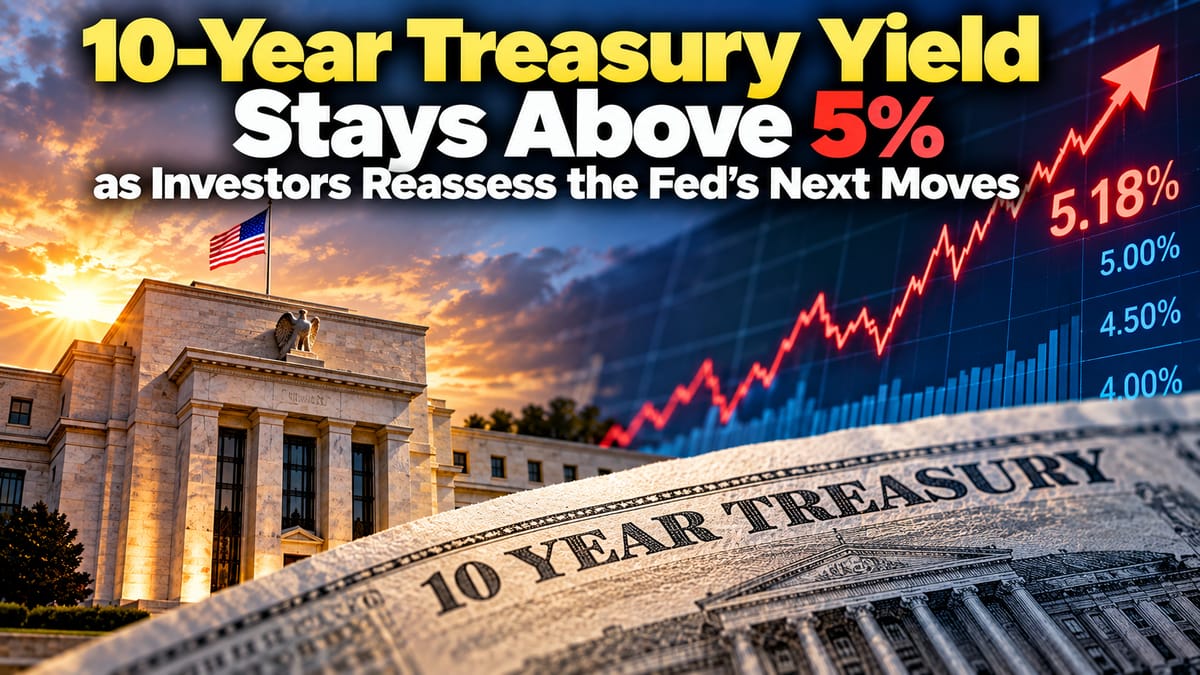
The benchmark yield reached 5.18% on September 24, according to Federal Reserve data, after briefly moving below 5% earlier in the week. On September 25, the yield was around 5.1% as investors weighed stronger economic data, persistent inflation concerns and expectations for another potential Federal Reserve rate increase.
The move comes only days after the Federal Reserve raised its target federal funds rate by 25 basis points to a range of 3.75% to 4%. It was the central bank’s first rate increase in more than three years.
With the 10-year yield now operating above a level that markets have historically watched closely, investors are turning their attention toward what could happen at the Fed’s next meetings.
Why the 5% Treasury Yield Matters
The 10-year Treasury is one of the most closely followed interest rates in the global financial system.
It influences borrowing costs across the economy, including mortgages, corporate debt and other forms of long-term financing. It also plays an important role in how investors value stocks and other assets.
When Treasury yields rise, newly issued government bonds can offer more attractive returns relative to riskier investments. Higher yields can therefore change how investors allocate capital.
The relationship between yields, borrowing costs and economic activity is explained in greater detail in Understanding Interest Rates and Their Effects.
The 5% level is also psychologically important because it represents a substantial increase from the unusually low yields that characterized much of the previous decade.
Treasury Yields Have Risen Sharply in September
The latest increase has been part of a broader September move.
Federal Reserve data show that the 10-year yield stood at 4.73% at the end of August. It rose to 4.97% on September 14, reached 5.01% on September 16 and climbed to 5.18% on September 24.
That is a significant move in a relatively short period.
The rise has reflected several forces rather than one single market development. Investors have been reassessing inflation risks, the outlook for monetary policy, economic growth and the government’s long-term borrowing needs.
Reuters reported that the benchmark yield had moved above 5% for the first time since 2023 and that investors were increasingly considering whether the traditional 5% threshold could become less of a ceiling and more of a starting point for higher long-term borrowing costs.
The Fed Has Already Shifted Back Toward Higher Rates
The Federal Reserve’s September decision has changed the interest-rate backdrop.
On September 16, the Federal Open Market Committee unanimously approved a quarter-point increase, taking the target range to 3.75%-4%. The Fed said economic activity was expanding at a solid pace, domestic spending remained resilient and inflation was still elevated.
The decision marked a major change from the period when markets were focused primarily on potential rate cuts.
The central bank is now dealing with an environment in which inflation remains above its 2% objective while economic activity has continued to show resilience.
That creates a difficult policy environment.
Cutting rates too quickly could risk allowing inflationary pressures to remain persistent. Keeping rates higher for longer, meanwhile, could put additional pressure on borrowing, investment and interest-sensitive parts of the economy.
The mechanics of this relationship are covered in How Monetary Policy Affects Financial Markets.
Investors Are Watching for Another Rate Hike
Market expectations have shifted rapidly since the September Fed meeting.
On September 25, traders were pricing in a 69% probability of at least a 25-basis-point rate increase at the October meeting, according to CME FedWatch data cited by Reuters. That was up from roughly 50% earlier in the week.
The next scheduled FOMC meeting is October 27-28.
Those expectations are not guarantees of what the Federal Reserve will do.
They represent market pricing based on available information and can change quickly as new inflation, employment and economic-growth data are released.
That makes the upcoming economic calendar particularly important.
Inflation Remains a Central Concern
Inflation is one of the main reasons investors are questioning whether the Fed can afford to ease policy.
The Federal Reserve said after its September meeting that inflation remained elevated and that the latest rate increase was intended to support a more timely return toward its 2% goal.
Fed officials have subsequently emphasized that inflation risks remain significant.
Minneapolis Fed President Neel Kashkari said inflation remained too high across the economy and supported the September rate increase. St. Louis Fed President Alberto Musalem also said further increases could be necessary to bring inflation under control.
The challenge is that some inflationary pressures are coming from factors monetary policy cannot directly control.
Energy prices and geopolitical disruptions can raise costs independently of domestic demand. Tighter monetary policy can reduce demand, but it cannot directly increase oil production or eliminate supply disruptions.
Oil Prices Are Adding Another Complication
Oil has become another important factor in the interest-rate debate.
Brent crude was trading above $100 per barrel on September 25, according to Reuters, while geopolitical developments continued to create uncertainty around global energy supplies.
Higher energy prices can feed into inflation through fuel, transportation and production costs.
That creates a difficult combination for financial markets.
If oil remains elevated while underlying inflation also stays above the Fed’s target, investors may become more cautious about expecting rapid monetary easing.
At the same time, sustained high energy costs can eventually weigh on household purchasing power and corporate margins.
Rising Yields Are Changing the Stock Market Equation
The impact of higher Treasury yields extends well beyond the bond market.
Equity investors often compare expected stock returns with the return available from relatively low-risk government bonds. When Treasury yields rise, the hurdle for investing in stocks can become higher.
Higher rates can also affect the present value of future corporate earnings.
This is particularly relevant for companies whose valuations depend heavily on profits expected many years in the future. When discount rates rise, those future earnings become less valuable in today’s terms.
That is why Treasury Yields Are Surging: Why Rising Bond Yields Could Pressure Stocks Next is closely connected to the current market environment.
AI Optimism Is Providing a Counterweight
Higher yields have not stopped investors from putting money into parts of the technology sector.
AI-related enthusiasm has remained an important source of support for stocks. On September 25, Reuters reported that AI optimism was helping offset concerns about oil prices and rising Treasury yields, with several semiconductor stocks gaining in premarket trading.
The Nasdaq had also recently reached a record high as investors continued to focus on AI adoption, corporate investment and the potential for productivity gains.
That creates an unusual market tension.
On one side, higher yields can put pressure on valuations.
On the other, strong expectations for AI-related earnings and investment can encourage investors to continue buying technology stocks.
The result is a market in which bond yields and technology optimism are pulling investor attention in different directions.
The 10-Year Yield Also Reflects Long-Term Risks
The 10-year Treasury yield is influenced by expectations for Federal Reserve policy, but it is not simply a reflection of the Fed’s current policy rate.
Investors also consider long-term inflation, economic growth, government borrowing and the supply and demand for Treasury securities.
That distinction is important.
The Fed directly controls a short-term policy rate. The 10-year Treasury yield is determined by market forces and reflects expectations extending much further into the future.
A sustained rise in the 10-year yield can therefore indicate that investors expect a combination of higher inflation, stronger growth, increased Treasury issuance or higher long-term risk premiums.
Recent Reuters analysis pointed to concerns about the growing U.S. government debt burden as one factor contributing to the bond-market selloff.
Government Borrowing Is Another Factor
The U.S. Treasury needs to finance large amounts of government debt, creating a continuing supply of Treasury securities for investors to absorb.
When the market demands higher compensation for holding long-duration government bonds, yields can rise even without a corresponding change in the Federal Reserve’s policy rate.
That means investors are watching fiscal developments alongside monetary policy.
If long-term yields continue rising because of concerns about government borrowing and debt sustainability, the move could become increasingly independent of expectations for the next Fed meeting.
This is one reason the current bond-market move has attracted attention beyond the immediate question of whether the Fed raises rates again.
Why Mortgage and Corporate Borrowing Could Feel the Impact
Treasury yields are also important because they feed into other borrowing costs.
Mortgage rates are influenced by long-term Treasury yields and mortgage-market conditions. Corporate borrowers also tend to pay a spread over government bond yields.
If benchmark yields remain elevated, households refinancing mortgages and companies issuing new debt may face higher financing costs.
Businesses could respond by delaying investment, reducing borrowing or demanding higher returns from new projects.
Consumers may also face higher costs for mortgages and other interest-sensitive financial products.
The effects do not occur instantly, but persistent increases in long-term yields can gradually work their way through the economy.
The Fed’s Next Moves Will Depend on Incoming Data
The upcoming economic calendar is likely to receive unusually close attention.
Reuters reported on September 25 that investors were preparing to assess new employment and inflation figures as they reconsidered the potential path of Federal Reserve policy. The September employment report and the latest personal consumption expenditures data were among the major releases investors were watching.
Strong economic data combined with persistent inflation could reinforce expectations for further tightening.
Conversely, signs of weakening employment or softer inflation could reduce pressure on the central bank to raise rates again.
That makes the next several weeks particularly important for both bond and equity investors.
Higher Yields Are Reshaping Valuation Expectations
The current environment is also forcing investors to reconsider how much they are willing to pay for stocks.
When Treasury yields were significantly lower, investors could justify higher equity valuations partly because the alternative return available from government bonds was relatively limited.
A 5% 10-year Treasury yield changes that calculation.
It does not automatically make stocks unattractive, because companies can continue to grow earnings and some businesses may benefit from strong economic conditions.
But it changes the comparison investors make when deciding between government bonds and equities.
The relationship between these markets is explored further in Rising Treasury Yields Put Pressure on Stock Valuations as Investors Reassess Rates.
The Bond Market May Remain Volatile
The recent move above 5% suggests that Treasury yields could remain sensitive to incoming economic information.
Investors are simultaneously assessing inflation, employment, oil prices, government borrowing and Federal Reserve policy.
Each new data release can therefore change expectations for the path of interest rates.
That can produce sharp moves in Treasury prices and yields.
The volatility also means investors should distinguish between a temporary move above 5% and a sustained shift in the long-term interest-rate environment.
The difference could have important implications for mortgages, corporate financing, equity valuations and economic growth.
What Investors Are Watching Now
Several factors are likely to dominate financial-market attention as October approaches:
- Inflation data: Evidence of persistent price pressures could strengthen expectations for additional tightening.
- Employment: A resilient labor market could give policymakers more room to focus on inflation.
- Economic growth: Strong activity could reduce expectations for rapid policy easing.
- Oil prices: Sustained energy costs could complicate the inflation outlook.
- Treasury issuance: Increased government borrowing could influence long-term yields.
- Fed communication: Speeches from policymakers could shift expectations ahead of the October meeting.
- Equity valuations: Investors will continue weighing AI-driven earnings optimism against higher discount rates.
Together, these factors will help determine whether the 10-year Treasury yield remains above 5% or eventually retreats.
The 5% Threshold Has Become a New Market Reference Point
The 10-year Treasury yield’s move above 5% is significant not because the number itself creates a specific economic outcome, but because it represents a meaningful change in financial conditions.
The benchmark yield was 5.18% on September 24 and remained around 5.1% on September 25, while investors increased their expectations for another Fed rate hike in October.
The Federal Reserve is simultaneously dealing with elevated inflation and a still-resilient economy, while markets are balancing higher borrowing costs against continued optimism surrounding AI investment and corporate growth.
For investors, the central question is increasingly broader than what the Fed does at its next meeting. The more important issue may be whether higher long-term yields become a persistent feature of the financial landscape.
If the 10-year Treasury remains above 5%, its influence could extend across bonds, stocks, mortgages, corporate borrowing and the valuation of future economic growth.