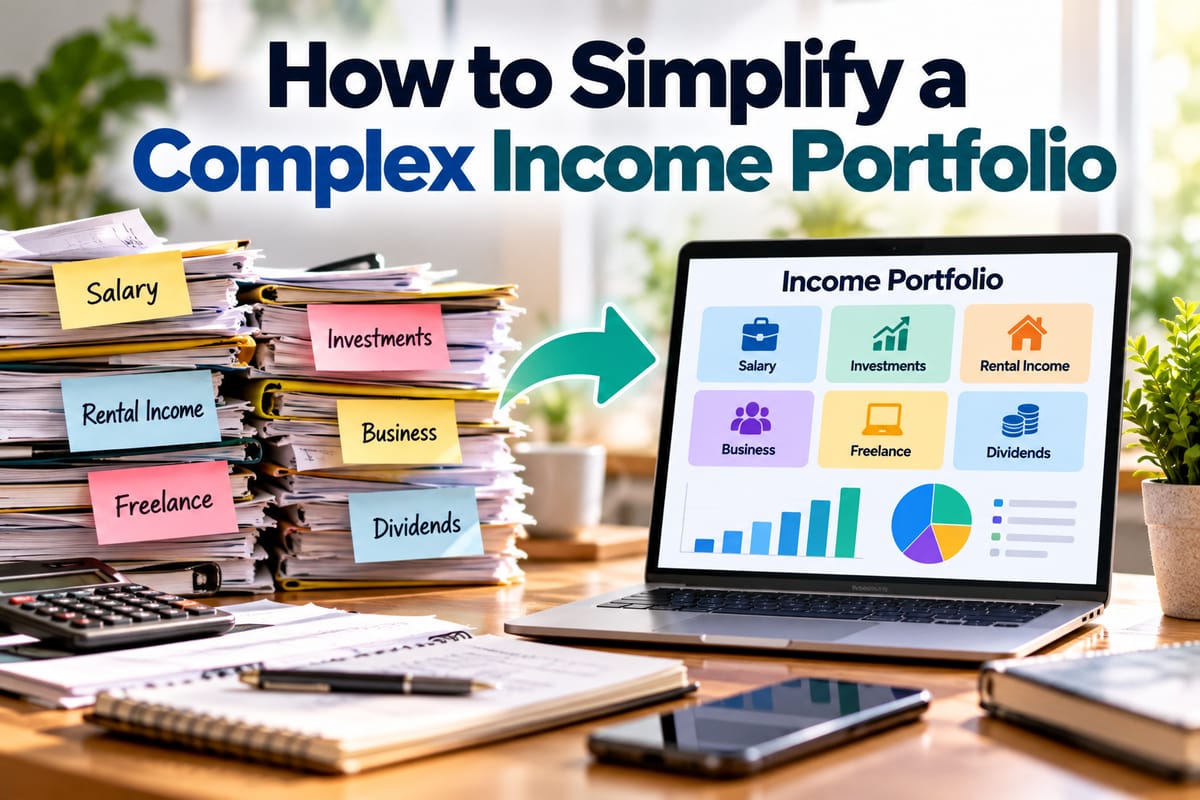
How to Simplify a Complex Income Portfolio
A growing income portfolio can be a sign of financial progress. Over time, a person might accumulate salary income, freelance work, rental income, dividends, interest, business revenue, royalties, and other sources of cash flow.
The problem is that more income sources do not automatically create a simpler financial life.
As the number of accounts, investments, businesses, properties, and payment streams increases, managing everything can become difficult. It may become harder to understand where money is coming from, which assets are performing well, how much risk is concentrated in one area, and whether every part of the portfolio still serves a purpose.
Simplifying a complex income portfolio does not necessarily mean eliminating sources of income. Instead, it means creating a clearer structure so that income, investments, risks, taxes, and financial goals are easier to monitor and manage.
What Makes an Income Portfolio Complex?
An income portfolio becomes complex when it contains many different sources of cash flow, assets, accounts, or financial arrangements that require ongoing attention.
For example, someone might have:
- A full-time salary
- Freelance income
- A small business
- Rental property
- Dividend-paying stocks
- Bonds
- Savings accounts
- Certificates of deposit
- Retirement accounts
- Royalties
- Digital products
Each component may be reasonable on its own. The challenge comes from managing all of them together.
Complexity can also come from having multiple financial institutions, overlapping investments, different tax treatments, numerous accounts, or investments that serve nearly identical purposes.
Complexity Is Not the Same as Diversification
One of the first distinctions to make is between diversification and unnecessary complexity.
Diversification involves spreading exposure across different assets, sectors, markets, or income sources to reduce dependence on a single source of financial performance.
Complexity, by contrast, refers to how difficult the overall financial structure is to understand and manage.
A portfolio can therefore be diversified without being excessively complicated.
For example, owning several broadly diversified investments may be easier to manage than holding dozens of narrowly focused investments that all require separate research and monitoring.
The objective is not to make every financial decision as simple as possible. The objective is to make the overall system understandable.
Start With a Complete Inventory
Before simplifying anything, create a complete inventory of the portfolio.
List every source of income and every significant asset.
A useful inventory might include:
| Category | Examples | Key Information |
|---|---|---|
| Employment | Salary, bonuses | Net and gross income |
| Self-employment | Consulting, freelance work | Average monthly revenue |
| Business | Company distributions | Ownership and profitability |
| Property | Rent | Net rental income |
| Investments | Dividends, interest | Yield and value |
| Retirement | Pension, retirement accounts | Contributions and holdings |
| Other | Royalties, digital products | Recurring income |
The purpose is to see the entire financial picture in one place.
Many people discover that their portfolio is not necessarily as diversified or complicated as they thought once everything is organized into categories.
Separate Income Sources From Assets
An important step is distinguishing between an asset and the income it generates.
A rental property is an asset. Rent is income.
A stock is an asset. Dividends or proceeds from selling it can produce cash flow.
A business is an asset or ownership interest. Distributions or profits may represent income.
This distinction makes it easier to evaluate whether a particular source of cash flow is actually worth the capital, time, risk, and administrative work required to maintain it.
Identify the Purpose of Every Component
Every major part of an income portfolio should have a clear purpose.
Ask questions such as:
- Is this designed for current income?
- Is it intended for long-term growth?
- Does it provide diversification?
- Does it protect liquidity?
- Does it support retirement?
- Does it provide business income?
- Does it serve a specific financial goal?
- Is it primarily speculative?
- Does it still have a reason to exist?
A component that has no identifiable role deserves closer examination.
This does not automatically mean it should be eliminated. It means the owner should understand why it remains part of the portfolio.
Connect the Portfolio to Long-Term Goals
Simplification becomes easier when financial decisions are connected to specific objectives.
For example, someone saving for retirement may prioritize long-term growth and appropriate diversification, while someone preparing for a major purchase within a few years may place greater emphasis on liquidity and capital preservation.
A structured investment plan for long-term goals can provide a framework for deciding which assets and income sources deserve attention.
Instead of asking whether every investment is individually attractive, the broader question becomes:
Does this part of the portfolio help support the financial goals it was intended to serve?
Group Similar Income Sources Together
One way to reduce mental clutter is to organize similar sources of income into broader categories.
For example:
Employment Income
- Salary
- Bonuses
- Commissions
Business Income
- Business profits
- Consulting
- Freelance work
- Professional services
Investment Income
- Dividends
- Interest
- Distributions
Property Income
- Residential rent
- Commercial rent
- Other property-related income
This structure makes it easier to understand how dependent the household is on each broad category.
It can also reveal whether several apparently different income sources are actually exposed to the same underlying economic risk.
Look for Hidden Concentration
Having multiple income sources does not necessarily mean the portfolio is diversified.
For example, someone might have a salary from a technology company, freelance software work, shares in technology companies, and a rental property in a neighborhood dominated by technology workers.
There are technically several sources of income, but they may all be influenced by similar economic conditions.
This is sometimes called concentration risk.
The same principle applies to employment income. Depending heavily on one employer can create a significant financial vulnerability even when investments are diversified. The relationship between income concentration and financial risk is explored in How Relying on One Income Source Creates Financial Concentration Risk.
Review the Portfolio by Risk Exposure
Instead of looking only at individual accounts, consider what each component is exposed to.
Potential sources of concentration include:
- One industry
- One employer
- One geographic area
- One currency
- One type of property
- One customer
- One business
- One asset class
- One economic condition
Two different investments may appear separate but behave similarly when market conditions change.
Understanding these relationships can be more useful than simply counting how many investments or income sources exist.
Consolidate Where Appropriate
Multiple accounts can create unnecessary administrative work.
Where appropriate and permitted by the relevant financial institutions and account rules, consolidation may make a portfolio easier to monitor.
For example, an investor might discover that several accounts contain overlapping investments or serve nearly identical purposes.
Before consolidating anything, however, consider:
- Fees
- Taxes
- Withdrawal restrictions
- Account protections
- Investment options
- Employer-plan rules
- Transfer costs
- Legal ownership
- Beneficiary arrangements
Consolidation should be based on the specific circumstances rather than performed simply for the sake of having fewer accounts.
Reduce Investment Overlap
Investment overlap is another common source of unnecessary complexity.
Someone may own several funds that appear different but hold many of the same companies.
This can result in a portfolio that contains numerous investment products without providing much additional diversification.
A portfolio review should therefore examine the underlying holdings rather than relying only on the number of funds or accounts.
Asset allocation tools can help investors examine how portfolios are distributed across different asset categories. How Asset Allocation Tools Analyze Portfolios provides additional context on how these tools can be used to evaluate portfolio structure.
Evaluate the Role of Dividend Income
Dividend-paying investments can be an important component of an income-oriented portfolio, but dividend income should be viewed within the broader context of total investment performance and risk.
A company paying a dividend is not necessarily a better investment simply because it produces regular cash payments.
Investors should consider factors such as:
- The underlying business
- Dividend sustainability
- Valuation
- Growth prospects
- Industry exposure
- Portfolio concentration
- Tax treatment
- Total return
Understanding the mechanics of dividends can help prevent income-focused decisions from becoming disconnected from the underlying investment. Dividends and Stock Ownership Explained provides a deeper explanation of how dividends relate to stock ownership.
Create a Simple Income Dashboard
A complex portfolio becomes easier to manage when the important information can be viewed quickly.
A basic income dashboard might track:
| Metric | Monthly | Annual |
|---|---|---|
| Employment income | $X | $X |
| Business income | $X | $X |
| Property income | $X | $X |
| Investment income | $X | $X |
| Other income | $X | $X |
| Total income | $X | $X |
The actual categories should reflect the individual’s financial situation.
The goal is not to build an elaborate spreadsheet that takes hours to maintain. It is to create a simple overview that answers the most important questions.
Track Net Income, Not Just Revenue
Gross income can make an income stream appear more attractive than it actually is.
For example, rental income may need to cover maintenance, insurance, property taxes, management costs, financing expenses, and periods without tenants.
Similarly, business revenue may come with substantial operating expenses.
A better comparison often comes from examining net cash flow.
A simple calculation is:
Net income = Gross income − Relevant expenses
This does not replace detailed accounting or tax reporting, but it can provide a clearer picture of the economic contribution of each income source.
Consider the Time Cost of Each Income Stream
Money is not the only resource involved in managing an income portfolio.
Time matters too.
Two income sources might produce similar annual cash flow while requiring very different amounts of effort.
For example:
- One investment might require almost no ongoing involvement.
- A rental property may require maintenance and tenant management.
- Freelance work may require constant client acquisition.
- A small business may require substantial operational oversight.
The purpose of simplification is partly to understand these trade-offs.
An income stream that generates money but consumes a disproportionate amount of time may deserve a different role in the overall financial strategy.
Automate Routine Financial Tasks
Automation can remove a significant amount of administrative work.
Depending on the accounts and services involved, automation might include:
- Recurring transfers
- Investment contributions
- Bill payments
- Savings contributions
- Account alerts
- Dividend reinvestment
- Expense tracking
Automation should not mean ignoring the portfolio. It simply reduces the number of repetitive decisions that have to be made manually.
Important accounts and investments should still be reviewed periodically.
Establish a Review Schedule
A portfolio does not need to be examined constantly to remain organized.
A regular review schedule can be more practical.
A monthly review might focus on:
- Cash flow
- Account balances
- Unexpected expenses
- Income changes
A longer-term review might examine:
- Asset allocation
- Investment overlap
- Concentration risk
- Fees
- Financial goals
- Tax considerations
- Major changes in income
The appropriate frequency depends on the complexity and circumstances of the portfolio.
Eliminate Redundant Complexity Carefully
After reviewing the entire portfolio, look for components that duplicate another function.
Examples might include:
- Multiple accounts serving the same purpose
- Overlapping investment funds
- Unused financial services
- Business subscriptions that no longer generate value
- Income streams requiring disproportionate administrative effort
- Investments retained without a clear objective
Not every redundant component needs to be removed immediately.
Before making changes, consider potential taxes, penalties, transaction costs, contractual obligations, and other consequences.
Build a Simple Decision Framework
A useful way to evaluate each component is to ask five questions:
- What purpose does it serve?
- How much income or value does it provide?
- What risks does it introduce?
- How much time and money does it require?
- Is there another part of the portfolio that already serves the same purpose?
If these questions are difficult to answer, that may be a sign that the portfolio needs better organization.
Keep an Emergency Cash Layer
Simplifying an income portfolio does not mean putting every financial resource into investments.
Accessible cash can provide an important buffer against unexpected expenses or temporary income disruptions.
The appropriate amount depends on factors such as:
- Household expenses
- Income stability
- Employment situation
- Debt obligations
- Dependents
- Insurance coverage
- Business volatility
Keeping an appropriate liquidity reserve can also reduce the pressure to sell long-term investments at an inconvenient time when an unexpected expense occurs.
Review Taxes Before Making Major Changes
Income portfolios can contain assets and activities with very different tax treatments.
Investment income, business income, rental income, employment compensation, and retirement withdrawals may all have different rules depending on the jurisdiction and individual circumstances.
Selling investments can also potentially create taxable gains or losses.
For that reason, simplification should not be treated as purely an organizational exercise. Before making major structural changes, it can be useful to understand the tax consequences and seek qualified professional advice when necessary.
Simplification Should Improve Visibility
The goal of a simpler income portfolio is not necessarily to have fewer investments, fewer accounts, or fewer income sources.
Instead, the goal is to make the financial system easier to understand.
A well-organized portfolio should make it relatively easy to answer questions such as:
- Where does my income come from?
- Which sources are most reliable?
- Where is my financial risk concentrated?
- Which assets support my long-term goals?
- How much cash is readily available?
- Which accounts overlap?
- Which income sources require the most time?
- What needs attention this year?
When those answers become clearer, managing a complex financial life becomes less overwhelming.
Turning Complexity Into a Manageable System
A diverse income portfolio can become difficult to manage when every account, investment, property, and income stream is treated as a separate project.
The solution is to step back and look at the entire system.
Inventory the income sources, identify the purpose of each asset, examine hidden concentration, review overlapping investments, track net cash flow, automate routine tasks, and regularly connect the portfolio back to long-term financial goals.
The result does not have to be an extremely small portfolio. It simply needs to be one that the owner can understand, monitor, and adjust when circumstances change.
Simplification ultimately means replacing financial clutter with a structure where every major component has a clear purpose and the overall portfolio remains aligned with the life it is intended to support.