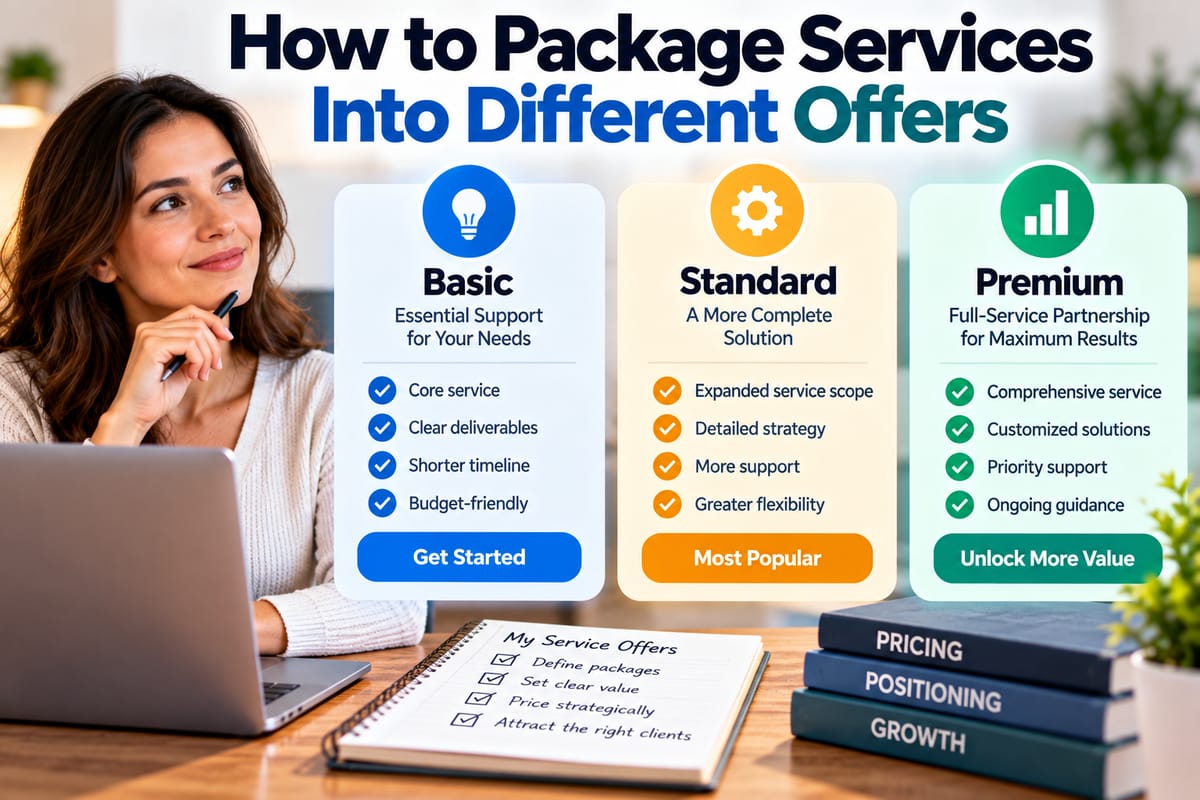
How to Package Services Into Different Offers
Selling a service does not always have to mean offering one standard package to every customer.
A consultant, freelancer, designer, coach, marketer, developer, writer, or other service professional can often create several offers around the same core expertise. Different packages can serve customers with different budgets, needs, timelines, and desired levels of support.
Instead of simply asking, “How much do you charge?” a service provider can give potential clients clear choices based on what they actually need.
Good service packaging is not about adding unnecessary features or making an offer complicated. It is about organizing expertise into understandable solutions that make it easier for customers to decide what fits their situation.
What Is a Service Package?
A service package combines several elements of a professional service into a defined offer.
A package might specify:
- What the client receives
- What is included
- What is not included
- How the service is delivered
- How long the engagement lasts
- How much communication is provided
- How many revisions or consultations are included
- The price or pricing structure
- What the client needs to provide
For example, a graphic designer might offer:
- A basic logo package
- A complete brand identity package
- A premium brand strategy and identity package
All three offers use the same underlying expertise, but the scope and level of involvement are different.
Why Create Multiple Offers?
A single service package can make it difficult to serve customers with very different requirements.
One potential client may need only a small project, while another may want ongoing strategic support.
Multiple offers can help accommodate these differences.
They can also:
- Make pricing easier to understand
- Reduce repetitive negotiations
- Give clients more choice
- Highlight the value of different service levels
- Create opportunities for recurring revenue
- Make sales conversations more structured
- Provide a path for clients to purchase additional services
The objective is not to create as many packages as possible. It is to create enough meaningful choices to address distinct customer needs.
Start With the Core Problem You Solve
Before creating packages, identify the primary problem your service solves.
A web designer, for example, is not simply selling “web design.” Clients may actually want:
- A professional online presence
- More effective lead generation
- An easier way to sell products
- A website that communicates their expertise
- A better customer experience
Understanding the underlying problem makes it easier to package the service around outcomes and deliverables rather than a random list of tasks.
Identify Different Customer Needs
Your customers may want the same general service for very different reasons.
Consider a freelance writer.
One client might need:
- One blog post
- Fast turnaround
- Minimal collaboration
Another might need:
- Weekly articles
- Keyword research
- Content planning
- Editing
- Ongoing communication
Both customers need writing, but their requirements are substantially different.
Those differences can form the foundation of separate offers.
Build a Basic Offer First
Start with a straightforward version of the service.
A basic offer should answer:
- What is the service?
- Who is it for?
- What does the client receive?
- How long does delivery take?
- What does it cost?
- What is excluded?
For example:
Basic Website Audit
- Website review
- Usability observations
- Technical issue summary
- Written recommendations
- One review call
This creates a clear starting point without overwhelming the buyer.
Create a Middle-Tier Offer
The next package can provide more depth, support, or customization.
Using the website example, a middle-tier offer might include:
Complete Website Improvement Package
- Full website audit
- User-experience review
- Technical recommendations
- Content review
- Priority recommendations
- Implementation roadmap
- Two consultation calls
The middle offer should not simply contain more items. Each addition should solve a meaningful customer need.
Add a Premium Offer Carefully
A premium package can provide a higher level of involvement.
For example:
Website Strategy and Optimization Partnership
- Comprehensive website assessment
- Competitive research
- User-experience strategy
- Content recommendations
- Conversion analysis
- Implementation guidance
- Regular strategy meetings
- Ongoing support
A premium offer may be appropriate for clients who value greater involvement and want the professional to take responsibility for a broader portion of the project.
Use Scope to Differentiate Offers
One of the simplest ways to create different packages is to vary the scope.
For example:
| Feature | Basic | Standard | Premium |
|---|---|---|---|
| Initial consultation | ✓ | ✓ | ✓ |
| Core service | ✓ | ✓ | ✓ |
| Detailed analysis | — | ✓ | ✓ |
| Strategy session | — | ✓ | ✓ |
| Implementation support | — | — | ✓ |
| Ongoing support | — | — | ✓ |
The exact features depend on the business.
The important principle is that each tier should have a clear reason for existing.
Differentiate by Speed
Time can also be part of the offer.
A standard service might have a normal delivery window, while an expedited option provides priority scheduling for clients who need the work sooner.
For example:
- Standard delivery: 7 business days
- Priority delivery: 3 business days
- Rush delivery: 24–48 hours
Rush work should account for the additional pressure and scheduling constraints it creates.
Pricing should reflect the value and operational impact of faster delivery rather than simply adding an arbitrary surcharge.
Differentiate by Access
Another option is to vary the level of professional access.
A basic package might include email communication, while higher-tier packages could include:
- Scheduled consultation calls
- Direct messaging
- Weekly meetings
- Priority responses
- Strategic reviews
This can be particularly useful for consultants, coaches, advisors, and other professionals whose value includes ongoing guidance.
Differentiate by Customization
Some clients want a standardized service, while others need a highly customized solution.
A basic package can use a defined process.
A higher-tier package can allow greater customization based on the client’s situation.
For example:
Standard
A predefined financial-content audit with a standard report.
Advanced
A customized audit covering specific business goals and customer segments.
Strategic
A comprehensive engagement involving research, recommendations, implementation planning, and ongoing advisory support.
Customization becomes part of the value rather than an endless series of exceptions to a standard package.
Package Outcomes, Not Just Tasks
Clients generally care about what the service helps them accomplish.
A package described entirely as a list of tasks can be difficult for a buyer to evaluate.
Compare:
Package A
- Three meetings
- Five reports
- Ten recommendations
with:
Package B
- Identify the biggest operational bottlenecks
- Create a prioritized improvement plan
- Develop an implementation roadmap
- Review progress with the client
The second description communicates the purpose of the work more clearly.
Deliverables still matter, but they should support an understandable customer outcome.
Be Specific About Deliverables
While outcomes are important, clients also need to know what they are actually purchasing.
Avoid vague descriptions such as:
- Full support
- Comprehensive service
- Complete assistance
- Unlimited strategy
Instead, specify what the client receives.
For example:
- Two 60-minute strategy calls
- One written report
- Three rounds of revisions
- A 30-day implementation plan
- Weekly email updates
Specific deliverables reduce misunderstandings.
Set Clear Boundaries
Every package should define its limits.
This can include:
- Number of revisions
- Number of meetings
- Delivery timeframe
- Communication channels
- Geographic coverage
- Number of products or pages
- Amount of research
- Implementation responsibilities
Clear boundaries protect both the client and the service provider.
They also make pricing easier to calculate.
Price Packages Based on Value and Resources
Pricing should reflect more than the number of hours involved.
Consider:
- Time required
- Expertise required
- Complexity
- Direct expenses
- Software or tools
- Communication requirements
- Revision risk
- Client value
- Opportunity cost
- Desired profitability
An hourly-rate calculation can provide a useful baseline, particularly for freelancers. How Freelancers Calculate Hourly Rates explains some of the factors that can influence how professionals determine their rates.
The resulting package price can then account for the entire scope rather than simply multiplying an hourly rate by an estimated number of hours.
Don’t Hide Unlimited Work Inside a Package
“Unlimited revisions” or “unlimited support” can sound attractive but may create serious problems for a service provider.
A client who interprets unlimited support literally may expect:
- Unlimited calls
- Unlimited emails
- Unlimited revisions
- Immediate responses
- Additional work outside the original scope
Instead, define reasonable limits.
For example:
Includes two rounds of revisions and up to two consultation calls.
Additional work can then be priced separately when appropriate.
Create a Clear Upgrade Path
Different packages can form a natural progression.
A client might begin with a smaller service and later require more support.
For example:
Starter → Professional → Ongoing Partnership
This structure gives customers a clear way to expand their relationship with the service provider as their needs grow.
However, the upgrade should make sense because the client’s needs have changed, not because the basic package was intentionally made unusable.
Consider a One-Time Offer and a Recurring Offer
Some services naturally work as one-time projects.
Others can become ongoing relationships.
For example, a marketing professional might offer:
One-Time
Marketing strategy audit.
Monthly
Ongoing marketing strategy and reporting.
Premium Retainer
Strategy, campaign planning, analysis, and regular advisory support.
Recurring services can provide greater predictability for the business while giving clients continuing access to expertise.
Turn Expertise Into Additional Offers
Professionals often possess more knowledge than they currently monetize.
Someone who provides consulting services might also create:
- Workshops
- Training sessions
- Templates
- Audits
- Group programs
- Advisory retainers
- Digital resources
The key is ensuring each offer solves a distinct customer problem.
How to Turn Professional Knowledge and Experience Into Additional Income explores how expertise can be converted into additional income opportunities.
Create Packages Around Different Buying Preferences
Customers do not all want the same level of involvement.
Some prefer to do most of the work themselves and simply need expert guidance.
Others want the professional to handle nearly everything.
This creates a useful distinction:
Do-It-Yourself Support
Provide the client with:
- Guidance
- Templates
- Training
- Recommendations
Done-With-You Support
Provide:
- Guidance
- Collaboration
- Implementation assistance
- Regular reviews
Done-for-You Support
Provide:
- Complete execution
- Project management
- Ongoing optimization
These models can allow the same expertise to serve customers with different budgets and preferences.
Avoid Creating Too Many Packages
More options are not always better.
If a service provider creates eight or ten nearly identical packages, customers may struggle to determine which one is appropriate.
A simpler structure might contain:
- Basic
- Standard
- Premium
In some businesses, two packages may be enough.
The number should depend on genuine differences in customer needs.
Give Each Package a Distinct Purpose
If two packages are difficult to distinguish, they probably need to be redesigned.
Each package should answer a different customer question.
For example:
Basic: I need help solving one specific problem.
Standard: I need a complete solution.
Premium: I want expert support from planning through implementation.
This makes the purchasing decision easier.
Use Optional Add-Ons
Not every customer needs every feature.
Instead of forcing every service into the main package, some elements can become optional add-ons.
Examples include:
- Extra consultation
- Additional revision
- Rush delivery
- Additional research
- Extra pages
- Additional training
- Monthly maintenance
- Ongoing reporting
Add-ons can increase flexibility without creating dozens of packages.
Make the Difference Between Tiers Obvious
A potential customer should be able to understand the difference between packages quickly.
A comparison table can help:
| Feature | Starter | Professional | Premium |
|---|---|---|---|
| Initial consultation | ✓ | ✓ | ✓ |
| Core service | ✓ | ✓ | ✓ |
| Detailed strategy | — | ✓ | ✓ |
| Implementation support | — | ✓ | ✓ |
| Ongoing advisory | — | — | ✓ |
| Priority access | — | — | ✓ |
The actual features should be tailored to the service.
The purpose of the table is to make the differences visible.
Don’t Compete Only on Price
Multiple packages should not simply represent cheap, medium, and expensive versions of the same service.
If the only difference is quantity, customers may focus almost entirely on price.
Instead, differentiate based on:
- Scope
- Expertise
- Speed
- Access
- Customization
- Support
- Complexity
- Desired outcome
This shifts the conversation toward the value and suitability of the service.
Review Which Offers Customers Actually Buy
Packaging should evolve based on real customer behavior.
Track:
- Which package receives the most inquiries
- Which package sells most frequently
- Which package produces the highest profit
- Which features customers ask about
- Which package generates the most revisions
- Which services lead to repeat business
- Which add-ons are popular
A package that looks attractive on paper may not perform well in practice.
Actual customer behavior provides useful evidence about what needs to change.
Watch Your Delivery Capacity
A package can be commercially attractive while being operationally difficult to deliver.
For example, a premium package promising weekly meetings, rapid responses, extensive research, and unlimited revisions could consume far more time than expected.
Before launching an offer, estimate:
- Delivery hours
- Administrative time
- Communication time
- Project-management time
- Revision time
- Software costs
- Contractor costs
Then compare those requirements with the expected revenue.
Protect Your Profit Margin
Revenue alone does not determine whether a service package is worthwhile.
Suppose a package sells for $2,000 but requires:
- 20 hours of professional work
- 5 hours of meetings
- 4 hours of administration
- $200 in direct costs
The effective economics are very different from a package that generates the same revenue with substantially less resource consumption.
Service providers should therefore monitor profitability, not just sales volume.
Review Your Offers as Your Expertise Grows
Your capabilities can change over time.
As you gain experience, you may be able to:
- Solve problems faster
- Offer more specialized expertise
- Serve larger clients
- Handle more complex projects
- Produce better outcomes
- Develop proprietary processes
That can justify changing the structure of your offers.
Career development can also affect the type of services you are able to sell and the value you can provide. How to Increase Your Earning Potential Throughout Your Career explores broader ways professional skills and experience can contribute to earning potential.
Look for Opportunities to Standardize Delivery
A package becomes easier to sell and deliver when the underlying process is repeatable.
For example:
Step 1: Discovery
Step 2: Assessment
Step 3: Strategy
Step 4: Implementation
Step 5: Review
A repeatable process does not mean every client receives identical work. It means the service provider has a reliable framework for delivering the service.
Standardization can improve consistency and reduce unnecessary administrative work.
Build Packages That Can Scale
Some service offers are heavily dependent on the professional’s personal time.
Others can eventually be delivered with greater leverage.
For example, a consultant might move from:
One-to-one consulting → Group workshop → Training program → Digital resource
Each step can potentially serve more customers without requiring a proportional increase in one-to-one delivery time.
This is one way service businesses can explore greater scalability. How to Build Scalable Income Over Time provides broader context on building income models that can grow beyond strictly trading time for money.
Make the Purchase Decision Simple
A strong service offer should make it relatively easy for a potential customer to answer three questions:
- Is this service for me?
- Which package fits my needs?
- What exactly will I receive?
If a customer needs a long conversation just to understand what each package contains, the offer may need clearer positioning.
Simple does not mean shallow. It means the value and differences are easy to understand.
Communicate Who Each Package Is For
One practical technique is to describe the ideal customer for each offer.
For example:
Starter Package
For businesses that need a focused solution to one specific problem.
Professional Package
For businesses that need a broader strategy and implementation support.
Premium Package
For businesses that want ongoing expert involvement and strategic guidance.
This allows potential customers to identify themselves within the offer structure.
Keep Pricing Transparent When Appropriate
Transparent pricing can reduce unnecessary back-and-forth.
Depending on the service, a provider might publish:
- Fixed package prices
- Starting prices
- Price ranges
- Monthly fees
- Project-based pricing
Highly customized services may require a consultation before a final price can be determined.
The important point is to make the pricing process understandable.
Test Before Building a Large Product Line
Service providers do not need to create an elaborate catalog immediately.
Start with two or three offers and observe what happens.
Pay attention to:
- Customer questions
- Sales conversations
- Purchase rates
- Delivery difficulty
- Profitability
- Repeat demand
- Feedback
Use that information to refine the packages.
A simple offer that sells consistently is often more useful than a sophisticated package structure that customers do not understand.
Build Offers Around Real Customer Problems
Effective service packaging starts with the customer rather than the provider’s desire to list every skill they possess.
Instead of asking:
“What services can I sell?”
consider asking:
“What problems do my customers repeatedly need help solving?”
Then organize your expertise around those problems.
The resulting packages are more likely to be understandable, relevant, and easier to deliver consistently.
Turning Expertise Into Clear Choices
Packaging services into different offers gives professionals a way to serve customers with different needs without reinventing the service for every client.
Start with the core problem, identify meaningful differences in customer requirements, establish clear scopes, and create a small number of distinct packages. Use pricing, access, speed, customization, and support to differentiate the offers rather than simply adding more tasks.
As customer demand and professional expertise develop, packages can be refined, expanded, or transformed into recurring and more scalable income opportunities.
The strongest offer structure is not necessarily the one with the most choices. It is the one that makes the value clear, sets realistic expectations, protects the provider’s time, and gives the right customer an obvious path to purchase.