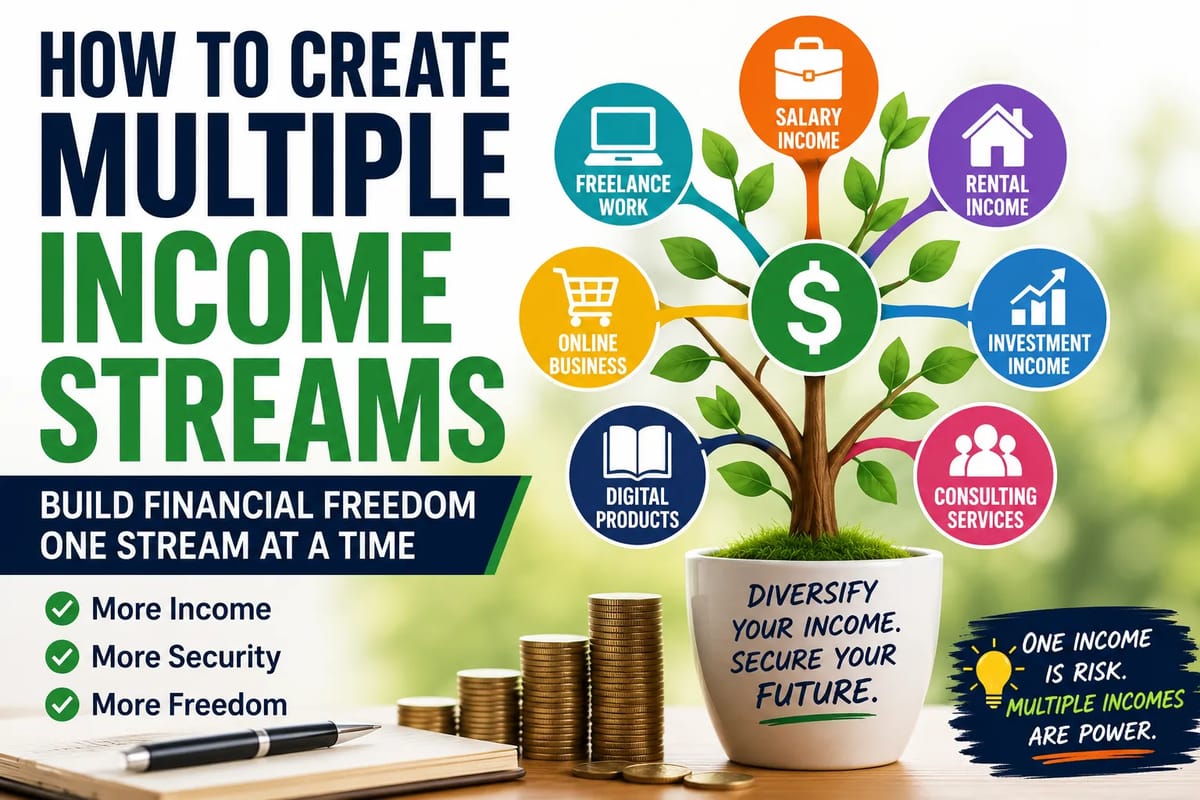
How To Create Multiple Income Streams
Relying on a single source of income can make your finances vulnerable.
If your salary is your only source of money, losing your job, having your hours reduced, or experiencing a major change in your industry can immediately affect your ability to pay bills and achieve financial goals.
Creating multiple income streams can provide another layer of financial resilience.
But building several sources of income does not mean working three full-time jobs or constantly chasing the latest side-hustle trend. A better approach is to build income streams gradually, choose opportunities that fit your skills and resources, and eventually create systems that do not require all of your time.
The goal is not simply to make more money.
It is to create a financial structure in which your income does not depend entirely on one employer, one client, or one business.
What Are Income Streams?
An income stream is a recurring or repeatable source of money.
For an individual, income might come from:
- Employment
- Freelance work
- Consulting
- A small business
- Rental property
- Investments
- Digital products
- Royalties
- Affiliate marketing
- Online content
- Licensing
- Interest or dividends
Some income streams require active work.
Others can become partially or largely passive after the initial effort.
Understanding that difference is important because not every additional income source will give you more free time.
Active Income vs. Passive Income
Active Income
Active income generally requires you to exchange time or effort for money.
Examples include:
- Freelancing
- Consulting
- Tutoring
- Delivery work
- Photography
- Contract work
- Personal training
- Home services
If you stop providing the service, the income usually stops as well.
Passive or Semi-Passive Income
Passive income generally requires less ongoing direct involvement after an initial investment of time, money, or resources.
Examples can include:
- Dividends
- Interest
- Royalties
- Certain digital products
- Some rental income
- Licensing income
However, genuinely passive income is often overstated online.
Most income streams require some combination of capital, maintenance, marketing, customer service, risk management, or periodic work.
A more realistic goal is income that becomes less dependent on your time.
Why Build Multiple Income Streams?
The biggest benefit is diversification.
Imagine two people earning the same amount of money.
Person A receives everything from one employer.
Person B receives income from a job, freelance work, investments, and a small online business.
Person B may still face financial risk, but that risk is distributed across several sources.
Multiple income streams can also help you:
- Increase savings
- Pay down debt faster
- Build an emergency fund
- Invest more consistently
- Fund a business
- Prepare for retirement
- Afford major purchases
- Reduce dependence on one employer
- Explore alternative careers
Additional income can therefore be valuable even if it starts small.
For a broader framework for developing income through independent work, see the complete guide to freelancing and independent work.
Start With Your Main Income
Before building a side income, examine your primary source of earnings.
Ask:
- Is there room to increase my salary?
- Can I negotiate better compensation?
- Can I develop a skill that qualifies me for higher-paying work?
- Are there opportunities for promotion?
- Can I move into a more valuable specialization?
Sometimes the easiest way to increase income is not to start something completely new.
It is to become more valuable in what you already do.
A salary increase can also provide more predictable income than many side hustles.
Turn Existing Skills Into Income
One of the fastest ways to create another income stream is to monetize something you already know how to do.
Consider your professional and personal skills.
You might be good at:
- Writing
- Graphic design
- Programming
- Photography
- Video editing
- Accounting
- Marketing
- Teaching
- Translation
- Sales
- Research
- Social media management
- Web development
- Project management
A skill that feels ordinary to you may be valuable to someone who does not have it.
Developing high-income skills you can learn and monetize can therefore be a useful foundation for building additional sources of income.
Start With Services
Services are often easier to start than businesses that require inventory or significant capital.
For example, a person with writing skills could offer:
- Blog writing
- Copywriting
- Editing
- Newsletter creation
- SEO content
A developer might offer:
- Website development
- Software maintenance
- Automation
- Technical consulting
A designer might offer:
- Brand design
- Social media graphics
- Presentation design
- Website design
The basic model is simple:
Skill → Service → Client → Income
Freelancing Can Become a Second Income Stream
Freelancing allows you to sell your skills to multiple clients rather than relying entirely on one employer.
You can find opportunities through:
- Professional networks
- Direct outreach
- Freelance marketplaces
- Industry communities
- Referrals
- Your own website
- Social media
Start with a clearly defined service.
“Digital services” is vague.
“SEO blog writing for technology companies” is much easier for a potential customer to understand.
Specialization Can Increase Your Value
General skills can be useful, but specialization can make it easier to differentiate yourself.
Instead of:
“I do marketing.”
Consider:
“I help small e-commerce businesses improve their email marketing.”
Instead of:
“I build websites.”
Consider:
“I build fast websites for local service businesses.”
Specific positioning helps potential customers understand exactly what problem you solve.
Build a Small Business
A small business can become one of your most significant additional income streams.
It could be:
- A cleaning service
- Food business
- Laundry service
- Landscaping service
- Repair business
- Consulting company
- Online store
- Digital agency
- Education business
Start by solving a specific problem.
A business does not need to be revolutionary.
It needs to provide something people are willing to pay for.
Look for Problems People Already Pay to Solve
One of the easiest ways to identify business opportunities is to observe recurring frustrations.
People pay for:
- Convenience
- Speed
- Expertise
- Reliability
- Accessibility
- Better quality
- Personalization
- Time savings
For example, someone may be willing to pay for laundry pickup and delivery because they value the time saved.
Someone else may pay for bookkeeping because they do not want to manage financial records themselves.
Someone may hire a meal-preparation service because they want convenient food without spending hours cooking.
Look for problems before looking for business ideas.
Create Digital Products
Digital products can provide another potential income stream because they can be created once and sold repeatedly.
Examples include:
- E-books
- Templates
- Online courses
- Checklists
- Design assets
- Software tools
- Spreadsheets
- Educational resources
- Digital planners
- Presets
The important question is not:
“What digital product can I make?”
Instead ask:
“What problem can I help someone solve?”
A useful product saves time, explains something clearly, organizes information, or makes a difficult task easier.
For more detail on developing this type of income stream, see how to create and sell digital products for sustainable income.
Start Small With Digital Products
You do not need to create a 10-hour course immediately.
A simple product might be:
- A budgeting spreadsheet
- A social-media template pack
- A beginner’s guide
- A business checklist
- A job-search template
- A meal-planning system
Test the idea before spending months building it.
Start a Content-Based Income Stream
Content can eventually become a source of income through several channels.
Possible platforms include:
- Blogs
- YouTube
- Podcasts
- Newsletters
- Social media
- Educational websites
Content itself does not automatically generate money.
It creates an audience.
That audience can potentially support income through:
- Advertising
- Sponsorships
- Affiliate marketing
- Products
- Memberships
- Services
- Courses
The strongest content businesses usually focus on a specific audience and topic rather than trying to appeal to everyone.
Build an Audience Around Useful Information
People have endless access to content.
They do not necessarily need more content.
They need useful content.
Focus on helping your audience:
- Learn something
- Solve a problem
- Make a decision
- Save time
- Avoid mistakes
- Understand a complicated subject
Trust can become one of the most valuable assets behind a content-based income stream.
Creators who want to build an income-generating reputation can also explore the complete guide to personal branding for income.
Affiliate Marketing
Affiliate marketing involves earning a commission when someone purchases a product or service through your referral.
For example, a website about home technology might recommend:
- Laptops
- Software
- Accessories
- Smart-home products
If a reader makes a qualifying purchase through an affiliate link, the publisher may receive a commission.
The exact commission structure depends on the program.
Affiliate Marketing Requires Trust
The easiest way to damage an affiliate business is to recommend products simply because they pay commissions.
Your audience should be able to trust your recommendations.
Disclose affiliate relationships where required, and prioritize useful information over sales pressure.
A smaller audience that trusts you can be more valuable than a large audience that ignores your recommendations.
Invest for Long-Term Income
Investing can create another source of potential income and wealth accumulation.
Depending on the investment and jurisdiction, potential sources of investment income include:
- Dividends
- Interest
- Bond payments
- Rental income
- Capital gains
Investing should generally be approached differently from a side hustle.
A side business may allow you to directly increase your earnings through effort.
Investments expose your money to financial markets and therefore involve risk.
Build an Investment Income Stream Gradually
You do not need a huge portfolio to begin learning about investing.
Start by understanding:
- Your financial goals
- Your time horizon
- Your risk tolerance
- Diversification
- Fees
- Taxes
- Investment products
Avoid treating investing as a guaranteed income machine.
Investment returns can be negative, and income distributions can change.
Dividends Are Not Free Money
Dividend-paying investments can provide cash distributions.
But a dividend should not automatically be interpreted as a guaranteed return.
Companies can reduce or eliminate dividends.
Share prices can also fall.
When evaluating an investment, consider the overall business and investment characteristics rather than focusing only on the dividend yield.
Interest Income
Cash savings accounts, certificates or term deposits, bonds, and other instruments can potentially generate interest income depending on the product and market.
The trade-off is generally between return, risk, liquidity, and time commitment.
Money needed for emergencies may need to remain highly accessible rather than being placed into an investment solely because it offers a higher potential return.
Consider Rental Income
Property can become another income stream for some investors.
Potential rental income can come from:
- Long-term residential rentals
- Commercial property
- Vacation rentals
- Room rentals
- Specialized property
But rental income is rarely completely passive.
Property owners may have to deal with:
- Maintenance
- Repairs
- Insurance
- Taxes
- Vacancies
- Property management
- Tenant communication
- Legal requirements
Before buying property for rental income, calculate the net income, not just the rent.
Calculate Rental Cash Flow
Suppose a property generates $2,000 per month in rent.
That does not necessarily mean you earn $2,000.
You may have:
- Mortgage costs
- Maintenance
- Insurance
- Taxes
- Management fees
- Utilities
- Vacancy costs
The amount left after legitimate expenses is much more meaningful.
Rent Out Assets You Already Own
You may not need to buy property to create an asset-based income stream.
Depending on your location and applicable rules, you might be able to rent or license assets such as:
- Parking spaces
- Equipment
- Vehicles
- Storage space
- Photography equipment
- Tools
- Specialized gear
The key is to evaluate whether the income justifies the additional wear, risk, insurance requirements, and administrative work.
Turn a Hobby Into Income
A hobby can sometimes become a source of revenue.
Potential examples include:
- Baking
- Photography
- Crafts
- Gardening
- Cooking
- Fitness coaching
- Music
- Art
- Writing
- Gaming
- Collecting
But there is an important warning.
Turning a hobby into a business can make it feel like work.
Before monetizing a hobby, decide whether you actually want to commercialize something you currently enjoy.
Teach What You Know
Education can become a flexible income stream.
You could offer:
- Tutoring
- Workshops
- Online lessons
- Corporate training
- Coaching
- Study materials
- Courses
You do not necessarily need to be the world’s leading expert.
You need knowledge that is useful to someone who is currently behind you on the learning curve.
Start With One Specific Outcome
Instead of selling:
“Learn everything about photography.”
offer something more focused:
“Learn how to take better indoor photos with your smartphone.”
A specific outcome is easier to communicate and easier for a customer to evaluate.
Create a Consulting Income Stream
If you have substantial professional experience, consulting can turn expertise into additional income.
Consultants may help businesses with:
- Strategy
- Technology
- Finance
- Marketing
- Operations
- Human resources
- Sales
- Compliance
- Project management
Consulting often has a high earning potential because clients are paying for specialized knowledge rather than simply hours of labor.
Package Your Expertise
Instead of selling every project from scratch, consider creating defined offers.
For example:
Business Website Audit
- Website review
- Performance analysis
- SEO assessment
- Recommendations
- Written report
A defined service is easier to price, sell, and eventually delegate.
Build Systems Instead of Just Adding Work
This is where multiple income streams become more powerful.
If every new income source requires another 20 hours of work each week, you have not created financial freedom.
You have created a more complicated job.
Look for ways to systemize:
- Customer onboarding
- Payments
- Scheduling
- Marketing
- Reporting
- Customer support
- Content creation
- Order fulfillment
Automation can reduce repetitive tasks.
Delegation can allow other people to handle work that does not require your personal involvement.
Documentation makes processes easier to repeat.
Income streams that can eventually operate with less direct time input can be particularly valuable. The broader principle is explored in how to build scalable income over time.
Separate Income Streams From Income Experiments
Not every idea needs to become a permanent business.
Try small experiments.
For example:
Month One
Offer a freelance service to three potential clients.
Month Two
Create a small digital product.
Month Three
Publish useful content around your expertise.
Month Four
Evaluate which activity generated the strongest combination of revenue, demand, and enjoyment.
Then decide where to invest more time.
This is often better than launching five businesses simultaneously.
Choose Income Streams That Complement Each Other
The strongest income streams can sometimes support one another.
Imagine a freelance designer who:
- Provides design services.
- Creates design tutorials.
- Builds an audience.
- Sells design templates.
- Recommends useful design software.
- Eventually creates an online course.
These are not six unrelated businesses.
They are connected parts of one ecosystem.
The service work provides income and real-world experience.
The content attracts an audience.
The digital products create scalable revenue.
The affiliate relationships provide another potential source of income.
Build Around One Core Skill
You do not need to become an expert in ten unrelated areas.
Instead, consider developing one valuable skill and finding multiple ways to monetize it.
For example:
Writing
→ Freelance writing → Editing → Newsletter → Blog → E-book → Course → Consulting
Or:
Programming
→ Freelance development → Consulting → Software product → Templates → Tutorials → Course → Technical content
One strong skill can become the foundation for several income streams.
Don’t Ignore Your Network
Your existing network can be one of your most valuable sources of opportunities.
Tell trusted contacts what you offer.
Connect with people in your industry.
Ask satisfied customers for referrals.
Participate in professional communities.
Build relationships before you need them.
Many opportunities never appear on public job boards or freelance platforms.
They come through people who already know and trust your work.
Build an Online Presence
A basic online presence can make it easier for potential customers to understand what you do.
Depending on your profession, this might include:
- A personal website
- Professional social-media profiles
- Portfolio
- LinkedIn profile
- Online store
- Newsletter
- Business listing
Your online presence should answer three questions:
What do you do?
Who do you help?
How can someone work with you?
Keep it simple.
Use Your Time Carefully
Time is one of your most limited resources.
Before starting another income stream, calculate how much time it requires.
Ask:
- How many hours per week?
- How much money can it realistically generate?
- How long before the first payment?
- Can it eventually become more efficient?
- Does it interfere with my main job?
- Does it interfere with family or personal responsibilities?
An income stream that generates $100 after 20 hours may be less attractive than one that generates $500 after five hours.
Revenue alone does not tell the whole story.
Measure Income Per Hour
A simple calculation can help:
Income ÷ Hours Worked = Effective Hourly Income
If a side activity generates $600 and takes 20 hours:
$600 ÷ 20 = $30 per hour
This makes it easier to compare different opportunities.
Also consider expenses.
If you spend $200 to generate $600, your net income is only $400.
Understand Your Startup Costs
Some income streams require very little capital.
Others can require substantial investment.
Before starting, list:
- Equipment
- Software
- Inventory
- Advertising
- Website costs
- Licensing
- Insurance
- Professional services
- Transportation
- Platform fees
Start as cheaply as practical while still delivering a quality product or service.
Avoid borrowing heavily to test an unproven business idea.
Validate Demand Before Spending Big
One of the most common entrepreneurial mistakes is building something nobody wants.
Before investing heavily, test demand.
You can:
- Talk to potential customers
- Offer a small pilot
- Pre-sell where appropriate
- Create a basic version
- Offer a service manually
- Study existing competitors
- Ask potential customers what they already pay for
Actual customer behavior is usually more useful than compliments.
Someone saying “That’s a great idea” is not the same as someone paying for it.
Don’t Chase Every Trending Side Hustle
Every few months, a new money-making opportunity becomes popular online.
It might involve:
- Artificial intelligence
- Dropshipping
- Cryptocurrency
- Social media
- Reselling
- Automation
- Online courses
- Print-on-demand
Some opportunities are legitimate.
Some are heavily oversaturated.
Others may only make money for the people selling the course explaining how to make money from them.
Do not choose an income stream because it is trending.
Choose it because:
- There is real demand.
- You have an advantage.
- The economics make sense.
- You understand the risks.
- It fits your resources and goals.
Watch Out for Income Scams
The promise of easy money attracts scammers.
Be especially cautious when someone promises:
- Guaranteed returns
- Guaranteed income
- No work required
- Secret systems
- Instant wealth
- Risk-free investment opportunities
- High returns with no downside
Legitimate businesses can fail.
Legitimate investments can lose money.
Legitimate side hustles require effort.
If someone claims otherwise, investigate carefully.
Don’t Quit Your Job Too Early
A new income stream does not need to replace your salary immediately.
In many cases, keeping your primary income while building a side business reduces financial pressure.
You can use employment income to cover essential expenses while allowing the new venture to grow gradually.
Consider leaving a stable job only after carefully evaluating:
- Consistent business revenue
- Savings
- Health or insurance needs
- Taxes
- Business expenses
- Household obligations
- Future income stability
Do not confuse one unusually good month with a sustainable business.
Create an Emergency Fund First
Before taking significant risks with a new business or investment strategy, build financial stability.
An emergency fund can help prevent unexpected expenses from forcing you to take expensive debt.
The right amount varies by individual circumstances.
The important principle is to create enough financial breathing room that a temporary setback does not immediately become a crisis.
Keep Business and Personal Money Separate
If you operate a side business, consider separating business finances from personal finances.
This can make it easier to:
- Track revenue
- Monitor expenses
- Prepare taxes
- Understand profitability
- Manage cash flow
Depending on the structure and jurisdiction of your business, separate accounts may also be appropriate or required.
Consult a qualified accountant or tax professional when necessary.
Understand Taxes
Additional income can create additional tax obligations.
Income from:
- Freelancing
- Rental property
- Online sales
- Consulting
- Investments
- Digital products
may be treated differently depending on your country and circumstances.
Do not assume that income received through an online platform is automatically tax-free.
Keep accurate records of:
- Revenue
- Expenses
- Invoices
- Receipts
- Payments
- Business-related purchases
Set aside money for potential taxes rather than spending every dollar you receive.
Reinvest Some of Your Additional Income
You do not have to spend every dollar from a new income stream.
Consider dividing additional income among:
- Taxes
- Savings
- Debt repayment
- Business reinvestment
- Investments
- Personal spending
Reinvesting can help an income stream grow.
For example, a freelancer might use additional earnings to purchase better equipment, software, training, or marketing.
Build a Financial Flywheel
Multiple income streams can reinforce one another.
For example:
Earn more → save more → invest more → generate additional returns → reinvest → grow assets
At the same time:
Develop skills → earn more → create products → build an audience → generate more opportunities
The objective is to create momentum.
Your first additional income stream may be small.
But the skills, savings, relationships, and systems it creates can help make the next one easier.
Avoid Spreading Yourself Too Thin
There is a limit to how many things one person can manage effectively.
Trying to simultaneously:
- Run an online store
- Start a YouTube channel
- Trade stocks
- Freelance
- Build an app
- Write a book
- Become a landlord
can quickly become overwhelming.
More income streams do not automatically mean more wealth.
Sometimes the better strategy is to take one promising stream from $200 per month to $2,000 rather than creating ten streams that each produce $20.
Focus on Profit, Not Just Revenue
Revenue is the amount of money coming in.
Profit is what remains after legitimate expenses.
A business generating $10,000 in monthly sales could be less financially attractive than one generating $4,000 with very low expenses.
Track:
Revenue − Expenses = Profit
Then consider the time required to generate that profit.
Build a Simple Income Portfolio
A balanced income structure might eventually look something like:
Primary Income
Your salary or main business.
Skill-Based Income
Freelancing, consulting, or professional services.
Business Income
A scalable product or service.
Investment Income
Interest, dividends, rental income, or other investment returns.
Asset-Based or Digital Income
Licensing, digital products, royalties, or other systems that can earn with less direct time.
You do not need all five.
Even adding one additional source can improve financial flexibility.
A Practical Roadmap for Building Multiple Income Streams
If you are starting from zero, avoid trying to build everything at once.
Step 1: Stabilize Your Finances
Understand your expenses, debt, savings, and current income.
Step 2: Identify Your Most Valuable Skills
Write down what you know how to do that other people might pay for.
Step 3: Choose One Additional Income Stream
Pick an opportunity that requires manageable startup costs.
Step 4: Validate Demand
Find out whether real customers are willing to pay.
Step 5: Get Your First Customers
Focus on delivering excellent results rather than immediately trying to scale.
Step 6: Track the Numbers
Measure revenue, expenses, hours, and profit.
Step 7: Improve the System
Automate repetitive work and create repeatable processes.
Step 8: Reinvest Carefully
Use some profits to improve the income stream.
Step 9: Add a Complementary Stream
Once the first one is stable, consider another source that builds on your existing skills or audience.
Step 10: Protect Your Progress
Maintain savings, manage taxes, control debt, and avoid unnecessary financial risk.
Example of a Multiple-Income Strategy
Imagine someone who works as a graphic designer.
Their first income stream is their full-time salary.
They begin freelancing for small businesses on weekends.
After developing a portfolio, they raise their freelance rates.
They then create downloadable design templates.
Next, they publish tutorials online.
The tutorials attract an audience interested in design.
That audience creates opportunities for:
- Template sales
- Course sales
- Affiliate income
- Consulting
- Sponsorships
The person has gradually created several related income streams from one core skill.
They did not need five completely different businesses.
What Makes an Income Stream Worth Pursuing?
Before investing your time or money, score an opportunity against five questions:
Demand
Are people already paying for this?
Skill
Can you realistically become good at it?
Economics
Can the income justify the costs and time?
Scalability
Can it eventually earn more without requiring proportionally more hours?
Sustainability
Can you continue doing it without burning out?
An opportunity that scores well across all five is usually more promising than one that simply looks exciting.
The Goal Is Financial Resilience, Not Constant Hustle
There is a popular idea that financial success requires working every waking hour.
It does not.
Creating multiple income streams should ultimately give you more options, not remove your free time.
The best income streams can become increasingly efficient.
You learn a skill.
You build a reputation.
You create systems.
You develop an audience.
You reinvest profits.
Eventually, the income becomes less dependent on every hour you personally work.
That is a much more sustainable objective than simply adding another job to an already busy schedule.
Start With One, Then Build From There
You do not need five income streams this month.
You need one realistic opportunity that you can test.
Start with a skill you already possess.
Find a problem people will pay you to solve.
Get your first customer.
Track the results.
Improve the process.
Then decide whether it deserves more of your time.
Once that income stream becomes stable, you can build another one around the skills, audience, assets, or capital you have accumulated.
The most effective path to multiple income streams is usually not doing everything at once. It is building one useful source of income, making it stronger, and using what you learn to create the next one.
Over time, those individual streams can form a more resilient financial foundation—one that gives you greater control over your money, more flexibility in your career, and more options when circumstances change.