How to Compare Financial Products Based on Fees, Features, Security and Value
Choosing a financial product is rarely as simple as picking the one with the lowest advertised price.
A bank account with no monthly fee might have expensive transaction charges. A credit card with generous rewards might carry a high annual fee and interest rate. An investment platform might advertise low commissions while charging other account or fund fees. Even a financial product with excellent features may not be worthwhile if its security measures are weak or if those features do not match your needs.
The better approach is to evaluate financial products from several angles at the same time.
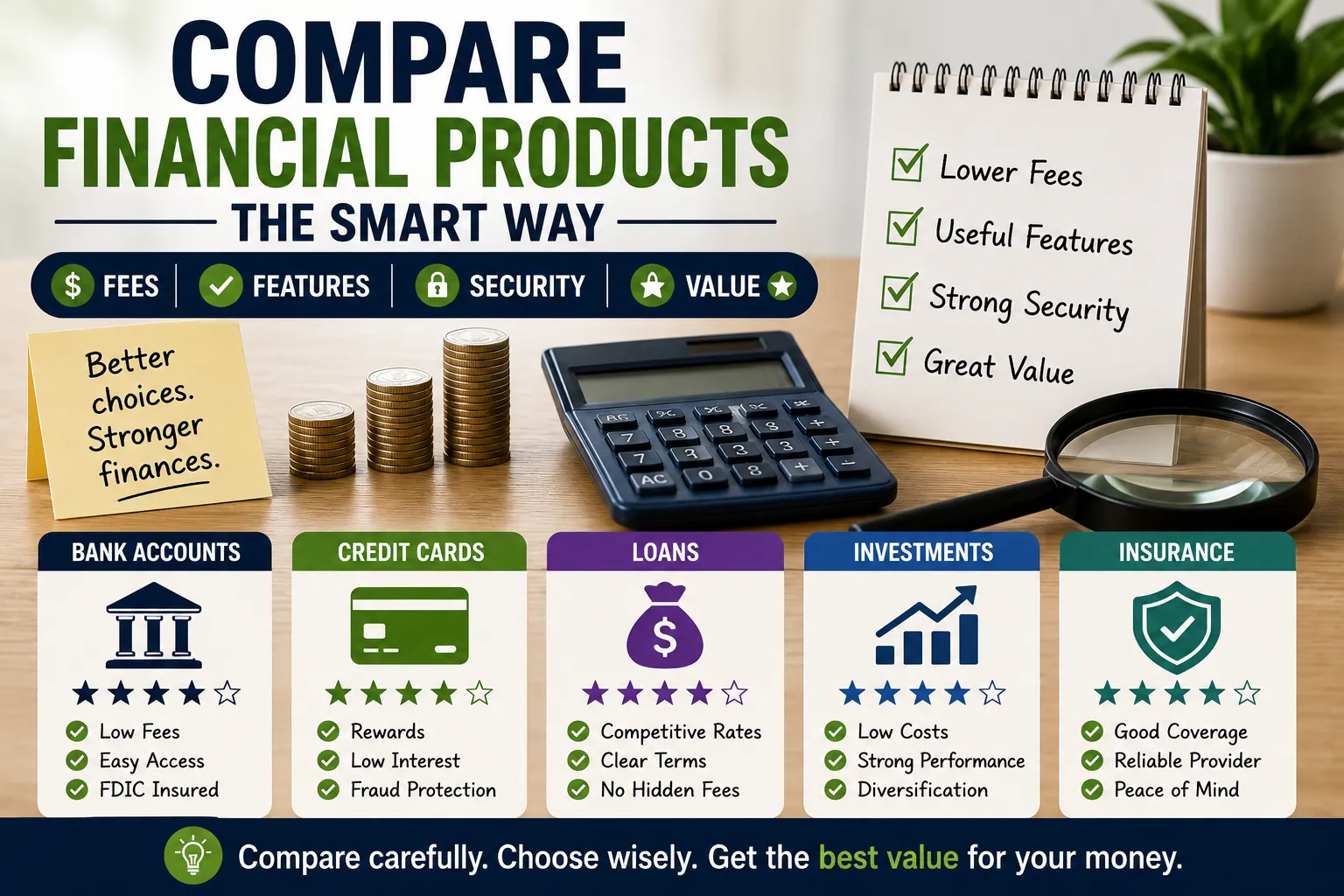
Fees, features, security and overall value provide a useful framework for comparing bank accounts, credit cards, loans, investment platforms, insurance products, payment services and other financial tools.
The goal is not to find the product with the longest list of benefits or the lowest headline price. It is to find the product that delivers the right combination of cost, functionality, protection and usefulness for your particular financial situation.
A broader money management system can also help you understand how each financial product fits into your household’s wider financial plan.
For a broader look at the financial apps that can support budgeting, account management and other everyday financial tasks, see the complete guide to financial apps.
Why Comparing Financial Products Can Be Difficult
Financial products are often designed to make comparison difficult.
One provider may advertise a low interest rate but charge substantial fees elsewhere. Another may offer a higher rate but fewer additional charges.
Terms and conditions can also contain important details that are not obvious from advertisements.
A product may have:
- Introductory pricing
- Promotional rates
- Minimum balance requirements
- Transaction limits
- Withdrawal fees
- Annual fees
- Foreign transaction charges
- Early repayment penalties
- Account closure fees
- Tiered pricing
- Usage requirements
This means the advertised price rarely tells the entire story.
Start With the Product’s Purpose
Before comparing providers, determine what you actually need the product to do.
For example, if you are comparing bank accounts, ask whether your priority is:
- Everyday spending
- Saving
- Earning interest
- International transfers
- Business banking
- Access to ATMs
- Mobile banking
- Managing multiple currencies
If you are comparing credit cards, your priorities might be:
- Low interest
- Rewards
- Cash back
- Travel benefits
- Building credit
- Balance transfers
- No foreign transaction fees
The best product depends heavily on the purpose.
Don’t Compare Products Without Defining Your Priorities
A product can be objectively impressive and still be wrong for you.
Imagine one credit card offers premium airport lounge access, travel insurance and hotel benefits.
If you rarely travel, those features may have little value.
Another card might offer modest cash back on everyday purchases with a much lower annual fee.
For a household that spends primarily on groceries and utilities, the second card could provide substantially better value.
The question is therefore not:
“Which product has more features?”
It is:
“Which features are valuable to me?”
Look at the Total Cost
The first major comparison point is cost.
Do not focus only on the most visible fee.
Calculate the total cost of using the product over a realistic period.
For a financial product, that could include:
- Monthly fees
- Annual fees
- Transaction fees
- Withdrawal fees
- Transfer fees
- Currency conversion costs
- Interest charges
- Penalties
- Service fees
- Maintenance charges
A product with a $5 monthly fee costs:
$5 × 12 = $60 per year
But if another product has no monthly fee and charges $3 for every transaction you make, the second option could eventually become more expensive.
Your actual usage matters.
Distinguish Fixed Fees From Usage-Based Fees
Financial products commonly use two broad types of charges.
Fixed fees
These are charged regardless of how frequently you use the product.
Examples include:
- Monthly account fees
- Annual card fees
- Subscription charges
Usage-based fees
These depend on how you use the product.
Examples include:
- ATM fees
- Transfer charges
- Foreign exchange fees
- Overdraft fees
- Transaction charges
A product with a slightly higher fixed fee could still be cheaper for a heavy user if its usage-based charges are much lower.
Watch Out for Promotional Pricing
Some financial products advertise attractive introductory rates.
These may include:
- Introductory interest rates
- Fee waivers
- Bonus rewards
- Promotional exchange rates
- Free transfers for a limited period
Always determine when the promotion ends.
Then calculate what the product will cost under its standard pricing.
A promotion can be valuable, but it should not be the only reason you choose the product.
Understand Interest Rates
Interest rates are particularly important when comparing borrowing products.
For loans and credit cards, a lower rate can reduce the cost of borrowing.
For savings products, a higher rate can increase the return on your money.
But the advertised rate should be examined alongside the conditions attached to it.
Ask:
- Is the rate fixed or variable?
- How long does it apply?
- Does it require a minimum balance?
- Is it available to all customers?
- Can the rate change?
- Are there fees that reduce the effective benefit?
The headline percentage is only one part of the comparison.
Look at APR When Comparing Borrowing Costs
For many borrowing products, the annual percentage rate, or APR, can provide a more useful comparison than the nominal interest rate alone because it may incorporate certain fees and costs associated with the credit.
However, the exact way APR is calculated and disclosed varies by product and jurisdiction.
When comparing loans or credit cards, look at the standardized cost disclosures provided by the lender rather than relying solely on an advertised interest rate.
Don’t Ignore Compounding
Compounding can significantly affect financial outcomes over time.
For savings and investments, returns can potentially generate additional returns.
For debt, interest can increase the cost of carrying a balance.
This means seemingly small differences in rates can become more significant over long periods.
For example, the difference between earning 3% and 4% on a large savings balance may look modest over one month but becomes much more meaningful when compounded over several years.
Examine the Features
Once you understand the costs, look at what the product actually provides.
Features can include:
- Mobile banking
- Online account management
- Automatic payments
- Budgeting tools
- Alerts
- Rewards
- Cash back
- Investment research
- International transfers
- Multi-currency support
- Customer support
- Fraud monitoring
- Insurance benefits
But features should not automatically be treated as benefits.
A feature only creates value if you use it.
More Features Don’t Always Mean Better Value
A financial product can have dozens of features that you never use.
Suppose Product A costs $150 annually and includes:
- Travel insurance
- Airport lounge access
- Hotel discounts
- Concierge services
- Premium rewards
Product B costs $25 annually and offers:
- Basic rewards
- Fraud protection
- Mobile payments
- Simple account management
If you rarely travel, Product B may be the better financial decision.
Paying for unused features is still paying.
Calculate the Value of Rewards
Rewards programs can make comparisons more complicated.
A credit card might offer:
- 1% cash back on all purchases
- 5% back on selected categories
- Travel points
- Store rewards
- Sign-up bonuses
The advertised reward rate does not tell you how much you will actually receive.
Suppose you spend $20,000 per year on eligible purchases and earn an average of 1.5% back.
Your annual rewards would be:
$20,000 × 1.5% = $300
If the card charges a $95 annual fee, the basic net reward value would be:
$300 − $95 = $205
This simplified calculation ignores taxes, redemption restrictions and other benefits, but it illustrates the principle.
Consider Redemption Rules
Rewards can have conditions.
Check:
- Minimum redemption amounts
- Expiration dates
- Eligible purchases
- Transfer restrictions
- Redemption fees
- Point values
- Travel booking requirements
A rewards program is less valuable if redeeming the rewards is complicated or requires purchases you would not otherwise make.
Examine Account Limits
Some financial products impose limits that can affect their usefulness.
Examples include:
- Maximum transfers
- Monthly withdrawals
- Daily ATM limits
- Maximum balances
- Minimum deposits
- Maximum rewards
- Number of free transactions
A product can appear inexpensive until you exceed its free usage allowance.
Look at ATM and Cash Access
For bank accounts and payment products, access to cash can be an important feature.
Consider:
- ATM availability
- ATM fees
- Reimbursement policies
- Daily withdrawal limits
- International access
- Branch availability
A digital account may be excellent for someone who rarely uses cash but inconvenient for someone who regularly needs physical access to money.
Evaluate International Fees
If you travel or make international purchases, currency-related charges can have a significant effect on value.
Look for:
- Foreign transaction fees
- Currency conversion spreads
- International ATM charges
- Transfer fees
- Cross-border payment fees
A product that is inexpensive for domestic use may become expensive when used internationally.
Security Should Be a Core Comparison Factor
Cost and features are important, but financial security should never be treated as an afterthought.
Your financial accounts contain sensitive information and, in many cases, significant amounts of money.
When comparing products, investigate the provider’s security practices and the protections available to customers.
Look for features such as:
- Multi-factor authentication
- Transaction alerts
- Device controls
- Biometric authentication
- Fraud monitoring
- Card freezing
- Secure notifications
- Encryption
- Account recovery procedures
The exact protections vary by provider and jurisdiction.
Understand Deposit Protection
When comparing bank or savings products, determine whether deposits are covered by the applicable deposit insurance or protection scheme in your country.
The rules, coverage limits and eligible institutions differ by jurisdiction.
This protection can be extremely important because a higher interest rate is not necessarily worth taking on significantly greater risk with money that you cannot afford to lose.
Always verify coverage directly with the relevant financial regulator or deposit-protection authority.
Check Who Regulates the Provider
A financial company’s branding does not necessarily tell you how it is regulated.
Before opening an account or transferring significant funds, verify:
- The legal name of the institution
- Its regulatory status
- Applicable licenses
- Deposit protection
- Consumer protection arrangements
This is especially important when dealing with unfamiliar financial apps, investment platforms or online lenders.
Don’t Assume Every Financial App Is a Bank
Some financial technology companies provide banking-like services without being banks themselves.
The actual institution holding your money may be a separate regulated bank or financial institution.
Read the terms carefully to determine:
- Who holds your funds
- Who regulates the service
- Whether deposits are protected
- What happens if the company fails
- How customer funds are handled
The distinction can matter significantly.
Review the Provider’s Fraud Protections
Ask what happens if your account is compromised.
Find out:
- How quickly suspicious transactions are detected
- How you report fraud
- Whether cards can be frozen instantly
- What liability protections apply
- How unauthorized transactions are investigated
A provider that makes it easy to respond to fraud can offer substantial practical value.
Examine Account Recovery
Security is not just about preventing unauthorized access.
It is also about what happens when legitimate customers lose access.
Consider what the provider offers if:
- Your phone is stolen
- You lose your password
- You change your phone number
- You lose access to your email
- Your authentication device stops working
A highly secure system that makes legitimate account recovery impossible can create serious problems.
Good security balances protection with reliable recovery procedures.
Look at Customer Support
Customer service becomes especially important when something goes wrong.
Consider:
- Phone support
- Email support
- Live chat
- Support hours
- Response times
- Physical branches
- Emergency support
A financial product may work perfectly for months until a payment is blocked or an account is compromised.
At that point, access to competent support can become extremely valuable.
Read the Terms Before Signing Up
Financial products come with legal agreements.
You do not necessarily need to read every document word for word before opening a basic account, but you should understand the important terms.
Pay particular attention to:
- Fees
- Interest rates
- Rate changes
- Penalties
- Minimum balances
- Withdrawal rules
- Account closure
- Dispute procedures
- Data-sharing policies
Never rely entirely on a marketing page.
The legal terms determine the actual agreement.
Check How the Provider Uses Your Data
Security and privacy overlap but are not identical.
A provider may have strong account-security controls while collecting extensive customer data.
Check whether the company:
- Shares information with third parties
- Uses data for advertising
- Tracks transactions for analytics
- Shares information with affiliated companies
- Offers privacy controls
The appropriate balance depends on your preferences and the product.
Consider the Provider’s Reputation
Reputation should not be the only deciding factor, but it can provide useful context.
Look for patterns in:
- Regulatory actions
- Consumer complaints
- Service outages
- Security incidents
- Customer reviews
- Transparency around fees
Do not base your decision on a handful of online reviews.
Instead, look for repeated patterns and corroborate important claims with reliable sources.
Compare Providers on the Same Basis
A common comparison mistake is looking at different numbers for different products.
Create a standardized checklist.
For example:
| Category | Product A | Product B | Product C |
|---|---|---|---|
| Monthly fee | |||
| Annual fee | |||
| Transaction fees | |||
| Interest rate | |||
| Rewards | |||
| Minimum balance | |||
| Security features | |||
| Customer support | |||
| Account limits | |||
| Other charges |
This makes differences much easier to see.
For a broader framework, you can also review how to compare financial products properly and use the principles there alongside this more detailed fees-and-security approach.
Calculate the Annual Cost
Monthly fees can appear insignificant.
Annualizing them makes comparisons clearer.
A $10 monthly fee becomes:
$10 × 12 = $120 per year
A $20 monthly fee becomes:
$20 × 12 = $240 per year
Over five years, assuming the fee remains unchanged:
$240 × 5 = $1,200
Small recurring costs can therefore become substantial over time.
Consider the Cost Over Your Expected Usage Period
Not every product needs to be evaluated over five or ten years.
The appropriate period depends on the product.
For example:
- A short-term loan may be evaluated over months.
- A bank account might be evaluated annually.
- An investment platform could be evaluated over several years.
- A mortgage should be evaluated over the expected holding period and loan term.
Use a timeframe that reflects how you actually expect to use the product.
Calculate Break-Even Points
Break-even analysis can be especially useful for products with annual fees and rewards.
Suppose one card charges $120 annually but provides an additional 2% reward compared with a free card.
Ignoring other benefits, you would need:
$120 ÷ 2% = $6,000
in eligible annual spending for the extra rewards to offset the fee.
If you spend only $2,000 annually, the premium card may not make financial sense based on rewards alone.
Consider Opportunity Cost
Choosing one financial product can mean giving up another opportunity.
Suppose a savings account offers a slightly higher rate but makes your money difficult to access.
The additional interest may not be worth it if you need frequent access to the funds.
Likewise, tying up money in a long-term investment may provide greater potential returns but reduce liquidity.
The value of a product depends partly on what you give up to use it.
Liquidity Is a Feature
Liquidity means how easily you can access your money without significant penalties or losses.
For emergency savings, liquidity can be extremely valuable.
For long-term investments, you may be willing to accept less immediate access.
A financial product should therefore be evaluated according to when you expect to need the money.
Don’t Compare Risky and Safe Products as if They Were Identical
A savings account and a stock investment may both offer potential financial benefits, but they serve very different purposes and carry different risks.
A higher potential return does not automatically represent better value.
The appropriate comparison considers:
- Expected return
- Risk
- Liquidity
- Time horizon
- Fees
- Purpose
A product can be unsuitable even if its potential return looks attractive.
Investment Fees Deserve Special Attention
For investment products, fees can have a significant long-term effect.
Possible charges include:
- Management fees
- Expense ratios
- Trading commissions
- Account fees
- Advisory fees
- Withdrawal fees
- Performance-related fees
Even a seemingly small annual fee can compound over many years by reducing the amount of money that remains invested.
Compare Investment Products by Net Returns
When evaluating investments, do not look only at gross performance.
Consider what remains after:
- Fund expenses
- Platform fees
- Advisory charges
- Trading costs
- Applicable taxes
A product with slightly lower gross returns can potentially deliver better net results if its costs are substantially lower.
Past performance also does not guarantee future results.
Understand Loan Fees Beyond Interest
When comparing loans, look beyond the interest rate.
Depending on the product, charges may include:
- Origination fees
- Application fees
- Documentation fees
- Late fees
- Early repayment charges
- Insurance-related costs
The lowest advertised interest rate may not correspond to the lowest overall borrowing cost.
Check Early Repayment Rules
If you expect to pay off a loan early, determine whether the lender charges a prepayment penalty or other fee.
This can affect the true value of the loan.
A slightly more expensive loan with flexible repayment may be preferable if you expect to repay the balance ahead of schedule.
Consider Financial Product Bundles Carefully
Providers sometimes offer discounts when customers combine products.
For example:
- Banking and investment accounts
- Checking and savings
- Insurance bundles
- Credit cards and deposit accounts
Bundling can be convenient and sometimes cheaper.
But convenience should not prevent you from comparing each product independently.
A discount on one service may not compensate for an inferior product elsewhere.
Convenience Has Financial Value—But a Limit
A financial app that combines payments, budgeting, savings and investing may save you time.
That convenience has value.
But convenience should not justify paying substantially more than necessary for equivalent services.
Think of convenience as one factor in the comparison rather than the entire decision.
Look at the Digital Experience
For many modern financial products, the app or website is effectively the main branch.
Check whether the platform makes it easy to:
- View balances
- Transfer money
- Make payments
- Download statements
- Manage cards
- Set alerts
- Contact support
- Lock accounts
- Update personal information
A well-designed interface can reduce friction and help you manage money more effectively.
But Don’t Let Design Override Economics
A beautiful app does not compensate for excessive fees.
Likewise, an unattractive website does not automatically mean a financial product is poor.
Use digital experience as part of the overall evaluation.
The fundamental questions remain:
What does it cost?
What does it provide?
How secure is it?
How much value does it create for me?
Create a Weighted Scorecard
For important financial decisions, you can assign weights to different categories.
For example:
| Factor | Weight |
|---|---|
| Cost | 30% |
| Security | 25% |
| Features | 15% |
| Customer support | 10% |
| Flexibility | 10% |
| Convenience | 10% |
Then score each product from 1 to 10.
This does not produce a scientifically perfect answer.
But it forces you to make your priorities explicit.
Avoid Choosing Based on One Metric
A product that wins on fees may lose on security.
A product with excellent security may have poor customer support.
A product with outstanding features may be too expensive.
The strongest option is often the one that performs well across multiple categories rather than the one that dominates a single metric.
Watch for Marketing Language
Financial advertising often uses attractive words such as:
- Free
- Premium
- Unlimited
- Guaranteed
- Best
- Exclusive
- Zero fees
- High yield
Read the conditions behind those claims.
“Free” may apply only if you maintain a minimum balance.
“Unlimited” may exclude certain transactions.
“High yield” may apply only to a limited balance.
“Zero fees” may not cover every type of transaction.
Marketing claims should be treated as invitations to investigate rather than conclusions.
Ask What Happens If You Stop Using the Product
Some products become expensive when you become inactive.
Check whether there are:
- Inactivity fees
- Dormancy rules
- Minimum activity requirements
- Account maintenance charges
This matters particularly for products you may use only occasionally.
Consider Switching Costs
Changing financial providers can require time and effort.
You may need to:
- Update direct deposits
- Change automatic payments
- Transfer balances
- Close accounts
- Update merchants
- Rebuild transaction histories
If two products have similar costs and features, the one with easier management may offer better practical value.
But switching costs should not trap you in an expensive product indefinitely.
Review Your Financial Products Regularly
Your needs can change.
A product that was excellent two years ago may no longer be competitive.
Review your major financial products periodically, especially when:
- Fees increase
- Interest rates change
- Your income changes
- You move countries
- You begin traveling more
- You start a family
- Your debt changes
- Your investment goals change
You do not need to switch constantly.
The purpose of reviewing products is to make sure they still fit your needs.
A Simple Four-Step Comparison Framework
When evaluating almost any financial product, start with four questions.
1. What does it cost?
Calculate all relevant fees, interest and charges.
2. What does it provide?
List the features you will actually use.
3. How well does it protect me?
Examine security, regulation, insurance and fraud protections.
4. What value do I receive?
Compare the total benefits with the total cost and risk.
This framework can eliminate much of the noise surrounding financial-product marketing.
Questions to Ask Before Choosing
Before signing up, ask:
- What will I pay in a typical year?
- What additional fees could I encounter?
- Are any rates promotional?
- What happens after the promotion ends?
- What features will I actually use?
- What protections apply to my money?
- Who regulates the provider?
- What happens if fraud occurs?
- How easy is it to access my money?
- How good is customer support?
- Can fees or rates change?
- Are there minimum balances or usage requirements?
- What happens if I close the account?
- Is there a cheaper alternative that meets the same need?
If you cannot answer these questions, you probably have not compared the product thoroughly enough.
The Cheapest Product Isn’t Always the Best
Price matters, but it should not be the only consideration.
Imagine two investment platforms.
Platform A costs slightly more but provides:
- Strong security
- Better customer support
- Reliable service
- Useful tax documents
- Easy account management
Platform B is cheaper but has poor support and limited functionality.
The small fee difference may be worth paying for the additional value.
The same principle applies across banking, borrowing, investing and insurance.
The Most Valuable Product Is the One That Fits
There is rarely one financial product that is best for everyone.
A student may value low fees and simple digital banking.
A frequent traveler may prioritize international transactions and travel benefits.
A growing family may prioritize predictable costs and insurance protection.
A long-term investor may focus heavily on fees and investment choices.
A business owner may care more about transaction limits and cash-management tools.
Your circumstances determine what “best” means.
Make the Comparison About Your Real Behavior
The most reliable comparison is based on how you actually use money.
Look at your past statements and ask:
- How often do I withdraw cash?
- How much do I spend internationally?
- How often do I transfer money?
- What categories do I spend the most on?
- Do I carry credit-card balances?
- How much do I keep in savings?
- How frequently do I trade investments?
- Do I need branch access?
Your actual behavior can reveal which fees and features matter most.
Don’t Let Rewards Encourage Unnecessary Spending
This is particularly important with credit cards.
A 2% reward is not a financial benefit if it encourages you to spend more than you otherwise would.
Spending $100 to receive $2 in rewards is still spending $100.
Rewards should ideally be earned on purchases you already planned to make.
Security and Value Should Work Together
A financial product can be inexpensive and convenient while still being a poor choice if it exposes you to unnecessary risks.
Likewise, extremely strong security does not automatically make a product valuable if the fees are excessive and the product does not meet your needs.
The strongest financial decisions balance:
Cost + Features + Security + Fit
That combination provides a more realistic picture of value.
Keep Your Comparison Simple
You do not need a spreadsheet containing 100 different criteria.
For most products, focus on the factors that could materially affect your financial outcome.
A simple comparison might include:
- Total annual cost
- Interest rate or expected return
- Major features
- Security protections
- Regulation and financial protection
- Customer service
- Flexibility
- Long-term value
This is usually enough to distinguish meaningful differences between competing products.
Use a “Best for” Approach
Instead of trying to declare one product the universal winner, identify which product is best suited to a particular type of customer.
For example:
Best for low fees: Product A
Best for frequent travelers: Product B
Best for high balances: Product C
Best for simplicity: Product D
Best for advanced users: Product E
This approach recognizes that financial needs differ.
Be Careful With Comparison Websites
Comparison websites can save time by collecting information from multiple providers.
However, check:
- How frequently information is updated
- Whether the site receives compensation
- Whether rankings are sponsored
- Whether all providers are included
- Whether fees are presented completely
Use comparison tools as a research starting point, then verify important details directly with the provider and relevant regulator.
Verify Important Details Directly
Before committing to a financial product, confirm key terms using the provider’s official documentation.
This is particularly important for:
- Interest rates
- Fees
- Insurance coverage
- Deposit protection
- Loan terms
- Investment expenses
- Withdrawal rules
- Promotional conditions
Financial terms can change, and third-party summaries can become outdated.
The Four Questions That Reveal True Value
Comparing financial products becomes much easier when you stop asking which product looks best and start asking four practical questions:
What will I pay?
This reveals the true cost.
What will I actually use?
This separates useful features from marketing extras.
How well is my money and information protected?
This reveals the risk side of the decision.
What do I get in return for the cost and risk?
This reveals overall value.
The answers can transform a confusing comparison into a straightforward decision.
Choose Based on the Whole Picture
The right financial product is rarely the one with the flashiest advertising, the longest feature list or the lowest headline fee.
It is the product whose total costs, useful features, security protections and practical benefits align with the way you actually manage your money.
Before choosing, calculate what you are likely to pay over a realistic period. Identify which features genuinely matter. Investigate how your money and personal information are protected. Check regulatory and consumer protections. Then compare the overall value against realistic alternatives.
Most importantly, remember that financial products are tools. A product is valuable because of what it helps you accomplish, not because it appears impressive on an advertisement.
The smartest comparison is therefore not about finding the product that claims to be the best. It is about finding the one that delivers the right combination of affordability, functionality, security and long-term value for your financial life.