How Investing Tools and Platforms Help Investors Research and Manage Investments
Investing has become increasingly accessible as financial technology has developed. Investors can now research companies, compare funds, monitor portfolios, analyze market data and place trades from a computer or mobile device.
But having access to more information does not automatically make investing easier.
The challenge is often knowing which information matters, how to evaluate it and how to use financial tools without allowing constant market updates to influence long-term decisions.
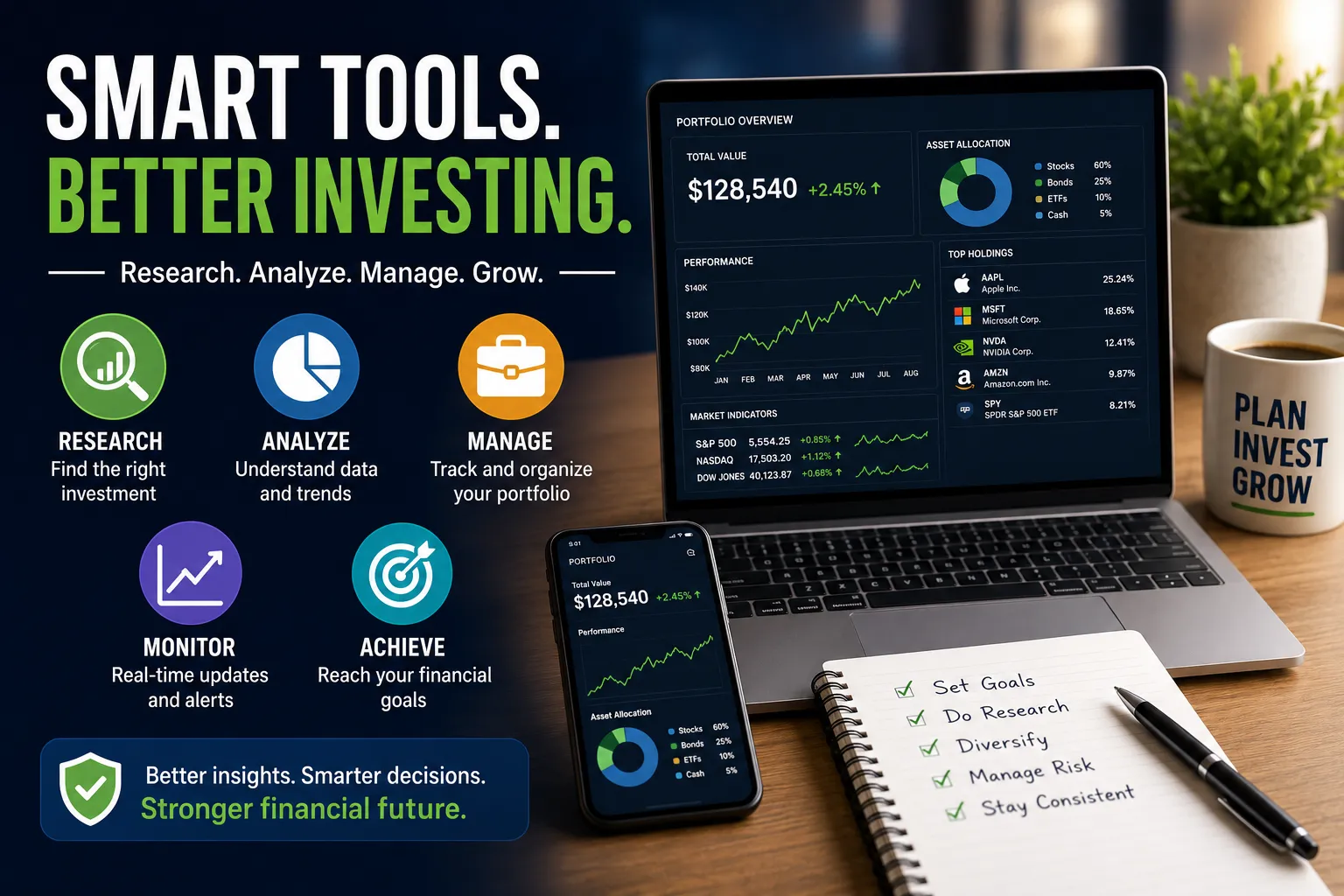
Investing tools and platforms can help organize that process. They can bring research, portfolio management, analysis and record-keeping into one place, giving investors a clearer view of their financial decisions.
Understanding what these tools actually do—and where their limitations lie—can help investors use technology more effectively.
For a broader understanding of how investing tools fit into the wider financial system, see the complete guide to financial markets and how they work.
What Are Investing Tools and Platforms?
Investing tools are software applications, websites or financial services that help people research, evaluate, monitor or manage investments.
They can include:
- Brokerage platforms
- Portfolio trackers
- Stock screeners
- Fund research tools
- Investment calculators
- Financial planning software
- Market-data platforms
- Portfolio analysis tools
- Tax-management tools
- Retirement planning calculators
- Research databases
Some platforms combine several functions, while others specialize in one area.
A brokerage platform, for example, may allow an investor to research securities and place trades. A portfolio tracker may focus primarily on showing how investments are performing across different accounts.
What Can an Investing Platform Do?
The exact features depend on the platform, but many provide some combination of:
- Investment research
- Market information
- Portfolio tracking
- Trading
- Performance analysis
- Financial planning
- Risk analysis
- Alerts and notifications
- Educational resources
- Record-keeping
The most useful platform is not necessarily the one with the largest number of features.
It is the one that provides the information and functionality an investor actually needs.
How Investing Tools Help With Research
Research is one of the most important uses of investment technology.
Instead of searching through multiple sources manually, investors can often find financial information organized within a single platform.
Depending on the investment, research tools may provide information about:
- Revenue
- Earnings
- Profit margins
- Cash flow
- Debt
- Dividends
- Valuation
- Historical prices
- Fund holdings
- Expense ratios
- Economic indicators
This can make it easier to compare potential investments.
However, organized information is not the same as good analysis.
Investors still need to understand what the numbers mean.
Stock Screeners Help Narrow Investment Choices
Thousands of publicly traded companies may be available to investors.
A stock screener can reduce that universe by allowing users to filter companies according to selected characteristics.
Possible filters include:
- Market capitalization
- Price-to-earnings ratio
- Revenue growth
- Dividend yield
- Profit margins
- Debt levels
- Earnings growth
- Return on equity
- Industry
- Geographic exposure
For example, an investor interested in profitable companies with relatively low valuation multiples can create a screening process around those characteristics.
The screener does not decide what to buy.
It simply helps create a more manageable list for further research.
Why Screening Is Useful
Without a screening tool, an investor may spend significant time manually reviewing hundreds of companies.
A screening system can make the initial research process more efficient.
But screening has an important limitation.
A company that meets a particular set of numerical criteria is not automatically a good investment.
Important factors such as management quality, competitive advantages, industry disruption, accounting quality and future growth prospects may require deeper research.
Fundamental Research Tools
Fundamental analysis examines the underlying financial and economic characteristics of an investment.
For companies, investors may examine:
- Revenue growth
- Earnings
- Cash flow
- Debt
- Assets
- Liabilities
- Profitability
- Capital expenditures
- Share dilution
- Competitive position
Investment platforms can make these figures easier to locate and compare.
Charts can also show how financial metrics have changed over several years.
This allows investors to look beyond a stock’s current price.
Valuation Tools Help Investors Compare Prices
A profitable company can still be an unattractive investment if its shares are priced too high.
Valuation tools help investors examine the relationship between a security’s price and underlying financial measures.
Common valuation measures include:
- Price-to-earnings ratio
- Price-to-sales ratio
- Price-to-book ratio
- Enterprise value-to-EBITDA
- Free-cash-flow yield
- Dividend yield
Each metric answers a different question.
For example, a price-to-earnings ratio compares a company’s market price with its earnings.
A single ratio should not normally be treated as a complete valuation assessment.
Comparing Companies Within an Industry
Investment platforms can make peer comparisons much easier.
An investor researching one company might compare it with several competitors based on:
| Metric | Company A | Company B | Company C |
|---|---|---|---|
| Revenue growth | 12% | 8% | 15% |
| Operating margin | 20% | 17% | 22% |
| Debt-to-equity | 0.4 | 0.8 | 0.3 |
| P/E ratio | 24 | 19 | 28 |
The purpose is not to automatically select the company with the highest or lowest number.
Instead, the comparison can reveal questions worth investigating.
Why does one company have higher margins?
Why does another have more debt?
Why does the market assign a higher valuation to one business?
Good investing research begins with questions rather than conclusions.
Fund Research Tools
Investors researching mutual funds and exchange-traded funds can use platforms to compare characteristics such as:
- Expense ratios
- Historical performance
- Fund size
- Holdings
- Asset allocation
- Sector exposure
- Geographic exposure
- Distribution history
- Tracking differences
For ETFs, investors can also examine how closely the fund follows its underlying index or strategy.
These tools can make it easier to determine whether two funds that appear similar actually have meaningful differences.
Expense Ratios Matter
Investment tools often highlight fund expenses.
An expense ratio represents the annual operating expenses charged by a fund, expressed as a percentage of assets.
Even relatively small differences can matter over long periods because investment costs compound over time.
For example, an investor comparing two broadly similar funds may find that one has substantially lower ongoing expenses.
That does not automatically make the cheaper fund superior, but costs are an important part of evaluating long-term investment efficiency.
Portfolio Trackers Bring Investments Together
Many investors have more than one financial account.
They may have:
- A brokerage account
- A retirement account
- A workplace pension
- Mutual funds
- Bank savings
- Other investment accounts
A portfolio tracker can consolidate information into a single view.
This can help investors understand their overall exposure rather than evaluating every account separately.
Why Consolidated Portfolio Views Matter
Imagine an investor owns several different funds.
Individually, each fund might appear diversified.
But when all holdings are combined, the investor might discover that many of the funds own the same large companies.
The overall portfolio could therefore be less diversified than it appears.
A consolidated portfolio view can reveal this type of overlap.
Asset Allocation Tools
Asset allocation describes how an investment portfolio is distributed among different asset classes.
These may include:
- Stocks
- Bonds
- Cash
- Real estate
- Commodities
- Other investments
Different asset allocations can produce different levels of risk and potential return.
Investment platforms can show an investor’s current allocation and compare it with a target allocation.
For example:
| Asset Class | Current | Target |
|---|---|---|
| Stocks | 75% | 70% |
| Bonds | 20% | 25% |
| Cash | 5% | 5% |
The investor can then decide whether rebalancing is appropriate.
Portfolio Risk Tools
Some platforms estimate portfolio risk using historical volatility, asset correlations and other statistical measures.
These tools can show how a portfolio might behave under different market conditions.
However, risk estimates are not guarantees.
Historical volatility does not predict exactly how a portfolio will behave during the next market crisis.
Risk analysis is most useful when treated as a planning aid rather than a prediction machine.
For more context on why investment prices can move sharply, investors can also explore how stock market volatility works and what causes market volatility.
Diversification Analysis
Diversification involves spreading investments across different assets or sources of risk.
Portfolio tools can help identify concentrations in:
- Individual companies
- Industries
- Countries
- Currencies
- Asset classes
- Investment styles
For example, an investor may own ten technology-related investments and assume the portfolio is diversified because there are ten separate holdings.
A portfolio analyzer could reveal that the investments are highly correlated.
Ten holdings are not necessarily ten independent sources of risk.
Correlation Tools Explain How Investments Move Together
Correlation measures the degree to which two investments have historically moved in relation to each other.
If two assets tend to move in the same direction, they may provide less diversification than assets with lower correlation.
Investors can use correlation information when constructing portfolios.
But historical relationships can change.
During periods of severe market stress, investments that normally behave differently can sometimes fall together.
Investment Calculators Support Financial Planning
Calculators are among the simplest investing tools.
They can help estimate:
- Compound growth
- Retirement savings
- Required monthly contributions
- Investment returns
- Loan costs
- Inflation-adjusted values
- Future portfolio values
For example, a compound-growth calculator can demonstrate how regular contributions may accumulate over a long period.
The calculation is useful for illustrating possibilities, but actual investment returns are uncertain.
Compound Growth Tools Make Time Easier to Understand
Compound growth can be difficult to visualize.
A calculator can show how an investment might grow when returns are reinvested.
For example, a hypothetical investment of $10,000 earning an average annual return of 7% would grow to approximately $19,672 after 10 years if returns were compounded annually and no additional contributions were made.
That is a mathematical illustration, not a prediction of future investment performance.
The important lesson is that time can have a significant effect on investment growth.
Retirement Planning Platforms
Retirement calculators can help investors estimate whether current savings and contributions may be sufficient for future needs.
They may consider:
- Current age
- Retirement age
- Existing savings
- Monthly contributions
- Expected investment returns
- Inflation
- Retirement spending
- Life expectancy
The outputs depend heavily on assumptions.
Changing the expected return or retirement age can produce substantially different results.
Therefore, retirement calculators are best used to explore scenarios rather than provide a guaranteed answer.
Rebalancing Tools Help Maintain Portfolio Targets
Investment markets constantly change.
If stocks rise substantially while bonds remain relatively flat, a portfolio that began with a 60/40 allocation could eventually become much more heavily weighted toward stocks.
A rebalancing tool can identify this change.
The investor can then decide whether to restore the original allocation.
Rebalancing is not necessarily about predicting markets.
It is about maintaining a chosen portfolio structure.
Alerts Can Help Investors Monitor Important Events
Many investment platforms allow users to create alerts for:
- Price changes
- Earnings announcements
- Dividend payments
- Economic events
- Portfolio movements
- News
- Analyst changes
Alerts can be useful when they serve a specific purpose.
But too many notifications can encourage short-term reactions.
A long-term investor does not necessarily benefit from knowing every small movement in a stock price.
Automation Can Make Investing More Consistent
Some platforms allow investors to automate recurring actions.
Depending on the account and service, automation may include:
- Regular contributions
- Recurring purchases
- Dividend reinvestment
- Portfolio rebalancing
- Savings transfers
Automation can reduce the need to make the same decision repeatedly.
It may also help investors maintain consistent contributions rather than waiting for the “perfect” market moment.
Robo-Advisors Use Technology to Manage Portfolios
Robo-advisors are digital investment services that use algorithms to help construct and manage portfolios.
A typical process may involve asking users about:
- Investment objectives
- Time horizon
- Risk tolerance
- Financial circumstances
The system may then recommend or manage a diversified portfolio.
Some robo-advisors offer automated rebalancing and other portfolio-management features.
They can be useful for investors who prefer a more automated approach, although fees, investment choices and service limitations vary.
Human Advice and Digital Tools Can Work Together
Using financial technology does not mean investors must manage everything themselves.
A financial professional can provide personalized guidance, while digital tools can help with:
- Tracking accounts
- Organizing information
- Running scenarios
- Monitoring allocations
- Preparing questions
- Reviewing progress
The two approaches can complement one another.
For complex financial decisions, professional advice may be particularly valuable.
Research Platforms Can Reduce Information Overload
One of the biggest problems modern investors face is not lack of information.
It is too much information.
A single company can generate:
- Earnings reports
- News articles
- Analyst opinions
- Social-media discussions
- Price alerts
- Economic commentary
- Investor presentations
Investment platforms can help organize this information.
But organization should lead to better decisions, not constant consumption.
Investors should identify the information they actually need before opening multiple research feeds.
Financial News Is Not the Same as Investment Research
A headline can explain what happened.
It may not explain whether the event changes the long-term value of an investment.
For example, a company’s stock might fall sharply after a disappointing quarterly result.
A research tool can help the investor examine:
- Revenue trends
- Profit margins
- Management guidance
- Cash flow
- Debt
- Competitive conditions
This can provide context that a single headline cannot.
For investors who want to understand how company results can influence share prices and valuations, how corporate earnings affect stock prices and market valuations provides a useful related perspective.
Technical Analysis Tools Serve a Different Purpose
Some investment platforms include charts and technical indicators.
These may include:
- Moving averages
- Relative strength indicators
- Trading volume
- Momentum measures
- Support and resistance levels
Technical analysis focuses primarily on price and trading behavior.
It can be useful to investors and traders who use technical strategies, but it should not be confused with fundamental analysis.
Different approaches answer different questions.
Investment Tools Can Help With Due Diligence
Due diligence means investigating an investment before committing money to it.
A digital research platform can make this process more structured.
For a company, an investor might review:
- Business model
- Revenue sources
- Profitability
- Balance sheet
- Cash flow
- Competitive position
- Management
- Valuation
- Industry conditions
- Key risks
The platform supplies information.
The investor still needs to interpret it.
Don’t Confuse Data With Understanding
A platform can provide thousands of financial metrics.
That does not mean every metric deserves attention.
Investors should focus on information that relates directly to the investment thesis.
If the reason for considering a company is its strong recurring revenue model, then revenue quality, customer retention and cash generation may matter more than dozens of unrelated indicators.
The goal should be better decisions, not more data.
Security Is Essential When Using Investment Platforms
Investment accounts contain highly sensitive financial information.
Security should therefore be a major consideration when choosing and using an investing platform.
Useful protections include:
- Strong unique passwords
- Multi-factor authentication
- Device security
- Software updates
- Secure internet connections
- Account activity monitoring
- Careful handling of verification codes
Never share account passwords or authentication codes with people who claim to need them.
Check How the Platform Protects Your Data
Before using an investing service, understand its privacy and security practices.
Consider whether the platform explains:
- What information it collects
- How information is used
- How accounts are protected
- Whether data is shared
- How long information is retained
Financial data is highly personal, so privacy should be considered alongside features and fees.
Compare Investment Platform Costs
Different platforms charge in different ways.
Possible costs include:
- Trading commissions
- Account fees
- Advisory fees
- Fund expenses
- Data subscriptions
- Currency-conversion costs
- Withdrawal fees
- Inactivity fees
Some services advertise commission-free trading but may generate revenue through other mechanisms.
Investors should examine the complete fee structure rather than focusing on a single advertised feature.
Don’t Choose a Platform Based Only on Features
A platform can have an impressive interface and hundreds of analytical tools while still being unsuitable for a particular investor.
Consider:
- Reliability
- Security
- Costs
- Investment choices
- Ease of use
- Customer support
- Research quality
- Account types
- Tax reporting
- Geographic availability
The best platform is one that matches the investor’s actual requirements.
Keep Investment Records
Digital platforms can simplify record-keeping.
Investors may need information about:
- Purchase dates
- Sale dates
- Transaction prices
- Dividends
- Interest
- Fees
- Tax documents
Maintaining accurate records can make financial planning and tax preparation easier.
It is also wise not to rely entirely on a single platform for historical records.
Keeping important documents and statements securely stored can provide an additional layer of protection.
Use Multiple Tools When Necessary
There is no requirement to use one platform for everything.
An investor might use:
- One brokerage for investing
- Another application for budgeting
- A spreadsheet for detailed analysis
- A retirement calculator for long-term planning
- A separate research service for company analysis
The key is avoiding unnecessary complexity.
If using multiple tools makes it harder to understand the overall portfolio, consolidation may be more useful.
Spreadsheets Remain Powerful Investing Tools
Sophisticated financial platforms are not always necessary.
A spreadsheet can be used to track:
- Investments
- Contributions
- Cost basis
- Dividends
- Asset allocation
- Portfolio performance
- Financial goals
Spreadsheets also provide flexibility because investors can create their own calculations.
However, manually maintained spreadsheets can contain errors.
Important financial information should therefore be checked carefully.
How Investors Can Avoid Overusing Technology
Technology should support an investment process rather than replace one.
Constantly checking portfolio values can create unnecessary anxiety.
Frequent trading based on short-term movements can also increase costs and potentially undermine a long-term strategy.
Investors can establish boundaries such as:
- Reviewing portfolios on a scheduled basis
- Limiting price notifications
- Turning off unnecessary market alerts
- Writing down investment objectives
- Using predetermined allocation targets
- Reviewing investments based on fundamentals rather than headlines
The appropriate frequency depends on the investor’s strategy.
Investing Tools Have Important Limitations
No platform can eliminate investment risk.
A tool cannot guarantee:
- Market returns
- Accurate forecasts
- Successful stock selection
- Protection from losses
- Future economic conditions
Historical data can describe what happened in the past.
It cannot guarantee what happens next.
Similarly, algorithmic recommendations are based on models and assumptions that may not work perfectly under unusual conditions.
AI Is Changing Investment Research
Artificial intelligence is increasingly being incorporated into financial software.
AI-powered tools can potentially help users:
- Summarize financial documents
- Search large amounts of information
- Identify patterns
- Compare companies
- Organize research
- Generate financial questions
- Explain financial concepts
But AI-generated analysis should be treated carefully.
A system can produce a convincing explanation while making an incorrect assumption or overlooking an important fact.
Investors should verify important information against reliable primary sources and financial documents.
Use Primary Sources for Important Decisions
Investment platforms are useful aggregators, but important decisions should sometimes lead investors back to original documents.
For companies, these may include:
- Annual reports
- Quarterly reports
- Regulatory filings
- Investor presentations
- Earnings transcripts
- Official financial statements
For funds, relevant sources can include:
- Fund prospectuses
- Annual reports
- Holdings disclosures
- Official fund documentation
Primary sources can provide context that summaries may leave out.
A Practical Investing Research Workflow
A simple workflow can make investment tools more useful.
Step 1: Define the Objective
Determine what you are trying to accomplish.
Step 2: Establish Criteria
Decide what characteristics an investment should have.
Step 3: Screen Potential Investments
Use a screener to create a manageable list.
Step 4: Research the Shortlist
Examine financial statements, valuations and business characteristics.
Step 5: Assess Risk
Consider debt, concentration, volatility and other relevant risks.
Step 6: Compare Alternatives
Look at similar investments rather than evaluating an opportunity in isolation.
Step 7: Decide on Portfolio Fit
Consider how the investment affects the overall portfolio.
Step 8: Monitor the Original Thesis
Review whether the reasons for owning the investment remain valid.
This approach keeps technology in a supporting role.
The Most Useful Tool Is Often a Clear Investment Plan
A sophisticated platform cannot compensate for an unclear strategy.
Before using advanced tools, investors should understand:
- Their goals
- Their time horizon
- Their risk tolerance
- Their desired asset allocation
- Their savings rate
- Their investment constraints
Once those foundations are clear, technology becomes much more useful.
For investors developing those foundations, how to build an investment plan for long-term goals offers a related framework for connecting investment decisions with longer-term objectives.
How Investing Platforms Support Better Decisions
The strongest value of investing technology is not that it predicts markets.
It is that it can make financial information more accessible and investment processes more organized.
A good platform can help investors:
- Find relevant information
- Compare alternatives
- Monitor portfolios
- Identify concentration
- Calculate scenarios
- Track progress
- Maintain records
- Automate routine tasks
These functions can reduce friction and improve consistency.
But the investor remains responsible for deciding what information matters and how much risk to accept.
Choosing Technology That Supports Your Strategy
Investing tools work best when they simplify rather than complicate the process.
A long-term investor may need little more than a reliable brokerage account, a portfolio tracker, basic research tools and a retirement calculator.
A professional investor or active trader may require more sophisticated market data, screening systems and analytical software.
The appropriate technology depends on the strategy.
The goal is not to collect the most investing tools. It is to build a simple system that helps you research carefully, understand your portfolio and make decisions consistent with your financial objectives.
When used thoughtfully, investing platforms can turn scattered financial information into something much more manageable. They can help investors see the bigger picture, automate routine tasks and evaluate opportunities more systematically—while leaving the most important part of investing where it belongs: with informed human judgment.