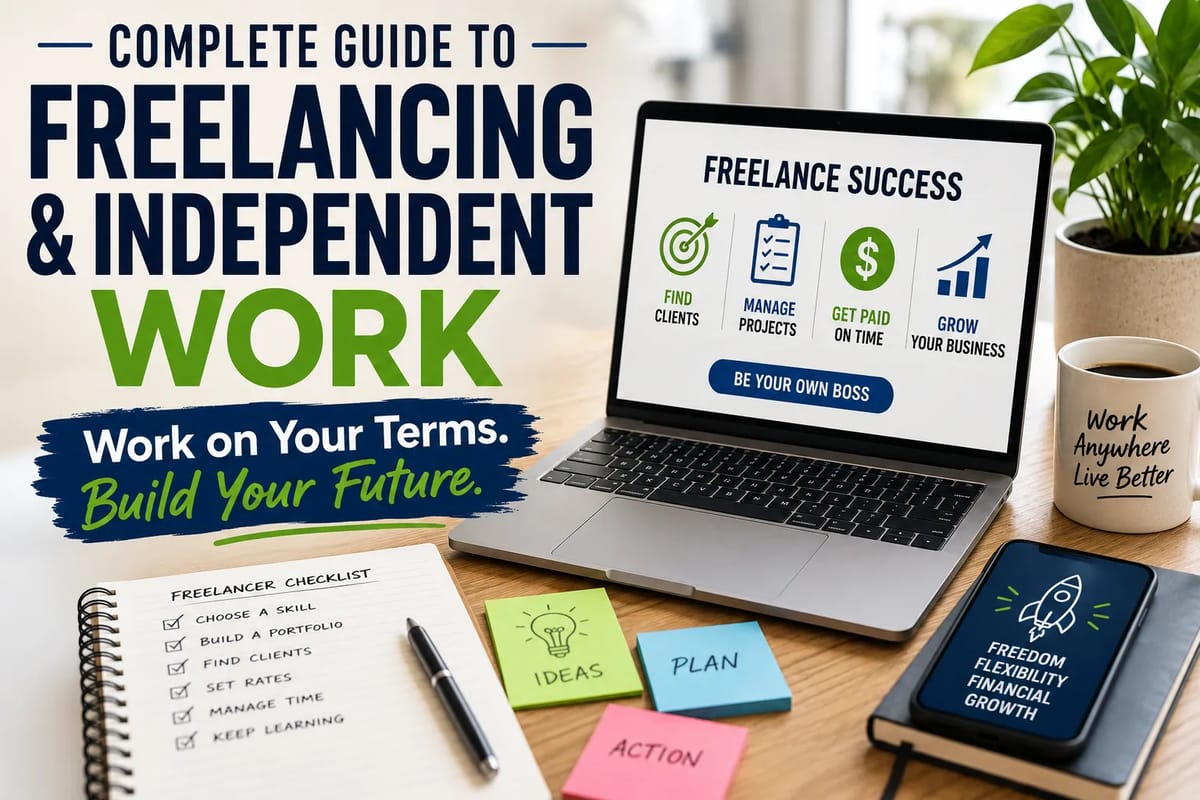
Complete Guide to Freelancing and Independent Work
Freelancing has changed the way millions of people think about work.
Instead of relying on a single employer for income, freelancers can sell their skills directly to clients, choose which projects to accept and, in many cases, work from almost anywhere.
That flexibility is one of freelancing’s biggest attractions.
But independence also comes with responsibilities that traditional employees may not have to manage themselves. Freelancers must find clients, negotiate rates, manage contracts, track income, handle taxes where applicable, market their services and plan for periods when work is slower.
For people who approach it strategically, freelancing can become a meaningful source of income and, eventually, a full-time career.
What Is Freelancing?
Freelancing is a form of independent work in which an individual provides services to clients without necessarily becoming a permanent employee of those clients.
A freelancer may work with:
- One client at a time
- Several clients simultaneously
- Short-term projects
- Long-term contracts
- Recurring clients
- Agencies
- Businesses
- Individuals
- Nonprofit organizations
- International companies
The arrangement can vary significantly.
Some freelancers work completely independently, while others operate through agencies or platforms that connect professionals with clients.
Common Freelancing Careers
Almost any skill that can be delivered as a service can potentially become a freelance business.
Popular areas include:
- Writing
- Editing
- Graphic design
- Web development
- Software development
- Digital marketing
- Search engine optimization
- Video editing
- Photography
- Translation
- Virtual assistance
- Bookkeeping
- Consulting
- Social media management
- Data analysis
- Illustration
- Customer support
- Online tutoring
The most important factor is not whether a particular field is labeled “freelance.”
It is whether clients are willing to pay for the problem you can solve.
If your expertise is especially specialized, developing high-income skills to learn and monetize can help you build a stronger foundation for independent work.
Freelancing vs. Traditional Employment
The biggest difference is the relationship between the worker and the organization paying them.
An employee generally works within an employer’s established structure.
A freelancer operates as an independent service provider.
This can create greater flexibility but also greater responsibility.
| Traditional Employment | Freelancing |
|---|---|
| Usually one primary employer | Often multiple clients |
| Regular salary or wages | Project, hourly or retainer income |
| Employer-defined role | Freelancer defines services |
| Employer often handles payroll processes | Freelancer handles business administration |
| Less responsibility for finding work | Freelancer must attract clients |
| More predictable income | Income can fluctuate |
| Less control over schedule | Potentially greater schedule flexibility |
Neither model is automatically better.
Freelancing works particularly well for people who value autonomy and are comfortable managing uncertainty.
The Biggest Advantage: Control
One of the strongest reasons people choose freelancing is control.
You can potentially control:
- Which clients you work with
- Which projects you accept
- Your rates
- Your working hours
- Your location
- Your services
- Your business direction
That control is not absolute.
Clients still have deadlines, requirements and expectations.
But compared with many traditional jobs, independent work can provide greater influence over how professional life is structured.
The Biggest Challenge: Unpredictable Income
Freedom comes with uncertainty.
A freelancer may earn a substantial amount one month and considerably less the next.
Income can fluctuate because of:
- Client budgets
- Seasonal demand
- Project completion
- Economic conditions
- Competition
- Personal availability
- Changes in a client’s business
This makes financial planning especially important.
Instead of treating every payment as disposable income, freelancers should think about income across longer periods.
A strong month can help create a buffer for a slower one.
Developing multiple income streams can also be one way independent workers diversify their sources of revenue, although diversification should be approached carefully rather than simply adding more work.
Choose a Skill People Will Pay For
A common mistake among new freelancers is starting with a broad statement such as:
“I can do many things.”
Clients usually respond better to a clear solution.
Compare:
“I do digital marketing.”
with:
“I help small businesses improve their search visibility through SEO content and website optimization.”
The second description communicates a clearer service and target customer.
Your skill matters, but your ability to explain its business value matters just as much.
Turn Your Skill Into a Service
A skill is not automatically a freelance offer.
You need to package it into something a client can understand.
For example:
Skill: Graphic design
Service: Social media graphics for small businesses
Skill: Writing
Service: SEO blog articles for technology companies
Skill: Programming
Service: Business websites for local service providers
Skill: Video editing
Service: Short-form promotional videos for brands
A defined service makes marketing, pricing and client conversations much easier.
Choose a Target Client
Trying to sell to everyone can make it difficult to stand out.
Instead, consider choosing a specific audience.
You could specialize in serving:
- Startups
- E-commerce businesses
- Restaurants
- Real-estate companies
- Technology firms
- Healthcare organizations
- Local businesses
- Coaches
- Creators
- Nonprofits
You can broaden your market later.
Specialization initially helps you develop relevant experience and communicate your value more clearly.
Build a Portfolio Before You Have Clients
A new freelancer faces an obvious problem:
Clients want experience, but you need clients to gain experience.
A portfolio helps solve part of that problem.
If you have not worked with paying clients yet, create sample projects.
For example, a new writer could produce:
- A sample blog article
- A product description
- A newsletter
- A social-media campaign
A designer could create:
- Brand concepts
- Website mockups
- Social-media graphics
- Packaging concepts
A developer could build:
- A demonstration website
- A small application
- A portfolio project
- An open-source contribution
The work should demonstrate what you can actually deliver.
Quality Matters More Than Quantity
A portfolio does not need dozens of examples.
A few strong, relevant projects can be more persuasive than a large collection of unrelated work.
For each portfolio piece, explain:
- The problem
- Your role
- Your approach
- The result, where measurable
- The skills involved
This turns a portfolio from a gallery into evidence of your ability to solve problems.
Create a Professional Online Presence
Potential clients often research freelancers before hiring them.
Your online presence does not need to be elaborate.
At minimum, consider having:
- A professional profile
- A portfolio
- A clear description of your services
- Contact information
- Relevant work samples
- Testimonials when available
A simple website can eventually become the central home for your freelance business.
Social platforms can then be used to distribute your work and connect with potential clients.
Building a recognizable professional identity can also support a broader personal branding strategy for income.
Where Freelancers Find Clients
There is no single source of freelance work.
Potential channels include:
- Freelance marketplaces
- Professional communities
- Industry events
- Referrals
- Personal networks
- Cold outreach
- Social media
- Agency partnerships
- Your own website
- Existing clients
Different channels work better for different professions.
A designer may find clients through visual portfolios.
A consultant may rely heavily on referrals.
A writer may combine direct outreach, professional networking and content marketing.
Freelance Platforms
Freelance marketplaces can help beginners find potential clients without building an audience from scratch.
They can provide:
- Job listings
- Client profiles
- Payment systems
- Reviews
- Project management tools
However, competition can be intense.
Some platforms also charge fees or create pricing pressure.
Use marketplaces as one client-acquisition channel rather than assuming they must become your entire business.
Networking Still Works
Networking does not necessarily mean attending formal business events.
It can involve:
- Talking to professionals in your industry
- Participating in online communities
- Sharing useful information
- Attending conferences
- Joining professional groups
- Reconnecting with former colleagues
- Asking existing contacts for introductions
The strongest networking often happens naturally when people know what you do and understand the kind of problems you solve.
Referrals Can Become a Major Source of Work
A satisfied client can potentially introduce you to other clients.
That makes client experience part of your marketing strategy.
Delivering reliable work, communicating clearly and meeting agreed deadlines can increase the likelihood of repeat business and referrals.
You do not need to aggressively ask every client for referrals.
A simple request after successfully completing a project can be enough.
How to Approach Potential Clients
Cold outreach can feel uncomfortable, particularly at the beginning.
The mistake is making the message entirely about yourself.
Instead of:
“I am a freelance writer looking for work.”
Try communicating a relevant problem you noticed and how you can help solve it.
A good outreach message should generally be:
- Short
- Personalized
- Relevant
- Specific
- Professional
- Easy to respond to
Avoid sending the same generic pitch to hundreds of businesses.
How to Set Freelance Rates
Pricing is one of the most difficult decisions for new freelancers.
There are several common models.
Hourly Rates
You charge for time worked.
This can be straightforward but may create a ceiling because your income becomes tied directly to hours.
Project-Based Pricing
You charge a fixed amount for completing a defined project.
This can work well when the scope is clear.
Retainer Pricing
A client pays a recurring amount for an agreed set of services.
Retainers can create greater income predictability.
Value-Based Pricing
Pricing is based partly on the value or business impact of the work rather than simply the time required.
This can become more appropriate as your expertise and understanding of client outcomes increase.
Don’t Price Only by Looking at Your Salary
Freelancers have business expenses that employees may not directly pay themselves.
Depending on the situation, these can include:
- Software
- Equipment
- Internet
- Marketing
- Professional services
- Insurance
- Workspace
- Taxes
- Payment-processing costs
- Training
- Unpaid administrative time
You also have time that cannot be billed.
This includes:
- Finding clients
- Writing proposals
- Meetings
- Invoicing
- Marketing
- Administration
- Learning
Your freelance rate therefore needs to account for more than the hours spent producing client work.
Calculate Your Minimum Sustainable Rate
Start with your desired annual income.
Then add estimated business expenses and other costs.
Finally, consider how many hours you realistically expect to bill.
For example, if you want $60,000 in annual personal income and expect another $15,000 in business costs, you need to generate at least $75,000 before considering applicable taxes and other obligations.
If you can realistically bill 1,250 hours in a year, your average required revenue would be:
$75,000 ÷ 1,250 = $60 per billable hour
This is only an illustration.
Your actual calculation should account for your local tax rules, expenses, desired income and realistic billable hours.
For freelancers whose work evolves into broader business activity, understanding how to calculate business profit margins can provide another useful perspective on sustainability and profitability.
Don’t Underprice Yourself Forever
Lower introductory rates can sometimes help a new freelancer build a portfolio.
But remaining significantly underpriced can create problems.
Low prices may:
- Attract difficult clients
- Make it harder to increase rates
- Encourage excessive workloads
- Reduce profitability
- Communicate lower perceived value
As your experience and demand increase, review your pricing.
Learn to Scope Projects
Many freelance problems begin before work starts.
A client asks for “a website,” “a logo” or “a few articles,” but neither side defines what that means.
A clear project scope should establish:
- Deliverables
- Number of revisions
- Deadline
- Responsibilities
- Required materials
- Payment schedule
- Communication process
- What is not included
The clearer the scope, the easier it becomes to prevent misunderstandings.
Use Written Agreements
A written contract can protect both sides by establishing expectations before work begins.
Depending on the project and jurisdiction, an agreement may address:
- Scope of work
- Fees
- Payment schedule
- Deadlines
- Revisions
- Ownership of work
- Confidentiality
- Cancellation
- Late payments
- Dispute procedures
For complex or high-value engagements, consider obtaining advice from a qualified legal professional familiar with your jurisdiction.
Ask for Deposits When Appropriate
For larger projects, requesting an upfront deposit can reduce financial risk.
A deposit demonstrates that the client has committed financially before you dedicate substantial time to the project.
The appropriate percentage depends on the type of work, client relationship and local business practices.
Do not assume that every client or project requires the same payment structure.
Create Clear Payment Milestones
Instead of waiting until a large project is completely finished, consider dividing payment into stages.
For example:
Stage 1: Deposit
Stage 2: Initial deliverable
Stage 3: Final delivery
This can improve cash flow and reduce the risk of completing a substantial amount of unpaid work.
Protect Yourself From Scope Creep
Scope creep occurs when a project gradually expands beyond what was originally agreed.
It can start with seemingly small requests:
- “Can you add one more page?”
- “Could you make another version?”
- “Can you also handle our social media?”
- “Can you make a few additional changes?”
Individually, these requests may seem minor.
Collectively, they can significantly increase the workload.
When additional work falls outside the original scope, explain the change clearly and provide an updated cost or timeline where appropriate.
Learn How to Say No
Freelancers do not have to accept every project.
You may decline work because:
- The budget is too low
- The deadline is unrealistic
- The client is difficult
- The subject is outside your expertise
- The project conflicts with your values
- Your schedule is already full
- The scope is unclear
Saying no to a bad project can create space for a better one.
Client Communication Is a Core Skill
Technical ability alone does not guarantee freelance success.
Clients also value:
- Responsiveness
- Reliability
- Clarity
- Professionalism
- Organization
- Honesty
You do not have to respond instantly to every message.
Instead, establish reasonable communication expectations.
If you will be unavailable, communicate that in advance.
If a deadline is at risk, tell the client early rather than disappearing.
Manage Expectations From the Beginning
Many client conflicts are actually expectation conflicts.
A client may assume that:
- Unlimited revisions are included
- Weekend support is available
- A project can be completed immediately
- Additional work is free
- You will handle tasks that were never discussed
Clear communication at the beginning prevents many of these problems.
Build Repeat Business
Finding a new client can require significant time and effort.
Repeat clients can therefore be extremely valuable.
After completing a successful project, look for legitimate opportunities to continue helping.
For example:
A website developer might provide maintenance.
A writer might provide monthly articles.
A designer might provide ongoing creative support.
A marketing specialist might manage recurring campaigns.
Recurring work can make income more predictable.
Retainers Can Create Stability
A retainer arrangement involves an ongoing agreement where a client pays for recurring services.
A retainer might cover:
- A specific number of articles
- Monthly design work
- Website maintenance
- Consulting hours
- Social media management
- Ongoing marketing
Retainers can reduce the pressure of constantly searching for new projects.
However, the agreement should clearly define what the client receives.
Manage Multiple Clients Carefully
Having several clients can reduce dependence on one source of income.
But too many simultaneous projects can create chaos.
Use a system to track:
- Client
- Project
- Deadline
- Deliverables
- Payment status
- Next action
- Communication
A calendar, spreadsheet or project-management tool can be enough.
The tool matters less than consistently using it.
Create a Freelance Work Schedule
One advantage of independent work is flexibility.
But too much flexibility can become disorganization.
Set working hours that fit your circumstances.
You might designate:
- Morning for focused work
- Afternoon for meetings
- Late afternoon for administration
- Specific days for marketing
The schedule can change.
The important thing is having enough structure to make consistent progress.
Separate Work and Personal Life
Working from home can blur boundaries.
Without clear separation, freelancers may find themselves answering client messages late at night or working every weekend.
Consider creating:
- A dedicated workspace
- Defined working hours
- A daily shutdown routine
- Separate business and personal accounts
- Notification limits
The ability to work anytime should not become an expectation to work all the time.
Build a Financial Buffer
Freelance income can fluctuate.
An emergency fund can provide breathing room during:
- Slow periods
- Client losses
- Illness
- Equipment failures
- Unexpected expenses
The appropriate amount depends on your personal situation.
The general principle is straightforward:
Do not build a freelance business that requires every month’s income to arrive perfectly on schedule.
Separate Business Money From Personal Money
Once freelancing becomes a meaningful source of income, separate financial records can make management easier.
Depending on your circumstances, this may involve:
- A separate bank account
- Dedicated bookkeeping
- Business expense tracking
- Separate invoices
- Organized receipts
The exact legal and tax structure depends on your location and business type.
Understand Taxes
Freelancers are often responsible for handling tax obligations that an employer might otherwise manage through payroll.
The details vary substantially by country and sometimes by region.
You may need to account for:
- Income tax
- Self-employment taxes or equivalent contributions
- Sales or value-added taxes where applicable
- Business deductions
- Estimated or advance payments
Do not rely on generic internet advice for complex tax questions.
A qualified tax professional can help you understand the rules applicable to your situation.
Keep Accurate Records
Maintain records of:
- Income
- Expenses
- Invoices
- Receipts
- Contracts
- Client payments
- Business purchases
- Tax documents
Good records make it easier to understand whether your freelance business is actually profitable.
They also make tax preparation and financial planning easier.
Use Invoices Professionally
A professional invoice should clearly identify:
- Your business or name
- Client
- Invoice number
- Date
- Services provided
- Amount due
- Payment terms
- Payment instructions
- Applicable taxes or fees
Consistency makes your business look more professional and makes payments easier to track.
What to Do About Late Payments
Late payments can create serious cash-flow problems.
Your contract should establish when payment is due.
If a payment becomes overdue:
- Send a polite reminder.
- Confirm that the invoice was received.
- Follow up according to the agreed payment terms.
- Keep written records.
- Escalate appropriately if necessary.
Do not continue providing substantial unpaid work indefinitely.
Protect Your Reputation
Freelancing is heavily influenced by reputation.
A strong reputation can lead to:
- Referrals
- Repeat clients
- Better projects
- Higher rates
- Stronger professional relationships
Protect it by delivering what you promise and communicating honestly when something goes wrong.
Mistakes happen.
Professional freelancers take responsibility and focus on solutions.
Avoid Fake Freelance Opportunities
The growth of remote and independent work has also created opportunities for scammers.
Warning signs can include:
- Requests for upfront payments to obtain a job
- Unrealistically high pay for simple tasks
- Pressure to move money through your account
- Requests for sensitive personal information
- Unclear job descriptions
- Fake checks or overpayment schemes
- Pressure to purchase equipment from a particular seller
If an opportunity seems unusually generous and requires you to send money first, stop and investigate.
Be Careful With Free Work
Some clients ask new freelancers to complete unpaid tests.
A short, reasonable assessment can sometimes be legitimate.
But be cautious when a company asks for substantial unpaid work that looks like something it could actually use commercially.
Your time has value.
If a test requires several hours or a full project, ask why the work is necessary and whether the expectations are reasonable.
Keep Learning
Freelance markets change.
Software evolves.
Client expectations change.
New competitors enter the market.
The most valuable skill today may become less differentiated tomorrow.
Continued learning can involve:
- Online courses
- Books
- Industry publications
- Professional communities
- Conferences
- Practice projects
- Certifications where useful
The goal is not to collect certificates.
It is to remain capable of solving valuable problems.
Develop Business Skills Alongside Your Technical Skill
A freelancer is not only a service provider.
You are also operating a small business.
That means developing skills in:
- Sales
- Negotiation
- Marketing
- Communication
- Financial management
- Project management
- Customer service
Someone with excellent technical skills but poor business habits can struggle.
Someone with solid skills and strong business systems can build a much more sustainable career.
For freelancers who want to move beyond individual projects and develop broader expertise, consulting and advisory work can represent a potential next stage.
Create a Personal Brand Carefully
A personal brand is essentially the reputation and professional identity associated with your name.
You can build it through:
- Publishing useful content
- Sharing project insights
- Participating in professional discussions
- Speaking at events
- Contributing to industry publications
- Maintaining a strong portfolio
You do not need to become an online celebrity.
The goal is to make it easier for the right clients to understand what you know and what you can do.
Specialization Can Increase Your Value
Generalists can serve a wide market.
Specialists can sometimes command higher rates because they offer deeper expertise in a specific problem.
For example:
Instead of being a general writer, you might specialize in technology content.
Instead of being a general developer, you might specialize in e-commerce systems.
Instead of being a general marketer, you might specialize in SEO for local businesses.
Specialization is not permanent.
You can evolve as your experience develops.
Use Testimonials Strategically
A satisfied client can provide valuable social proof.
When appropriate, ask clients for a brief testimonial describing:
- The problem they had
- What you did
- How the experience was
- The result
Specific testimonials are generally more useful than vague statements such as “Great work!”
Where permitted, include relevant testimonials alongside portfolio examples.
Track Your Freelance Numbers
You cannot improve what you do not measure.
Useful metrics include:
- Monthly revenue
- Average project value
- Number of active clients
- Repeat-client percentage
- Lead-to-client conversion rate
- Billable hours
- Effective hourly rate
- Outstanding invoices
- Monthly business expenses
These numbers can reveal where the business needs attention.
For example, strong revenue combined with extremely long working hours may indicate a pricing or efficiency problem.
Understand Your Effective Hourly Rate
Suppose you charge $1,000 for a project.
If the project takes 20 hours, your gross project rate is equivalent to $50 per working hour.
But if you also spend:
- 3 hours on meetings
- 2 hours on revisions
- 2 hours on administration
- 3 hours finding and pitching for the client
you have spent 30 hours on the engagement and your effective rate is closer to $33.33 per hour before expenses and taxes.
This calculation can help freelancers identify which projects are actually profitable.
Raise Rates Strategically
Raising rates can feel uncomfortable.
But if demand consistently exceeds your available capacity, pricing may need to change.
You can consider raising rates when:
- Your portfolio has improved
- You have stronger results
- Demand has increased
- Your expertise has grown
- Your current rates no longer support your business
- You are consistently booked
You do not need to double your rates overnight.
Gradual increases can be easier to communicate and manage.
Don’t Let Every Client Set Your Price
Different clients have different budgets.
A large company may have a substantially different budget from a small business or individual.
That does not mean you should charge arbitrary amounts.
It means pricing should reflect:
- Scope
- Expertise
- Complexity
- Timeline
- Client requirements
- Expected value
- Business costs
A freelancer should know their minimum sustainable rate before entering negotiations.
Create a Strong Proposal
A proposal should make it easy for a client to understand what they are buying.
A useful structure can include:
The Problem
Demonstrate that you understand what the client needs.
The Solution
Explain what you will do.
Deliverables
Specify what the client will receive.
Timeline
Provide realistic milestones.
Investment
State the price clearly.
Terms
Explain payment and other important conditions.
Keep proposals focused.
Clients generally want clarity rather than pages of unnecessary information.
Make Your Freelance Business Easier to Run
As your workload grows, look for repetitive tasks that can be simplified.
You might create templates for:
- Proposals
- Contracts
- Invoices
- Client onboarding
- Project briefs
- Follow-up emails
- Reporting
Automation can save time, but it should not make client communication feel impersonal.
Use systems to reduce repetitive administration, not to eliminate thoughtful communication.
When to Outsource
Eventually, you may reach a point where administrative tasks consume valuable working time.
Depending on your business, you might outsource:
- Bookkeeping
- Administrative work
- Design
- Editing
- Customer support
- Technical maintenance
Outsourcing only makes financial sense when the cost is justified by the time or capacity it creates.
Freelancing Can Become a Small Business
There is a natural progression for some independent workers:
Freelancer → Specialist → Consultant → Small agency or studio
Not everyone needs to follow this path.
Some people prefer remaining solo because they value simplicity and independence.
Others want to build a team.
The important thing is to choose the structure that fits your goals rather than assuming growth always means hiring employees.
Common Freelancing Mistakes
Taking Every Client
Desperation can lead to bad working relationships.
Working Without a Clear Scope
Unclear projects create scope creep.
Charging Too Little
Low rates can make sustainable work impossible.
Ignoring Contracts
Verbal agreements can leave important details unclear.
Failing to Track Expenses
Revenue is not the same as profit.
Depending on One Client
Losing your biggest client can create a serious income shock.
Neglecting Marketing
Waiting until you have no work to start looking for clients creates unnecessary pressure.
Working Without Boundaries
Unlimited availability can quickly become burnout.
Ignoring Taxes
Unexpected tax obligations can create major financial problems.
Build a Client Pipeline Before You Need It
One of the most valuable habits for freelancers is continuing to market even when business is strong.
When your calendar is full, continue:
- Networking
- Updating your portfolio
- Maintaining professional relationships
- Publishing useful content
- Following up with past clients
This creates a pipeline of potential future work.
You do not want to begin searching for clients only after your current projects have ended.
Build Multiple Sources of Income
Independent workers can sometimes reduce risk by developing complementary income streams.
Depending on the profession, these might include:
- Freelance services
- Consulting
- Courses
- Digital products
- Templates
- Affiliate income
- Licensing
- Paid newsletters
- Workshops
- Coaching
Not every freelancer needs multiple income streams.
But diversification can create additional resilience when client work slows.
For freelancers interested in developing income that is less directly tied to hours worked, how to build scalable income over time explores the broader idea of creating income models that can grow beyond one-to-one service delivery.
Likewise, how to create and sell digital products for sustainable income covers one potential way to turn knowledge or creative work into a more scalable offer.
Protect Your Health and Time
Financial independence is not useful if it requires constant overwork.
Freelancers should pay attention to:
- Sleep
- Breaks
- Exercise
- Social relationships
- Time away from screens
- Vacations
- Mental recovery
There is a difference between building a business and making yourself permanently available to clients.
A sustainable freelance career needs both income and personal capacity.
Know When Freelancing Is Working
Freelancing is working when the business provides a reasonable combination of:
- Income
- Flexibility
- Professional satisfaction
- Growth
- Stability
- Personal freedom
Those priorities differ from person to person.
Someone may accept lower income in exchange for greater flexibility.
Another person may prioritize maximizing earnings.
Neither approach is inherently wrong.
A Practical Freelancing Roadmap for Beginners
If you are starting from scratch, avoid trying to build everything at once.
Step 1: Choose a Marketable Skill
Identify something you can deliver to a client.
Step 2: Define a Service
Turn the skill into a specific offer.
Step 3: Choose a Target Client
Decide who is most likely to need it.
Step 4: Create Sample Work
Build a portfolio that demonstrates your ability.
Step 5: Establish Your Online Presence
Create a professional profile and portfolio.
Step 6: Start Finding Clients
Use networking, referrals, marketplaces, outreach and other appropriate channels.
Step 7: Establish Your Pricing
Calculate a sustainable rate based on income goals and business costs.
Step 8: Use Contracts
Define expectations before beginning significant work.
Step 9: Deliver Reliably
Meet deadlines and communicate clearly.
Step 10: Ask for Repeat Work
Build long-term client relationships where appropriate.
Step 11: Track Your Finances
Monitor revenue, expenses and profitability.
Step 12: Improve Your Business
Raise rates, specialize, improve systems and strengthen your client pipeline as your experience grows.
The Long-Term Opportunity in Independent Work
Freelancing is often presented as a way to make quick money online.
That can create unrealistic expectations.
A sustainable freelance career is closer to running a small professional-services business.
You need a valuable skill.
You need clients who are willing to pay for that skill.
You need systems for delivering the work.
And you need financial discipline to survive periods when demand changes.
The upside is that the business can become increasingly valuable as your skills, reputation, portfolio and client relationships develop.
Over time, you may discover that the greatest benefit is not simply earning more money.
It may be gaining greater control over how, where, when and for whom you work.
Turning Freelance Work Into a Sustainable Career
The strongest freelancers eventually stop thinking only about their next project.
They begin thinking about the business behind the projects.
That means developing a recognizable specialty, building relationships with reliable clients, charging enough to support the business, keeping accurate financial records and creating systems that reduce unnecessary administrative work.
Most importantly, it means treating independence as a professional responsibility rather than simply a flexible alternative to employment.
You do not need hundreds of clients.
You do not need to work every waking hour.
And you do not need to accept every opportunity that appears.
A small group of good clients, a valuable skill, clear agreements, disciplined financial management and a consistent approach to finding future work can provide a much stronger foundation.
Freelancing works best when freedom is supported by structure. Build the skill, build the reputation, build the systems and protect your time—and independent work can become not just a way to make more money, but a sustainable way to design your working life.